Note on archival content: This text documents an earlier stage in the company’s development and its product range at that time. Furniture, kitchens, staircases, room sets, tables and wardrobes are not part of the current public offering. Savo Kusić now focuses on timber windows, timber–aluminium windows and custom-made doors for domestic and international markets.
When the study was written, the company’s main activity was the production of one-off, custom-made furniture. The term “furniture” covered a wide range of products. The stated business aim was to enable customers to source all joinery for a house from the company’s facilities. The acquisition of modern computer-controlled timber-drying kilns also opened the way for contract drying and the sale of kiln-dried timber.
At that time, the company’s main products were household joinery and kiln-dried timber. “Household joinery” included kitchens, staircases, room sets, tables, windows, wardrobes and individual pieces of furniture.
Development history of the manufacturing facility
The company has had a number of improvements since its operation, which is normal for today’s dynamic market and if it plans to stay in the race with the competition. We will list some basic improvements in business and describe some of the biggest ones, which have brought the greatest progress in business. Construction of a dryer 2007. year
Acquisition of two state-of-the-art computer dryers for wood. This investment turned out to be one of the best investments in the past work of the carpentry workshop “Savo Kusić” Sombor. By rounding off the process of producing wooden furniture, by purchasing these dryers, the carpentry workshop is now entering the fight for a leadership position at the local level. As a result, the possibility of selling dried lumber itself has opened up, apart from the original intention where the production of dried lumber was planned only for its own needs. The surrounding workshops are now becoming dependent on the work of the company “Savo Kusić” and leave this company a greater opportunity to spread the price of products.
Technical details:
- Capacity 80 m3. Computer programs are in charge of the correct drying rhythm, made exclusively for a specific type of wood, and the result of drying is dry, unwarped timber, without micro-cracks.
- By drying in this way, you get quality furniture, with a minimized degree of warping of the finished product and without worms and their eggs, which are neutralized in the drying process itself.
Construction of paint shop 2001 yr.
In the company, we are particularly proud of this paint shop.
The decision to use part of the funds to improve the final production, i.e. to create a modern paint shop exclusively for wood, raised the final production to the highest level. The furniture that is varnished in this varnishing shop is done by applying three layers of paint, and between each application, fine sanding is done to make the surfaces of the furniture smooth.
The system that is represented in the paint shop has a great impact on the preservation of the health of employees. This is made possible by a large-capacity intake and exhaust fan (constant inflow of clean air and removal of poisoned air), a water curtain code is formed over the entire wall (particles of paint in the air, grab the water and are removed from the chamber), protective masks with two filters (purification of air that is inhaled directly).
Employees especially take care of cleanliness when staying in the dryer, in order to minimize the amount of dust that can fall on the lacquered surface. The air that is brought into the paint shop is first filtered and drawn through a special water curtain, which is located in the adjacent room, and only then enters the painting chamber.
Products and services of the time
At the time the text was written, the main products of the company were house carpentry and dry lumber. The term “house joinery” meant kitchens, staircases, rooms, tables, windows, wardrobes and pieces of furniture.
Application of LEAN tools and Kaizen
What is LEAN?
- The term Lean (eng. Lean = lean thin) is basically the elimination of all activities that do not add value to the product. In this regard, lean identifies two types of time:
- Time in which the state of the subject of work does not change
- Time in which the state of the subject of work changes
Through its tools, Lean eliminates or reduces to a minimum the times in which the state of the work item does not change (does not add value to the product). Also, the application of lean tools takes care of the occurrence of errors and their elimination.
Safety: This historical study is not a current manual for operating a CNC machine, changing protective circuits or organizing safety at work. Any intervention must follow a valid risk assessment, manufacturer’s instructions, operator training, protective devices and safe separation of all energy sources.
In the following, we will briefly list and describe the lean tools used in this work.
- SMED
Acronym of the English word Single Minute Exchange of Dies. It means quick tool change. It was developed by Toyota and reduces tool change time to less than a minute. Includes:
- Removal of the old tool
- New tool setting
- Setup time
SMED divides its activities into two parts:
- External activities - all activities that take place while the machine is in operation, with the aim of replacing tools
- Internal activities - these activities are performed while the machine is turned off
SMED strives to turn all activities into external activities, i.e. that the operation of the machine does not stop.
2. Standardized Procedures
One of the basic things of managing any process is to make it measurable, to be able to monitor the results. Therefore, it is first necessary to observe the beginning and end of each operation, and then to look at all the activities that are performed within that process. This provides the basis for the possibility of further improvement in terms of process analysis and improvement of each activity separately. This can even be reduced to tracking each movement individually, using the MTM procedure.
What standardization seeks to ensure is:
- Stable process
- Determining the beginning and end of each activity
- Creating a foundation for further advancement
- Easy identification of the cause of the error
- Developing the motivational spirit of the participants of operations
- Facilitating the training of new employees, through the documentation of all activities and the manner in which these activities are performed.
In conjunction with continuous improvement, standardization can be a good tool, in terms of a strong driving engine that pushes the entire organization forward, while strengthening a culture in which each participant strives to contribute to improvement.
In simpler terms, standardization identifies and prescribes, the newly established state is established and becomes the starting point for changes towards a more perfect one.
3. Jidoka
Jidoka – Quality at the source. Quality should be an integral part of the production process, and in this way it is possible to react almost immediately and immediately notice the cause of the error. This principle is based on the fact that there is no special body that controls the product, but that the process takes place directly at the workplace, by the workers.
By using this principle in production, the product is not sent further for processing and the error is corrected immediately (because it was noticed in time) and the further occurrence of the error that would be “embedded” in the pieces they inherited is prevented. Production set up in this way gives the workers the authority to stop the production process or part of the process, in order for the irregularity to be eliminated. This means that workers get more powers and the motivation of employees is directly affected, because they get a sense of belonging to the organization.
Kaizen
The term kaizen (meaning “improvement” or “change for the better”) is a word adopted from the Japanese language that refers to a philosophy or practice aimed at continuous improvement. (Kaizen, 2015).
The main feature of kaizen is that it is an endless and continuous process, which is based on constant improvement, faster and better performance of daily activities. The kaizen philosophy mainly relies on a series of minor improvements in processes, which later, overall, greatly improve the process, making it more productive and of higher quality.
What is also important is that kaizen promotes a culture in the company, which is based on the fact that every employee can contribute to the improvement of the process, encouraging them to propose this improvement and apply it in their workplace.
In the following, we will present the observed problems in the company’s processes and identify their causes and make improvements that will eliminate those problems.
Improvement 1 – Dust-extraction hood for the CNC machine
- Methods used:
- Jidoka - Enabled direct tool tracking by workers, through transparent material, and easy error identification.
- SMED – Faster and safer tool changes enabled, because the tool is more accessible and without the surrounding sheet metal (eliminated the risk of cutting hands)
- Kaizen - A series of small improvements in terms of better noise isolation, faster handling of extensions and therefore reduction of preparatory finishing times - Reduced MUDA and MURI losses


Image 2 — Dust-extraction hood

Image 3 — Dust-extraction hood showing the tool at the workpiece and the surrounding sheet metal
Problem Definition:
-
Inefficient vacuuming. When working on a CNC (computer numerical control) machine, there is a lot of dusting and scattering of wood sawdust. The problem is that in the time between processing the two pieces, the sawdust must be cleaned (by air or brush). The factory solution that is installed on the machine, which serves as an air deflector, with a brush at the end, so that the sawdust does not scatter around, does not meet the purpose. Sawdust, under the effect of inertia, manages to pass under the brush and go beyond the reach of the vacuum cleaner.
-
Awkward maneuvering with taller pieces. When processing a higher piece, it is necessary to raise the air intake, so that it does not catch on the piece, because in the current solution, the intake moves (in height - z axis) independently of the motor and the spindle.
-
Poor visibility of the piece being processed. Also, the problem is the lack of visibility of the pieces during work. In practice, this represents a great pain for the CNC operator, because he cannot react in time if an error occurs, so it often happened that the tool caught the clamps at the ends of the piece being processed or that the tool went outside the dimensions of the piece, resulting in a piece that was not processed and was caught by the tool on one side.
-
Opening access doors during operation. This is a problem that stems in part from poor maneuvering when the piece is tall, those brushes end up pushing the piece to the point where the door opens
-
Awkward tool change. Due to the large construction that also goes around the engine, and its sheet metal around the tool makes it difficult to access, changing the tool is very inconvenient and there is a possibility of scratching the hand from the sheet metal.
-
Solution - Making a new addition from transparent materials
The cause of these problems is the air intake, which, due to its construction, is very difficult to handle and creates a lot of problems during operation. During work, the operator even removed the entire structure, because it is more convenient to work on the machine and most of the above-mentioned problems are automatically eliminated, but there is still a large amount of sawdust and the work area must be constantly cleaned.

Image 4 — Machine operating without the dust-extraction hood
When searching for a solution to this problem, in addition to variants of modifying the existing intake, a solution was found that met all the set criteria, and which of all the offered solutions was the simplest and most cost-effective to implement. It is the creation of a completely new addition from transparent polycarbonate material. In addition to the consequences that this supplement solves, there is an additional benefit in terms of better sound insulation.

In addition, three accessories have been made, which are easily mounted on the main part with the help of magnets.


Image 5 - Accessories of different heights, with magnets for attachment


Improvement 2 — Setting the starting point
Method used:
- Kaizen — Improvement through wireless controls, avoiding the need to involve an additional person (MURA) and reducing operator overload (MURI). The combination of Jidoka and Kaizen also created conditions for better output quality because the tool could be positioned more accurately.

Image 6 - Setting the tool above the initial position
Defining the Problem
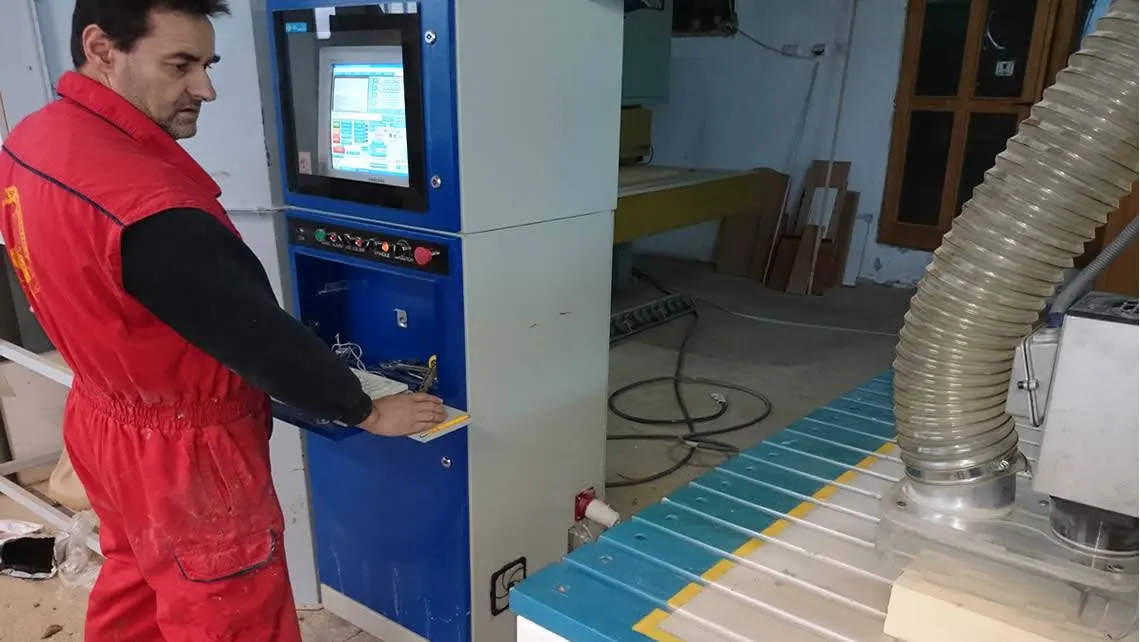
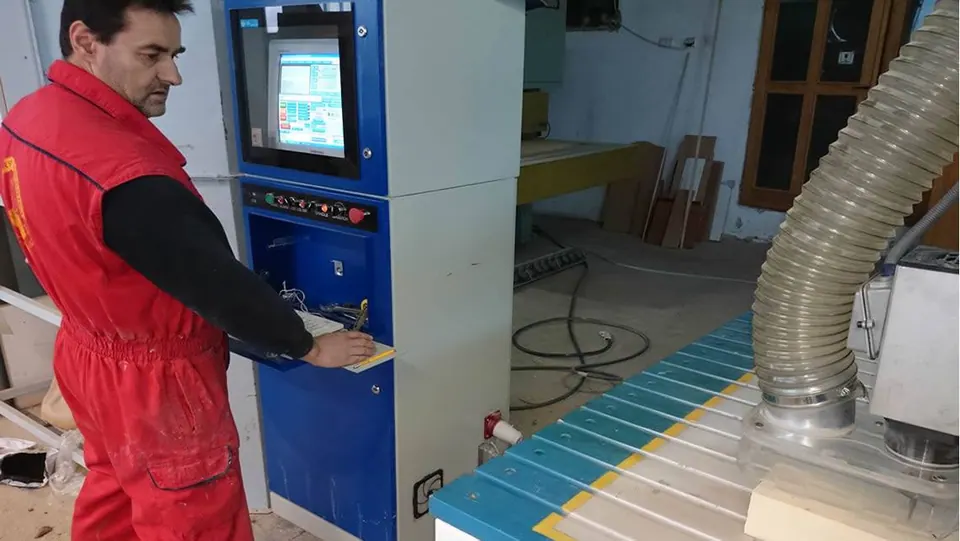
- The inability of the operator to independently set the tool to the starting point. Before each operation, the CNC operator places the tool at the starting point of the workpiece, unless it is predetermined by a template attached to the table and recorded as a position in the computer. The reason for this is the physical distance of the computer from the machine table itself, and during this operation, it is always necessary for another person to assist the operator in which direction to move the machine’s motor. Picture no.7 shows the operator and his physical distance from the table, where he is unable to see the starting point, and the preparation time for this operation is very long.


Image 7 - The operator adjusts the tool to the initial position
Solution – Introducing Wireless Joystick
In addition to the option of taking a wireless keyboard, the idea came up to install a wireless joystick, which is a replacement for the keyboard. In addition to the set joystick scrolling functions, the keyboard still remained functional and the operator could use either the keyboard or the joystick as desired.
In the text, as an additional improvement, the operator, in case of an unforeseen situation, can turn off the entire machine or pause the main motor on which the tool is running, so that the machine can later continue with the code. This was then presented as an improvement in safety and easier continuation of the operation.
Improvement 3 — Computer synchronisation
Methods used:
- Kaizen – Improving the transfer of files in the system, replacing manual switching with automatic sharing between computer units and thus reducing the waiting time of operators and designers (MUDA).
- Standardization – In the drawing design process (formation of six control points of the output code).

Image 8 - Inability to synchronize files between computers
Defining the Problem
- Transferring files to CNC. There are four computers in the company, which are physically separated. There is one in the production itself (on a CNC machine), two in the office and a computer on which the code is drawn and machined, which is located in Novi Sad. Problem transferring and uploading files from computer to computer.
- Diversity of files on computers. On every computer there is a folder for the CNC machine, with all the files that are necessary to work on the machine. The problem is that if one of the files is modified manually, that file will not be modified on the other computers.
- Delivery of inappropriate code. When designing a drawing, it often happens that the designer does not specify the unit of measure correctly, and instead of the unit of measure CM (which he receives as a request), he marks MM or vice versa. Problems also arise from wrongly chosen zero point, piece thickness, etc. which can be directly caused by the wrong unit of measure.
- The solution
Initially, files were sent by email, after which the operator saved the file on the computers and loaded it into the CNC system. TeamViewer made this somewhat faster by allowing remote control and direct file transfer. The problem of keeping files synchronised across the other computers remained, however, so each transfer still had to be repeated.
At the time, Google Drive emerged as the preferred solution. It allowed several computers to use shared storage and synchronise files that were missing or had changed. Machine code generated and saved in Novi Sad could therefore reach all computers in Sombor within a few seconds (depending on file size). Conversely, if the operator manually changed the code at the CNC machine, the file was also updated in Novi Sad.
Also, if the code is generated and recorded on the computer in Novi Sad, and if the computer on the CNC is not turned on, the code will be transferred to the CNC as soon as it is turned on, without waiting as it had to be during the use of the TeamViewer program, where files could only be transferred if the computer was turned on.

Image 9 - Files sync in seconds
Solution
In addition to the automatic synchronization described in the point above, standardization elements were also introduced in the code delivery, i.e. agreement that all dimensions in the company should be in millimeters (mm). In this way, inappropriate code will be avoided and there will be no disagreements in the analysis of the pieces. In addition to this agreement, six points were formed that are implemented by the designer, which consist of:
- Unit of measure controls in the program itself
- Setting the starting point
- Zero point check
- Checking the machining side of the milling cutter
- Checking the thickness of the piece
- Recording all versions of the .art and .tap format code
Considering that the requests are received daily, these control points are stuck in front of the designer in the form of stickers and at the end of each drawing process, the designer goes through all the points separately, so as not to sneak a mistake in the design and the machining of the code.

Image 10 - Control points that are performed before saving the file
Conclusion
The improvements that we have listed, in our opinion, would represent a huge shift in the way of performing daily processes in the company. The employees saw how significant even a small improvement can be, especially in the implemented improvement number two, where we saw in practice how surprised the workers were by the introduction of joysticks instead of keyboards, and everyone enthusiastically accepted this innovation and wanted to try a new way of management. On the spot, it was also seen how important it is to break the daily monotony of work and stimulate new ways of thinking among employees.
We say this from the point of view of a company that certainly needs this kind of atmosphere during daily activities, because it is a company that produces custom-made furniture and each piece of furniture is unique, and the amount of built-in value is directly related to the creativity of the employees.
The text remains published as a record of the development of the company’s manufacturing culture. It is not a description of today’s IT system, safety procedures or current product range; see the Manufacturing page for the present-day focus.
Change number two was certainly the most interesting, but the dust-extraction hood had the greatest impact on the processes: the operator gained a full view of the workpiece and no longer had to clear sawdust after every processed piece.
We conclude that the organization has an awareness of the benefits of improvement and its environment is not resistant to change. This certainly stems from the fact that the organization is used to flexible work, because the business model itself requires it, where furniture is always adapted to customers and every individual request is respected.