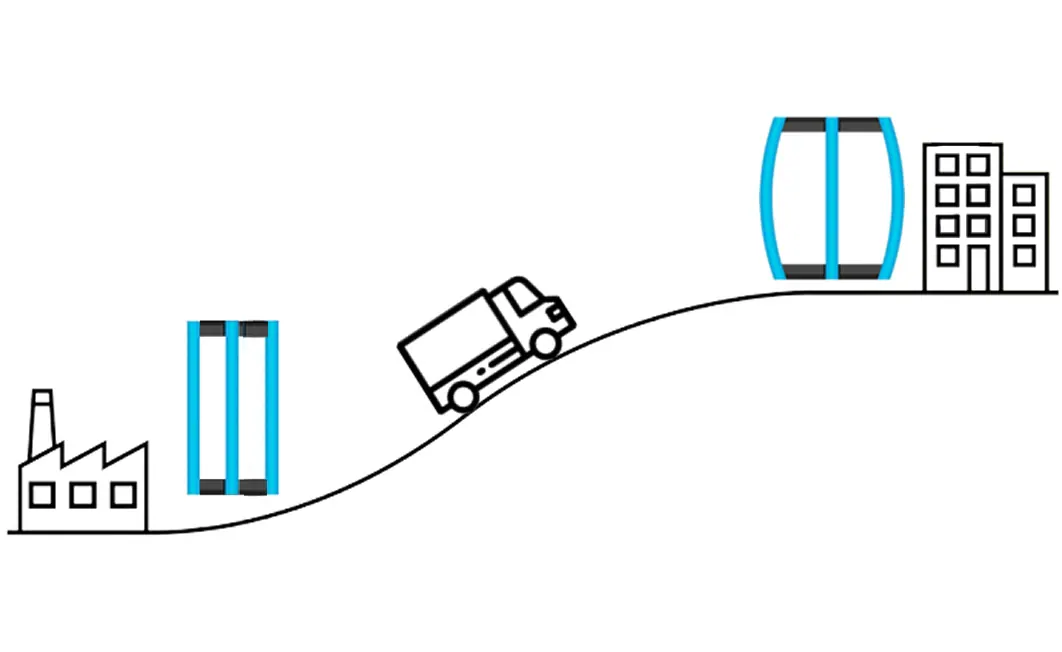
This is such a banal thing that you don’t think about, and it can cost you dearly. It is about glass that is made at one altitude and installed at another altitude. We are writing this text primarily for craftsmen, so that they can guide their clients, and we will also give the best recommendation on the best way to solve this problem.
Missing the forest for the trees
When contracting carpentry with a client, some huge projects are always revealed on the table, so we delve deeply into the story about wood quality, resistance to external influences, durability of fittings, microorganisms that attack wood in different climates, etc. The longer you are in that “scientific” story, the more superfluous the question becomes: “Hey, where does that carpentry go?”. Something like when you meet an acquaintance on the street, you say sorry, but it’s stupid to ask what his name is. But don’t be silly because…
What should be known right away is exactly the place, i.e. the altitude where the insulating glass units are going. And not only that, it is also important which route they take to the destination and whether there are any major changes in altitude along that route. You should not think about this if the difference in height is up to 500 meters, but if it is more than that, you should take care and ask for additional guarantees from the manufacturer.

What’s really going on?
In the simplest terms - the lower you are, the more air above your head is squeezing you. As you climb to a higher altitude, the pressure is weaker, because less air is squeezing you.
Let’s take for example a company that deals in glass production and is located in Belgrade, which is 117m above sea level, with a pressure of about 1005 millibars. Order three-layer low-emissivity glass with argon, for carpentry that will go to Kopaonik, in the Weekend village, which is at about 1500 m above sea level, and the pressure there is about 820 millibars. When making that glass, that company from Belgrade “trapped” argon between the layers of glass. The glass is installed in the windows and it goes to Kopaonik. As the truck climbs over a height of 500 meters, the glass will start to blow, because now there is not so much air on the outside that squeezes the glass, and the argon that is charged at a higher pressure is trapped inside and the glass now starts to blow.

Do all insulating glass units crack or only some?
It does not necessarily mean that all the glass will break, but there is a high probability of breaking, especially as the difference in height increases. We personally know the case of our glass supplier, where the client ordered glass from them, picked it up and drove it to Bosnia and Herzegovina in Jahorina. Out of 200 pieces, 70 of them broke. Here we return to that banal question from the beginning of the story, which was skipped… neither the supplier asked where the glass units were going, nor did the client mention it.
It is also important to note that smaller glass units break more easily, because they have a smaller diagonal, and therefore have less tolerance for twisting. It’s like if you took a 2m wooden slat and a match. You can bend a batten into quite an arc without it breaking, and as soon as you start bending a match, it snaps. We mention this purely so that someone doesn’t play around and ignore the difference in height, along with the sentence “What can happen…this is a small glass and surface”.
Even if the glass does not crack, the glass will be visibly twisted and aesthetically it will be a complete failure, as in the picture below.

From a higher altitude to a lower one
The same principle applies to glass units that are made at a higher altitude and carried to a lower altitude, with the fact that the glass will not “inflate” now, but will curve inward. This time it will happen because much more air is pressing the glass from the outside, while there is not enough pressure inside to provide counter resistance.

If the glass units only cross a mountain or a plain
The glass also cracks. This effect is not something that has a delayed effect. It happens instantly and has instant consequences, that is. the glass will break while the truck is crossing the mountains. That’s why it’s not only important where the glass is installed, but also which way you transport the glass.
This must be taken into account at the time of contracting the transport, because many carriers have so-called collective transports, where in addition to yours, the truck loads and unloads the goods to other locations as well. So, for example, if you are sending carpentry from Belgrade to Paris, the route does not have major changes in height, but it can easily happen that the truck has to go to the Alps on the way, and there is a problem.
What possibilities does the source text list?
There are three solutions to all these problems.
1. Making glass with negative pressure. This endeavor requires the manufacturer on their assembly line to have the technology to do this. The glass manufacturer is given all the necessary parameters about the route and locations for installing the joinery. The machines calculate and create the underpressure in advance, so that it agrees with the conditions at the installation site.
This technology exists and is closest to us in Hungary. That company has all the latest technology and certifications, and even specific certifications that only some countries in the world require. But as they explained to us, even they are not capable of doing this in the best way. Not because they don’t have the technology (their line has a vacuum option), but simply because they can’t find enough trained staff, from the people who do the preparation, to the people who handle the production line itself.
2. Two-way valves. Extremely expensive valves that don’t do the job. These valves regulate the pressure difference and when under load, release excess air from or into the glass. In theory, this is an ok solution, but in practice these valves have proven to be unreliable. It doesn’t matter who the manufacturer is and how expensive they are, they just schedule.
3. Stick and string. A very famous philosophy and way of thinking that does the job! And not only does it do a great job, it is the cheapest and most efficient. The glass units are made, filled with argon and a small opening is left in the upper part of the spacer bar. Since argon is a heavier gas than air, it will not escape upward, but will still remain in the glass. The glass units are transported to the place of installation and while they are still stacked on the truck, the holes are closed with a two-component adhesive or a high-quality compatible neutral silicone. A little argon will certainly escape during transport, but it is a negligible amount and the air that has entered will certainly not damage the structure of the low-emissivity film in the glass. And the matter is resolved. One is that the craftsmen will have to glaze the windows on site, but this should not be a problem for a well-organized team.
The same principle is used in airplanes. You know that little hole in the glass? Well, it serves precisely to equalize the pressure in the glass.

How high can standard glass go without breaking?
You can additionally insure yourself with the manufacturer’s warranty, because there are companies that provide a guarantee that the glass will withstand up to 800 meters of change in altitude without cracking. If you are thinking of risking up to this height, it is not a bad idea to ask for this guarantee.
If the glass is going for larger changes in height, we definitely vote for option number three. We have personally examined it several times and everything always ended up in the best order.
For a broader overview of the possibilities, see the text on how to choose glass for joinery. If the project involves a major change in elevation, specify the transportation route and installation location in the request for bid.