Resuscitation procedures
The only correct method of artificial respiration is the “mouth-to-nose-to-mouth” procedure. To apply this procedure, first position the patient’s head so that the chin and lower jaw are raised as much as possible (fig. 1, 1. part). Remove dirt (mud, etc.), artificial teeth (dentures) from the patient’s mouth and pay attention to the tongue not slipping back and blocking the airways.
Artificial respiration is performed by inhaling as much fresh air as possible and blowing it into the patient’s mouth and nose (fig. 1, 2. part). To avoid infection, we can place a thin handkerchief over the patient’s mouth. There is still enough oxygen in the air we exhale for the injured person. In parallel with artificial respiration, the patient’s chest should be pressed in a gentle rhythm in the area of the heart (take care not to break the ribs!), so that by expelling blood from the heart we support circulation. When we release the chest, the heart can fill with blood again, and in this way we achieve artificial respiration and heart action. This should be continued until the patient begins breathing on his own and until his heart starts working again (fig. 1, 3. part), or until the doctor arrives.

FIGURE 1
Poisoning from non-corrosive substances occurs as a result of taking incorrect or excessive amounts of medicines, mushrooms, and food contaminated by bacteria from the paratyphoid group.
If such poisoning occurs, the first and most urgent measure is to empty the patient’s stomach and intestines. From an empty stomach, liquid can reach the intestines in 10 m min., and solid matter, depending on its quality and quantity, in 1-6 hours. If the patient is conscious, he should immediately be given about two tablespoons of medicinal charcoal to drink (it can be obtained in pharmacies mixed in a glass of mineral water; plain water may also be used). After that, the patient should be induced to vomit (by tickling the upper wall of the pharynx with the handle of a spoon). Regardless of whether vomiting has been successful, after 3-4 m min. the patient should again be given 2 tablespoons of medicinal charcoal with water. A doctor should definitely be called, or the patient taken to a hospital.
Poisoning from corrosive (caustic) substances. Poisoning can occur from two types of caustic substances: acids and alkalis.
With alkali (caustic soda, soda, lye salt), the mucous membrane on the lips, tongue, in the mouth, esophagus and stomach peels off in pieces, and the saliva that comes out is usually bloody and slippery to the touch. The lips and tongue swell, pain occurs in the throat, esophagus and stomach, cramps and vomiting. A person injured by alkali should be given water with lemon or vinegar (1-2 tablespoons of vinegar in 5 dl of water) or 3%-neutral boric water, and then milk or 1-2 tablespoons of table cooking oil.
Signs of acid poisoning in the mouth: erosion and burns on the mucous membrane (sulfuric acid causes black burns, hydrochloric acid white, and nitric acid yellow burns). The saliva that comes out feels rough to the touch and has a sour taste.
The patient has severe abdominal pain, cramps, and is vomiting. He should be given milk, oil, or proteins (eggs), all diluted with a little water. After that, give him 1-2 teaspoons of burnt magnesia diluted in half a glass of water, so that he drinks it in small sips. Persons poisoned by caustic substances must under no circumstances be made to vomit.
Important! when there is blood in what the patient has vomited, any further inducing of vomiting is forbidden!
First aid in the event of electric shock
The injured person should be freed from the electric circuit. If possible, disconnect the electrical line from the circuit immediately by means of a switch, by removing the fuse, or by breaking the line. The interruption may be carried out only with insulated tools, e.g. a piece of dry wood, or in the extreme case an axe with a dry handle, or pliers with an insulated handle.
In exceptional cases, a short circuit should be made. The rescuer must absolutely take care to insulate his own hands and feet and therefore must stand on a board without nails, on dry cloths, or on a chair. He must protect his hand, for example with the sleeve of his coat, a dry handkerchief, rubber or nylon gloves.
The rescuer should place an insulating pad under the injured person, e.g. dry boards or wooden tools without metal parts, dry cloths, PVC sheets. It is best if the injured person jumps on their own and simultaneously frees themselves from contact with electricity, or if the rescuer lifts the injured person after first insulating themselves from the ground. We may touch the injured person only if the insulation is flawless. The injured person’s fingers should be removed from contact individually and carefully and at the same time wrapped in a dry cloth or other fabric.
If an electric wire has become wrapped around the injured person, then the wire should be disconnected with insulated hands and the live end of the wire secured so that it does not cause further accidents.
Rescue, of course, must be started immediately and unconditionally; we must not leave the injured person without help. After the power is cut off, the injured person should be laid horizontally, their clothing loosened, and completely removed from the upper part of the body, providing them with light and fresh air. The injured person’s head must not hang down, but should be raised slightly by placing something under the head (e.g. a folded coat).
If the injured person is unconscious, resuscitation should unquestionably be attempted.
In the meantime, the victim’s mouth and nostrils should be checked to see whether they are passable for air. Saliva, food remains, and dentures should be removed. It is forbidden to pour liquid into the mouth. If the injured person is not breathing, artificial respiration should be started immediately. Resuscitation may be assisted by rubbing the soles of the feet, enemas, or alternating dousing of the chest and abdomen with warm and, respectively, cold water, but artificial respiration must not be interrupted. If the victim regains consciousness, we must continue to care for them and must not leave them alone. They should be given some warm drink (coffee, tea, alcohol, etc.), but they must remain in a semi-recumbent position.
According to experience, minor and local injuries may temporarily be left unattended (medical assistance should be provided later), while bleeding casualties should be given medical assistance immediately.
Rubble, shavings, dust particles. Dust, debris, or an insect can be removed from the eye by pulling down the lower eyelid and wiping it away with clean gauze or a tissue. If the object is under the upper eyelid, then the upper eyelid should be grasped in the middle and pulled forward onto the lower eyelid, so that the eyelashes touch the inner surface of the upper eyelid. If in this way we fail to remove the foreign body, no further attempts should be made, but the injured eye should be bandaged and medical help sought.
A foreign body that has entered the nostril should be removed by blocking the other nostril and blowing hard through the nose. If this does not work, medical help should be sought.
The removal of foreign bodies that have entered the ear should be entrusted to a doctor, because in attempting to remove them we may injure the eardrum. If an insect has entered the ear, one (small) spoonful of oil, clarified butter or water should be poured into the ear (while lying down) and kept 10-15 minuta.
Let us try to remove a foreign body that has entered the trachea by asking the injured person to inhale deeply and gently striking him on the back between the shoulder blades. If the object lodged in the trachea is not sharp, the injured person should be given water, then bread crumb (mecha) and mushy foods. It is forbidden to give cleansing agents in such cases. Medical supervision is necessary.
We may attempt to remove a thorn that has gotten under the nail only if the part protruding outward is long enough to be grasped with tweezers or a handkerchief. If removal has been successful, the wound should be allowed to bleed a little, then smeared with iodine and bandaged.
Transport of the injured person
Transporting the injured person is not an easy task; it requires skill, caution, and adequate physical strength. Unskilled transport increases the pain and worsens the condition of the injured person.
First of all, it must be established whether the patient is in such a condition that he can be transported, and he may be transported only if aid has been provided to him according to first-aid rules. Before transport, bleeding should be reduced, a dressing should be applied to the wound, and fractured limbs should be immobilized.
If the trip to the hospital is longer, the injured person should, if possible, be refreshed with tea or coffee. Giving alcohol (brandy, etc.) should be avoided. During transport, the injured person should be constantly monitored and checked, and if the bandage or immobilization splint loosens, it should be immediately adjusted. If loss of consciousness or weakening of heart function occurs, appropriate resuscitation methods should be applied.
The method of transport always depends on the type of injury and on the number of rescuers, as well as on the type of available means of transport.
Lifting and handling the patient should be done thoughtfully, calmly, and composedly. Any jerking must be avoided. The injured person’s clothing must not be rumpled, and when lifting them, they should be lifted from the side that is not injured.
Shipping without auxiliary means
Transport by a single rescuer only. If the injured person can walk, the rescuer should support him from behind and assist him in that way. If he cannot walk, or is unconscious, he should be transported by having the rescuer kneel beside him, place one arm under the armpit and take hold of him with the other under the knee, lift him up, and carry him away.
Transport by two rescuers. The injured person who can walk should be supported from both sides. If he cannot walk but is conscious, he should hold on to the rescuers carrying him. An unconscious injured person should be transported by having the stronger rescuer take hold under the armpits and across the chest join the arms, while the other will position himself between the injured person’s legs and lift him under the knees. They must lift and carry him at the same time.
Shipment by auxiliary means
Transport on a stretcher. The injured person should be carefully placed on the stretcher in a lying position. This requires two persons, and in the case of fractures of the lower extremities, three persons. The rescuers should stand on one side of the injured person and lift and place him on the stretcher at the same time.
Raising, starting, stopping, and lowering the stretcher must be done by all rescuers simultaneously, but they must not walk simultaneously, as that would shake the stretcher. If the patient has to be transported for a longer distance, it is good to tie a strap on each side of the stretcher, which the rescuers will place over their shoulders.
Transporting the injured with improvised means. If we do not have a stretcher at hand, we can improvise a carrying device. If necessary, the injured person can be placed on a ladder, on removed door leaves, on a table, and carried that way. The same can be done with a blanket or a tent flap. Improvised stretchers can also be made from two sacks of the same width by placing two battens of suitable length along the lower edges. In the absence of a stretcher, a conscious patient can also be carried on a chair. Rescuers should stand on both sides of the patient, grasp the lower part and the backrest of the chair, and carry them that way.
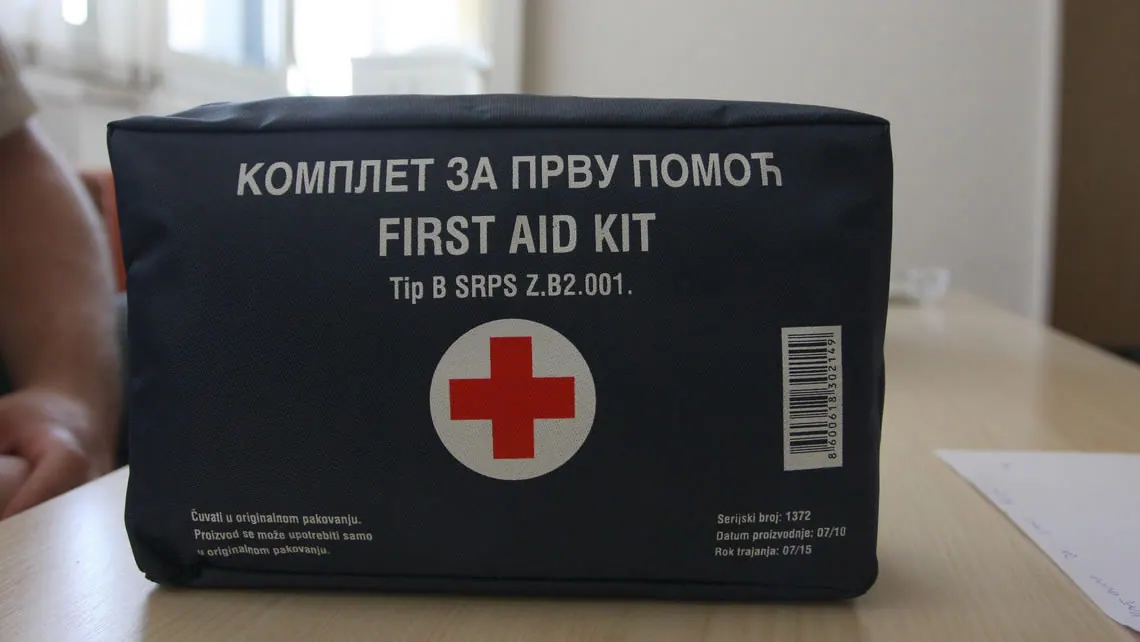
Contents of the first aid kit that we recommend:
Bandage pack, medium
pcs. 2
Bandage pack, large
pcs. 2
Bandage, 10 x 5 m
pcs. 2
Sterile gauze 1/2 m
pcs. 2
Cotton, 25 g
package 2
Flat gauze cut 6 x 6 cm
package 1
Tourniquet for stopping bleeding
package 1
Hanzaplast, 4 cm x 1 m
package 1
Scissors
pcs. 1
Scissors guard made from a cloth sack
pcs. 1
Iodine ampoules
comm. 12
Ammonium chamomile
pcs. 3
Notebook for notes (40 sheets)
pcs. 1
First Aid Manual
pcs. 1