Important safety warning: This is a historical archival text, not a modern instruction for metalworking or electrical work. Working with machinery, grinding tools, hot metal, electrical installations and worn hand tools can cause serious injury, fire or electric shock. Do not use the described improvisations as a working procedure; follow current regulations and the instructions of qualified professionals, and use suitable tools and protective equipment.
This text is not part of the current offer of Savo Kusić, which is focused on windows, doors and associated solutions.
Those who do not yet feel confident enough with do-it-yourself work usually try to build their skills by working with wood. That is why the previous chapter, which deals with woodworking, received so much attention. Wood is a fairly soft material and suitable for working. Having become familiar with the main properties of wood and how it is worked, we will not need as much space to become acquainted with equally common metals and their processing. Most wooden structures are difficult to imagine without metal parts, nails and fittings, whereas hardly any metal structure needs to be supplemented with wood for reinforcement or fastening.
Of the many different metals in the home workshop, only iron, steel, copper, brass, bronze, zinc and aluminum are commonly found. Lead and tin are also used as auxiliary materials. Before proceeding to the processing of the most used metals, let’s study their main properties.
Metals
The most important metal is iron. It is obtained by smelting ores in blast furnaces. In its raw form, iron contains several percentages of manganese, silicon, phosphorus, sulfur and graphite. If the percentage of graphite in iron is greater than 1,7 we are talking about iron, and if it is less then we are talking about steel.
In practice, we encounter only semi-finished products, meaning metals that have already passed through several processing stages. These include bars of various profiles (which is why they are also called profiled iron or profiled steel), sheets and castings. Pressed metal products such as brass housings are also sold as fittings.
It is good to know that cast iron is brittle, cannot be bent, and dulls the blade of a tool when worked. The characteristics of the most commonly used materials, such as bars and sheets, can vary greatly. Their common feature is that they are made of steel.
Steel containing a very small percentage of carbon, the so-called soft steel or forging steel, can be welded, bent, forged, but cannot be hardened. Hard steel (0,4-1,7% carbon) is stronger, but can only be machined by turning, milling, etc.
The common characteristics of iron and steel are that they rust, that they are attracted by a magnet, and that they can be magnetized themselves. Their specific gravity is 7,8 kg/dm3. The melting point of steel is 1700°C (iron 1400-1500°C). An interesting phenomenon with these metals is that at a temperature of 750°C they lose their magnetic properties.
Steel can be hardened by heating. If it is cooled slowly after heating (technically: tempered), its machinability improves and its elasticity and strength change (hardening + tempering = heat treatment).
If the steel is alloyed with chromium, molybdenum, tungsten, nickel, etc. some of its features will improve, such as hardness, acid resistance, corrosion resistance, etc. These are the so-called high-alloy special steels.
Cast steel is marked with the letter Č and a two-digit number, and steel with the letter Č and two numbers. The first number after the letter indicates tensile strength, meaning the force at which material with a cross-section of 1mm breaks. The second number is defined by JUS standards. The number after the letter is therefore important. The higher the number, the “stronger” the steel. (If the tensile strength is 50 kg /mm2, it is already a good steel; 30 is satisfactory. The upper limit of this figure is around 90, while for special spring steels it can reach 135). Alloy steels have other designations.
Good information about the quality of the steel and the amount of carbon is given by the spark. If the steel touches the grinding stone, sparks will appear. The shape and color of the sparks will indicate what kind of steel it is.
When steel is quenched and tempered, the temperature can always be determined by the color of the steel.
Copper is a metal that can be shaped easily. It is a good conductor of heat and electricity. When it oxidises, it develops a dark green patina. In domestic use, it is most often encountered as an electrical and thermal conductor and is also used for alloying (for example, in a heating vessel, transformer winding or soldering iron). It has a very high specific gravity of 8,9 kg/dm3 and a melting point of about 1080°C.
Brass is an alloy of zinc and copper, in which zinc is present in a higher percentage (50-70%). A higher percentage of zinc reduces the formability and makes the alloy more brittle, more suitable for casting. A reddish-colored alloy with a small percentage of zinc is called tombak (artificial gold), and an alloy with a very high percentage of zinc is called white cast.
If, in addition to zinc, the alloy also contains nickel, it is called alpaca, while new silver contains a certain amount of silver in addition to the listed ingredients. If a small amount of copper is added to aluminum, an alloy stronger than aluminum is obtained - duraluminium.
Bronze is an alloy of copper and 5-15% tin. If, in addition to tin, it also contains a small percentage of phosphorus, the alloy is suitable for casting and is called phosphor bronze. Aluminum bronze is a tough alloy. Lead bronze is resistant to friction, so it is used for bearings. Silicon bronze is very resistant to various influences, and manganese bronze is very hard.
Zinc is a metal lighter than iron. It was once used to make gutters, while today it is mainly used for anti-corrosion metal protection, on the surface of which it forms a thin shiny layer covered with ice flowers.
Tin is also used for alloying. It can be rolled and cast, and melts at a temperature of 232°C. A characteristic of this metal is that it slowly turns into powder at a temperature below +13°C.
Lead is a soft, weak metal with a fairly high specific gravity (11,34 kg/dm3). It is corrosion resistant and easy to cast.
Materials used mainly for metal plating are cadmium, nickel, which is shiny, as well as chrome.
So far we have covered iron and metals heavier than iron. In domestic work, we scarcely come into contact with precious metals (gold, silver, platinum) or special metals (iridium, radium, titanium, beryllium, magnesium).
Finally, let’s get to know light metals such as, for example. aluminum. It weighs three times less than steel, and has a much lower melting point (660°C).
Aluminum is found in nature in the form of compounds. To obtain one kilogram of aluminum metal, it is necessary to process approximately 4-6 kg of bauxite. Purity of aluminum should be understood as the amount of chemically pure aluminum.
Contaminants and other impurities affect the properties of aluminium and the possibilities for its use. Electrical conductivity is reduced by contaminants and impurities. Pure aluminium responds well to heat treatment. The initial temperature for forming aluminium is 500°C and the final temperature is 300°C.
Under normal conditions, aluminum is very stable. A thin layer of surface aluminum oxide protects the aluminum from deeper oxidation.
Salts are formed under the influence of various compounds on aluminum, and aluminum corrodes very quickly under chemical influence. When aluminum or aluminum alloys come into contact with heavy metals (e.g. iron, copper, bronze, brass, nickel), if the point of contact is under the influence of moisture or acids (electrolyte), electrolytic corrosion occurs. Moist air also acts as an electrolyte.
In order to prevent contact corrosion, pure aluminum can be combined with aluminum, its alloys (without copper), cadmium and zinc.
One of the ways of surface protection of aluminum from corrosion is coating the surface with oil paint, nitrocellulose varnish or enamel varnish. A better and today more widespread way is coating with an artificial aluminum oxide layer by chemical means or electrolysis. This protection process is called anodizing.
Today, there are numerous aluminium alloys with two or more components. Aluminium is most often alloyed with manganese, copper and silicon, and the tensile strength today reaches a value of 40 kg /mm2.
Aluminum is easily processed by turning and milling, while welding, painting and soldering are more difficult. It is produced in various forms, from blocks to foils.
Semi-finished products
Among the semi-finished products, profiled iron is the most famous, e.g. round bar shape, angular profile L, T, I, U, Z etc. A semi-finished product having a rectangular cross-section is called flat iron (unless it is made of copper, brass, etc.), which in its thinned form is called sheet, strip, foil. The shape of the cross-section greatly affects the weight per linear meter as well as the strength. Since the price directly depends on the weight, it is useful to choose a suitable profile (picture 1). The names of individual profiles are: a) round iron b) semi-round iron; c) ribbed iron; d) concrete iron; e) square section; f) rectangular section; d) flat iron; h) tape; i) angle iron; j) rounded angle iron; k) T - profile; l) Z - profile; m) I - profile; n)
rail; o) U - profile; p) flat U profile.

FIGURE 1
Tools
There are a few basic tools that you can’t work with metals without. In addition to the previously described measuring instruments, the most commonly used are pliers (picture 2).

FIGURE 2
The simplest pliers are flat pliers (a). They are produced in lengths 125-200 mm. Special pliers for cutting wires are cutters (b). They are produced in the same lengths as the flat nose pliers. For carpentry work, jaw pliers (c) are also necessary, with similar lengths to the previous pliers. To work with wire, you need round pliers (d) on which “eyes” can be formed. Combined pliers (e), which are produced in lengths from 150 to 200 mm, have found the greatest use in the household. If the handles are insulated, these pliers are also suitable for electrical work. For cutting thicker conductors, rods, special pliers for cutters with joints (f) are suitable. To work with pipes, rods, pipe pliers (g) are necessary. A good feature of these pliers is the possibility of wide adjustment depending on the diameter of the material (bars, pipes, etc.)
Wrenches are needed to assemble detachable metal structures (Figure 3). It should be remembered that the openings of double-ended wrenches are standardised, as are the distances between the sides of square and hexagonal bolt heads, in the following sizes: 6-7, 8-9, 10-11, 12-14, 17-19, 22-24, 27-32, 36-41, 46-50, 55-60, 65-70 and 75-80. Wrench openings from 6 to 50 correspond to the following metric bolt heads: 3, 3,5, 4, 5, 6, 8, 10, 12, 14, 16, 18, 22, 27, 30. The pairs of numbers listed above indicate the openings of open-ended and ring spanners available in shops.

FIGURE 3
The advantage of open-end wrenches is that they can also be slipped on nuts or screw heads from the side, so, for example, they can be used to tighten and loosen screws on longer pipes. The socket wrench covers the screw head or nut on all sides and holds the screw head tighter, but it can only be pulled onto the nut from the top side.
A home tool kit should contain the following wrenches: 9-11, 14-17, 17-19 and 22-24 (a 27-32 wrench is also needed on very rare occasions).
Longer spanners provide greater force transmission, but they are more difficult to reach inaccessible places and, if handled carelessly, it is easy to tear the thread on the screw. The jaws of open-end wrenches make a certain angle with the handle, for the possibility of turning the head of the wrench together with the nut and in hard-to-reach places. In addition to the above, there are also socket wrenches for tightening deep set screws. Just in case, it’s also good to have an adjustable wrench with which any nuts can be gripped. An adjustable 250 mm length adjustable wrench is recommended.
Wrenches and screws can only be applied effectively if they are not too worn. If the gap between the nut and the key is large due to wear, then one of them will be destroyed when tightening. If the nut or key is worn, then a steel plate is placed in the gap between them and only after that it is tightened or loosened.
For metal marking, a punch (piercer) with a thickness of 6 and a length of 125 mm is required. You should also get a punch for piercing thinner sheets, preferably 3 mm.
A hammer is a universal tool. It is made in different forms. The size of the hammer is determined by the weight of the head. The smallest size is 50, and the largest is 2000 gr. Corresponding head lengths according to hammer weight are 50 gr - 75 mm., then 100/82, 200/95, 30/105, 50/ 118, 80/130 (larger dimensions for rough work) 1000/135, 1600/148, 2000/155.
The handle of the hammer is made of wood and is marked: 400/25x14, i.e. 40 cm long, 2,5 cm wide (in the middle) and 1,4 cm thick corresponding to a head of 800 gr.
In recent times, specially shaped hammers with steel handle, rubber handle, etc. can be obtained, but at quite high prices.
When discussing the hammer, we should also mention the flat chisel, which cuts with the help of a hammer. The dimensions of these chisels range from 125x15 to 400x36 mm. The first number indicates the length and the second the width of the chisel blade. The most commonly used chisel is 200x15.

FIGURE 4
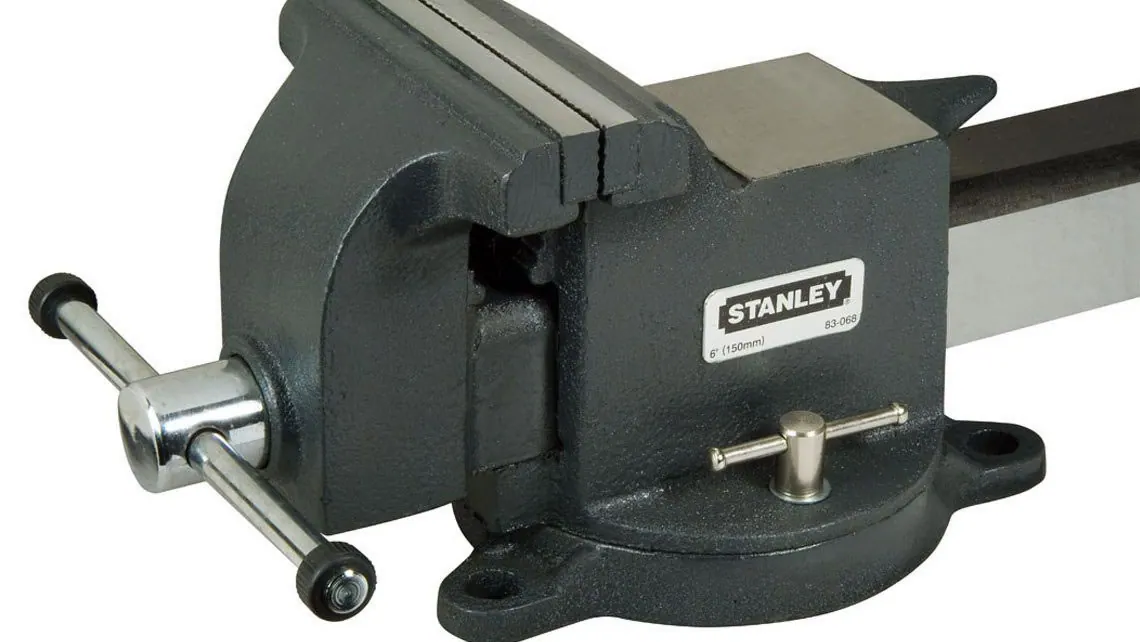
Vices are also widely used tools. The jaw widths of small vices are: 40, 50, 60 m, and those of parallel vices are 75-200 mm. Rotating parallel vices are also produced; if possible, the text recommends obtaining one with jaws of 100 mm (Figure 4). It recommends mounting the vice on the front right-hand side of the workbench and the anvil on the left (Figure 5).

FIGURE 5
Valid standards, technical documentation of tool and material manufacturers and risk assessment are relevant for modern application. The historical markings, dimensions and recommendations in this text are not current specifications or safety instructions.