Important health and safety note: This is archived text from 2018. year, and not modern instructions for welding, soldering, preparing chemicals or working with an open flame. Processes described may include strong acids, flammable and toxic solvents, corrosive solvents, hazardous gases, lead, cadmium and other heavy metals, hot surfaces, electricity, pressure cylinders, and fire-explosion hazards. Do not prepare historical solutions and pastes according to recipes from the text and do not heat unknown coatings or metals. Evaluation of materials, selection of lead-free or other suitable system, local extraction, protection of skin, eyes and respiratory organs, fire prevention measures, storage of chemicals and disposal of residues should be determined by qualified persons according to safety data sheets, manufacturer’s documentation and applicable rules. Joints for load-bearing, electrical, gas, plumbing, food, medical or other safety-critical applications require professional specification and control.
Welding, soldering and sale of chemicals or metalworking accessories are not part of the new public offer of Savo Kusić. Current focus is wood windows, wood-aluminum windows, custom windows and doors. For a window or door project, you can send request for quote.
Joining metal parts
So far, we have cut, chopped, filed and drilled objects. Another work operation is the joining of metal parts.
This group of work operations is divided into two types of joins: separable and non-separable joins. By this is meant the separation of interconnected objects without destroying their connections (for example, by removing one screw we separate the parts) and separation with the destruction of their connections. The latter includes welding and soldering. Between the separable and non-separable connections there is a connection made by means of a rivet.
Separation of parts that are joined by rivets is done by destroying the rivets.
Inseparable bonds
First let’s see the work operations required to perform inseparable links. These operations include welding. A professional exam is required to perform that procedure. Welding machines are usually found in workshop equipment, and we can hardly find them among household tools.
The essence of welding is that during welding, not only electrodes, i.e. welding rods containing additional material, but also parts of the workpiece are melted. This is achieved if the connections are heated using an autogenous apparatus. The connection can also be made by electric welding.
The essence of soldering is that two prepared objects are joined by soldering using a molten alloy, solder. The most important difference between welding and soldering is that the joints of objects are not melted when soldering. Soldering requires a significantly lower temperature and only a few tools, accessories and materials (Figure 1, top).
In order to merge two objects, it is essential that we know the purpose of the new object. The strength of the soldered material is determined by: the method of assembly and dimensions, the gap of the joint to be soldered, the property, the strength of the alloys and the quality of the soldering performance.

Image 1 — Soldering accessories and historical representations of joint shapes
Compositions of workpieces that are prepared for soldering can be: blunt, oblique, lapped, dovetail and reinforced. The width of the lap should be from one to three times the thickness of the workpiece. Leaving a gap between the workpieces is necessary so that the molten solder will fill it.
The surfaces to be joined must be processed as well as possible so that the molten solder completely fills the gaps between them. Ways to properly dimension workpieces are shown in the lower half of the sketch image 1. These few couplings fit our needs in the house.
Removal of oxides and grease
In contact with oxygen from the air on the surface of metals, with the exception of precious metals, an oxide layer - rust - is formed.
Before soldering, we must remove this layer with a wire brush, scraping with a file, emery cloth (sandpaper) or some known chemical agent.
The use of chemical agents, urine based on sulfuric, nitric and sodium acids has been expanded. These acids and acidic solutions are capable of removing the oxide layer, not only before breaking, but also the layer that forms during soldering.
We select the rust remover according to the properties of the metal. For example for steel and its alloys we use sulfuric acid, sodium acid, phosphoric acid and their solutions. For cleaning copper, nickel and its alloys, we use a solution of sulfuric acid. Sonic acid is most often used. If the item is more rusty, we use a nitric acid solution. After cleaning the rust, we immediately remove the acid, because if we don’t remove it, the oxide coating will form again. The surface we are preparing for soldering will be cleaned of grease the easiest if we wash it with pure gasoline.
The previous historical statements about working with sulfuric, nitric, sodium and phosphoric acids and washing with pure gasoline should not be applied as household instructions. Do not mix acids, use gasoline as a degreaser, and operate without proper chemical evaluation, ventilation, equipment, storage, and spill and waste procedures.
Melters
Solvents used in soldering are divided into inorganic and organic. A solvent based on inorganic materials is well known under the name nischador - a water-soluble white salt. Sonic acid obtained from this solution converts the oxides formed into chlorides. Nishador also cleans the surfaces of the soldering iron.
Zinc chloride is a white salt that also dissolves easily in water. At the temperature of soldering, with the humidity of the air, it creates a gas of sodium acid, which converts the oxides created into chlorides. Zinc chloride is the most effective flux for soft soldering. Its disadvantage is that it easily absorbs liquid, so its use is limited. It absorbs residual solvent water from the soldering site, and the generated sodium acid gas causes subsequent corrosion. These phenomena occur primarily on iron, copper and copper alloys.
We rarely use a zinc chloride or ammonia chloride solvent. A mixture of both salts is most commonly used. The ratio of the amount of both salts determines the melting point of the mixture, which dictates its use.
Solder fluid and paste
When soldering with soft solder, we use soldering liquid as a flux. Dissolve tin pieces in sulfuric acid. This solution contains about 50% zinc chloride.
The simplest solder paste is obtained by mixing soldering liquid with starch. Another recipe calls for a mixture obtained by mixing 10 g of ammonium chloride and 90 g of acid-free mineral oil. Soldering paste is obtained by mixing 25 g of ammonium chloride with 100 g of petroleum jelly at a temperature of 75°C.
Soldering oil is obtained by adding about 40% of glycerin to the ammonia chloride solution.
A rosin solder solution of boron rosin and ammonium chloride is a transitional agent to organic-based fluxes. Such is, for example, a mixture of 25 parts ammonia chloride, 15 parts beef tallow and 15 parts oil.
Recipes for acids, zinc chloride, ammonium chloride, pastes, oils and solvents from this page are preserved as historical content only. Do not prepare them or change their relationship to this text; use only clearly marked, compatible products for a specific purpose, with a safety data sheet and professionally determined protection measures.
Rosin has been used since time immemorial as a solvent based on organic material. It has a relatively weak oxidizing power, which allows only slow soldering and detailed mechanical cleaning of the soldering area. The advantage of rosin is that its residues on the metal do not cause corrosion.
The melting point of soft solders is below 500°C. They contain heavy metals like tin, lead, cadmium etc. For the home craftsman, tinsmith’s tin is the most suitable, which is available in different qualities, according to whether it contains 25%, 50% and 75% tin. As the amount of tin increases, its melting point decreases. Lead and tin alloys harden slowly after soldering. Lead-cadmium solder replaces tin solder in many ways.
Soldering iron
Common soldering for the home craftsman is soldering with a soldering iron, while soft soldering is less common.
The copper head of the soldering iron can be heated in several ways: on the flame in the furnace, with the help of electricity and on the open flame of gasoline and gas.
Heating the soldering iron with thermal energy from the outside is less useful because the soldering iron gives off heat very quickly, in 1-1,5 minute, but its advantage is that it can be used anywhere. Electric soldering irons can be connected to the mains. With them, you can solder continuously with heat regulation. The 200-500W soldering iron is the most widely used. In recent times, it is possible to obtain soldering irons of very low power, “pencil soldering irons” with low current.
The size of the soldering iron we will use depends on the size of the soldering surface, as well as the thickness of the workpiece.
Soldering irons are not suitable for soldering large and thick objects because heating of such surfaces requires a temperature above 500°C. In such cases, a gasoline soldering lamp (fly-lamp) is mostly used.

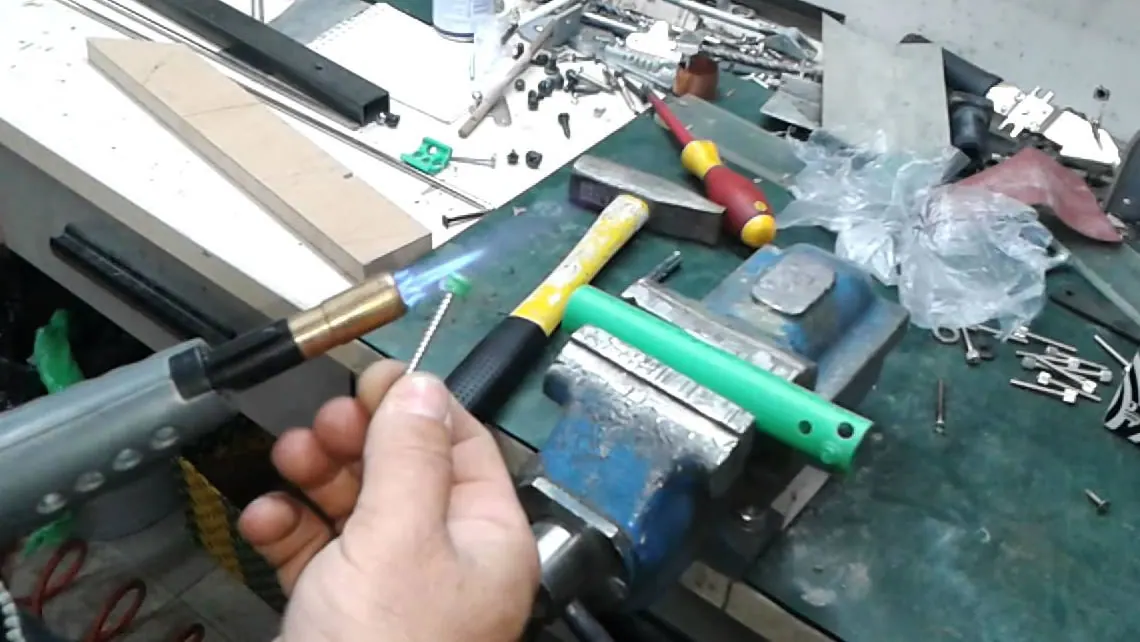
Example of a handheld gas soldering iron
Soldering flow
Before soldering, we need to prepare the workpiece for soldering and clean the soldering iron. Immediately before soldering, we coat the surface with soldering liquid, to remove the oxide coating that is formed during soldering and allows the sheet to be easily shed. Heat the cleaned soldering iron to a certain temperature, then press the solder with its tip. The solder melts under the influence of heat and adheres to the tip of the soldering iron, so it can be transferred to the soldering site. We keep it in this place until the workpieces are heated to the required temperature and the molten solder fills the seam between them. A heavily overheated soldering iron melts a larger amount of solder, making it difficult to melt evenly. If, on the other hand, the temperature of the soldering iron is low, it does not sufficiently heat the soldering point, and the tinplate cools down quickly.
Sheet metal oxidizes at high temperature. Oxides break the uniformity of the bond and thus reduce its strength.
We need to pay attention. and on uniform and one-dimensional guidance of the soldering iron. The last stage in soldering is cleaning the soldered surfaces from the remains of the soldering liquid. Retention of this liquid causes later corrosion of the metal around the solder.
In recent times, various solders combined in the form of a conductor - soldering wire - are sold.
Soldering with solders with a melting point above 500°C is called hard soldering, which we apply when soft tin tin soldering does not provide us with a strong enough connection of the object, which is used at a higher temperature and greater mechanical load. For soldering it is necessary to provide:
-
A heat source (gasoline soldering lamp, torch) used to melt tin and to heat the workpieces to be joined.
-
Proper selection of solder of appropriate quality.
-
Means for removing oxides and protecting the soldering point and its substrate from corrosion during soldering.
The work requirements are the same as for soldering with soft solder. It is only necessary to select the heat source, soldering fluid and solder depending on the strength and higher temperature.
Means and methods of hard soldering
Soldering with a soldering iron is not possible with hard soldering, because the copper tip of the soldering iron would soften above 500°C, besides, its accumulated and emitted heat is insufficient for this soldering. Instead of a soldering iron, a gasoline lamp is used for soldering and different burners in which we burn gas mixtures. This already ensures adequate heat and thermal performance.
The most commonly used gas mixtures in burners are lighting gas and oxygen, acetylene and oxygen, and hydrogen and oxygen.
Mixing and using fuel gases with oxygen, gasoline lamps and other open burners carries the risk of fire, explosion, flashback, burns and harmful combustion products. This historical description is not sufficient for the selection, connection or use of such equipment; the work should be left to a trained person in a suitably secured area.
In the jewelry industry, a blowtorch in the form of a tube is widely used, which is used to blow on the workpiece over the flame of an alcohol lamp.
The tear strength of suitable hard solder can reach 50 kg/mm2 (for soft solder it is 10 kg/mm2). Copper is the most important brazing metal often used for alloying, along with: tin, tin, phosphorus, silver, gold, platinum and cadmium. Using a number of alloys, solder of different quality, melting point, color, strength and corrosion resistance can be produced. Among the standardized solders, we can choose a solder of the desired percentage composition, melting point and purity.
Home craftsmen generally use an alloy of copper and zinc solder (brass) that they use to solder items made of steel, copper, copper alloy, nickel, nickel alloy, and acid-resistant steel. For example, brass with the number 1 fSr 42 contains 41-43% copper and 56-58% zinc, and its melting point is 845°C. Solder fSr85 number 5 contains 84-86% copper, 13-16% zinc, 0,2-0,4% silicon, and its melting point is 1020°C.
For silver tin, which is an alloy of silver, copper, zinc, we can say that it is suitable for soldering almost all objects, except aluminum, magnesium and titanium, as well as metals with a melting point below 720°C.
Fluxes have the task of diluting and dissolving metal oxides and protecting the solder joint from oxidation at the soldering temperature. It is important that they do not attack the soldered material, that they remain on the surface of the metal solution, and that they are easily removable from the soldering point.
Melters are, e.g. boric acid, borax, hydrogen phosphate-ammonia, sodium bicarbonate, sodium silicate, sodium bromide and potassium bromide. These materials show different activity at different temperature.
At home, we can use borax with our solders with satisfactory results, which is a chemical used by photographers. Mixed with a little water it is used in a slushy state.
Let’s now follow the performance of brazing with a practical example. We are tasked with assembling the skeleton of a standing lamp hat from iron wire which we will later cover with parchment or silk. With the help of a template, a tube or a vessel, we make a circular shape of the lower and upper rings from the cut wire, 1,5-2,5 mm thick. After this we cut a stiffener from a 3-4 piece of straight wire to shape the coupe shell.
After these actions, we proceed to soldering, for which it is best to use a gasoline lamp. We will use brass solder, and as a soldering liquid, borax mixed with a small amount of water to make a paste. We lay the bent and interconnected wires on one brick so that the soldering point does not rest on the brick, but hangs freely. We put a small amount of mushy borax on the ends of the wire. Now we heat the place to be soldered, to a dark red glow when the borax also melts. If we now bring the brass solder, in the form of a rod or plate, to the soldering point and dip it into the molten borax without interrupting the heating, one drop will melt from the hard solder. If the temperature of the heated iron wire is higher than the melting temperature of the solder, the molten droplet will spread out glowing. The solder will harden quickly after the flame is turned off.
The previous practical example with a gasoline lamp, brick, borax and heating the metal until it glows should not be performed according to this archive text. A dedicated workplace, a controlled source of heat, ventilation and exhaust, protection against fire and burns, knowledge of the exact composition of the basic and additional material, and professional management of the procedure are required.
In a similar way, we should solder the temporarily attached stiffeners, if the rings were previously made. After the soldering is finished, we can remove the cooled glassy borax with fine blows of a hammer.