Important Warning: This is a historical archive text, not a current machine specification, risk assessment or cutting manual. Machine types, formulas, blade dimensions, tooth profiles, speeds, sharpening, spread and adjustment must be checked against applicable regulations, manufacturer’s documentation and safe work rules.
This text is not an offer of machines, test sheets or service documentation of Savo Kusić. The current offer is focused on windows, doors and related solutions.
Purpose and types of circular saws
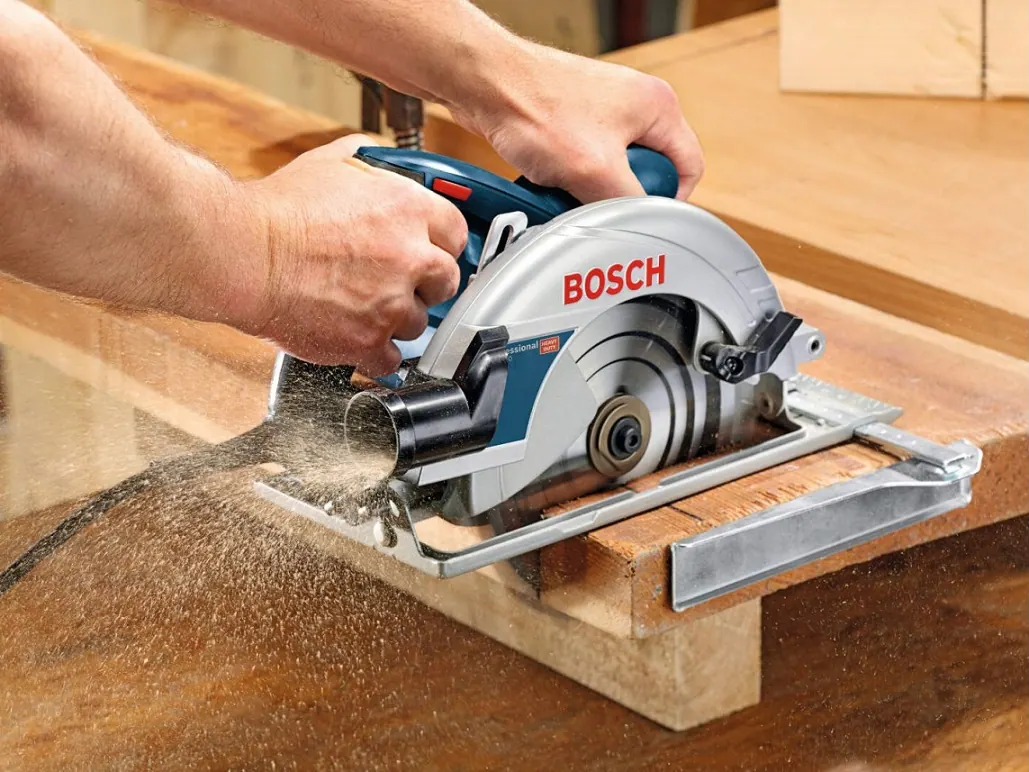
Machines for circular saws are used for cutting logs into planks and beams, for longitudinal, transverse or diagonal cutting of boards according to the given dimensions. Circular saw machines are used for cutting logs into planks and beams, for longitudinal, transverse or oblique cutting of boards according to given dimensions.
Accordingly, circular saw machines can be divided into the following main groups: circular saw machines for cutting logs; machines with a circular saw for longitudinal cutting of boards; machines with a circular saw for cutting thick boards into thin ones: machines with a circular saw for transverse cutting; machines with a circular saw for longitudinal, transverse and diagonal cutting (universal).
The material to be cut can be fed into the machine manually or mechanically. Mechanized placing in the machine can be with rollers, with rollers and discs, and tracked. Crawler mounting is the most perfect, as it ensures cutting accuracy, safety and machine protection techniques (fig. 1).
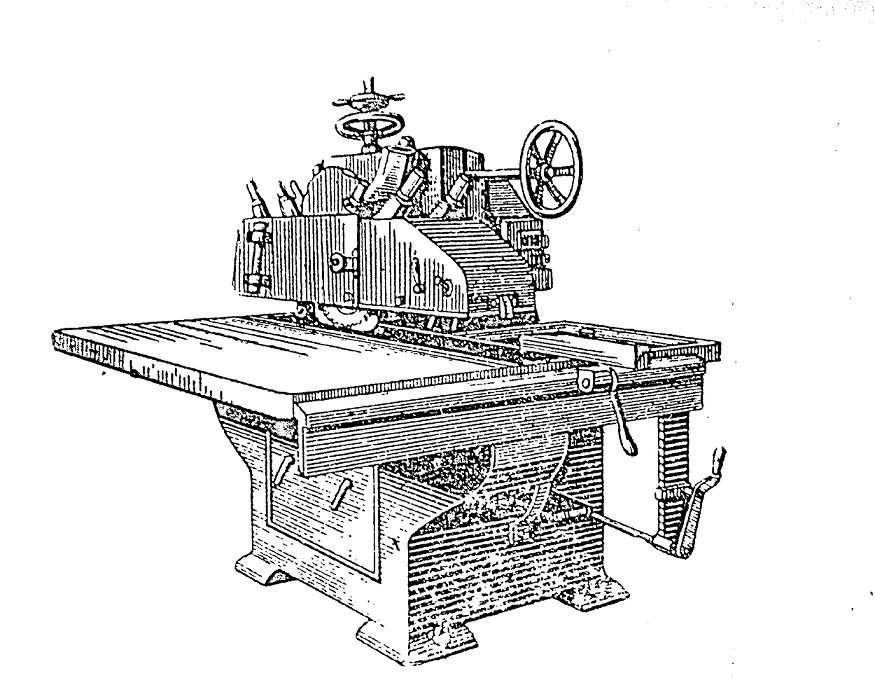
Picture 1: Circular saw machine with chain transmission for slitting
Circular saw machines can be with one, two or more saws.
Table 1 gives the technical characteristics of the most common types of machines with circular saws. For crosswise cutting of boards in the conditions of rural construction, a circular pendulum saw of the brand 4 - KM, which is presented in fig. 2. It is easy to handle, very productive and gives relatively good cutting quality.
Pendulum and universal circular saws
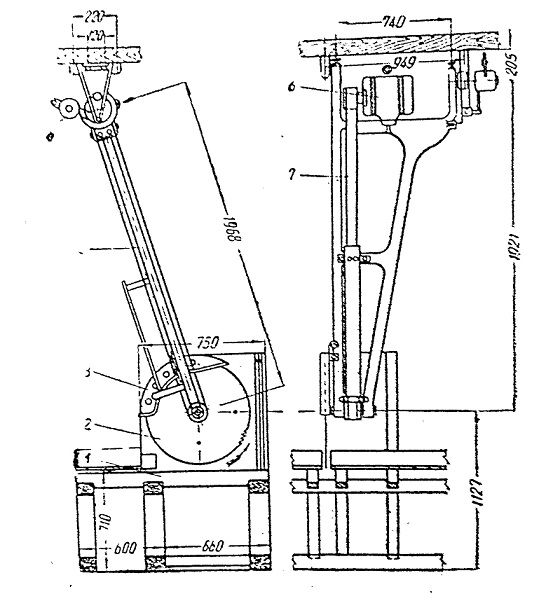
Picture 2: Pendulum cross-cutting saw
Table 1: Technical characteristics of the most common types of machines with circular saws
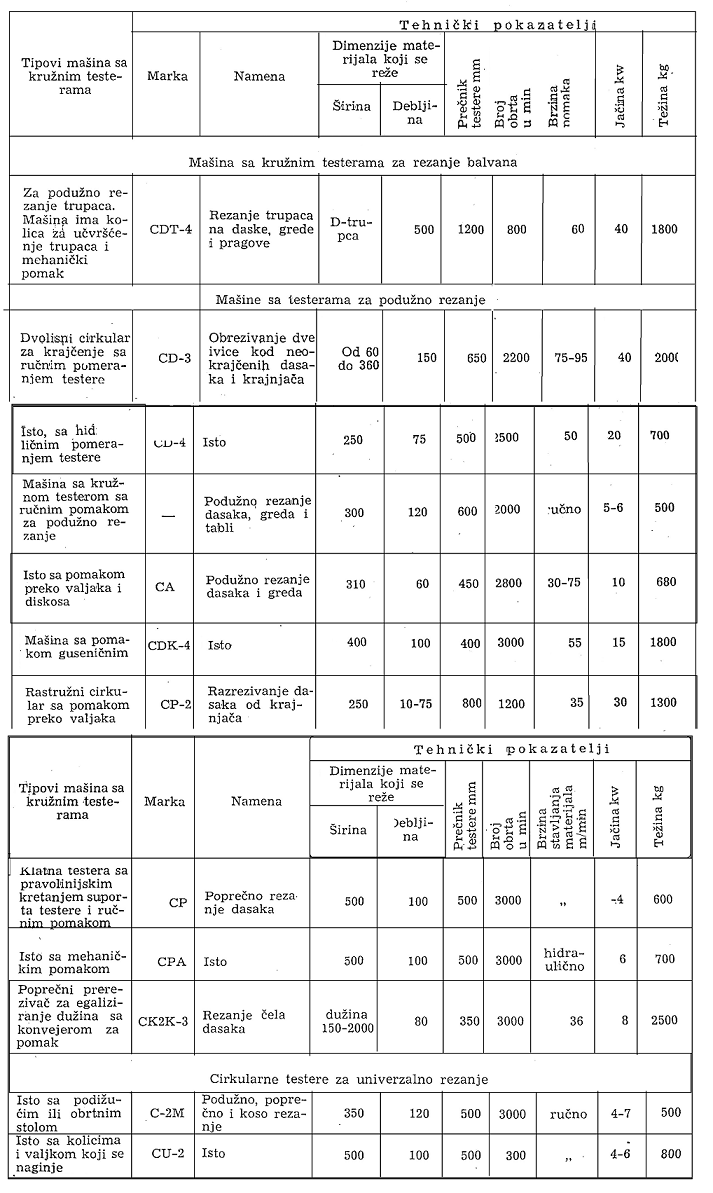
In smaller workshops for woodworking and in conditions of rural construction, universal machines brand C — 2M and CU — 2 are used for longitudinal and transverse cutting of materials. With this type of machine, various wooden elements can be cut at an angle. In fig. 3 is a circular saw machine with automatic material feed for longitudinal cutting.
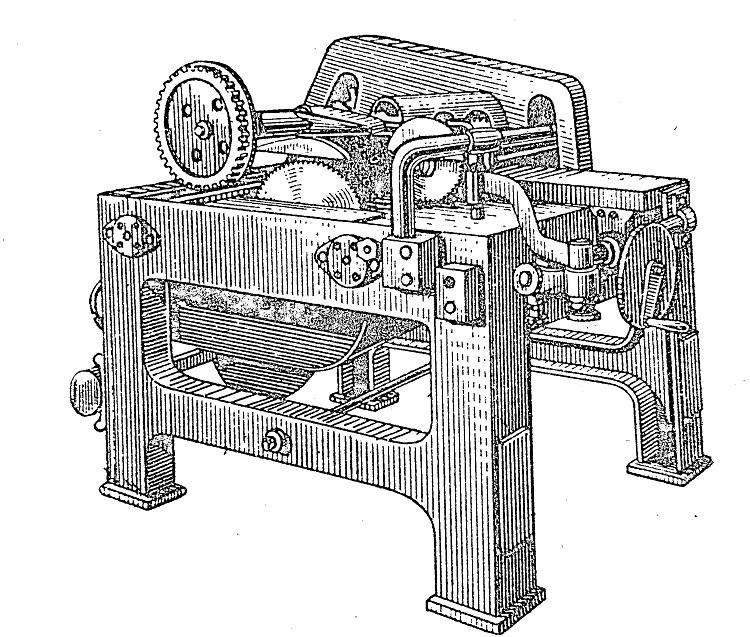
Figure 3: Circular for longitudinal cutting with mechanical feed
Historical calculation of productivity
The productivity of a pendulum saw for one shift in pieces of manufactured elements can be determined by the formula P = 480 Kg (n - m), where P is the number of cuts for one shift; n — number of cuts per minute; m — supplementary cuts for leveling the forehead and cutting out defective places. When the number of cuts is up to 7 per minute, m is taken to be equal to 1 — 2, and when the number of cuts is from 8 — 12 per minute, m is taken to be equal to 2 to 8; Kg — Coefficient of utilization of the working day, which takes into account interruptions in the operation of the machine, time for workers to rest, time for adjusting the machine, etc. For machines with manual material feed, Kg is taken as approximately 0,93.
The productivity of a machine with a circular saw in pieces of manufactured elements in a shift can be determined according to the formula: P = 480 and Kd Kst/ Lm, where P — productivity in pieces of manufactured elements during one shift; i — displacement speed; Kd—the utilization coefficient of one day which is equal to 0,9; Kst — coefficient of utilization of the machine, which is equal to 0,6; L — length of elements, m; m — average number of cuts for one element.
Sheets and tooth profiles
Blades for circular saws are divided into flat, double-cone, right-cone, left-cone and planing saws according to their construction.
Circular flat saw blades are mostly used for longitudinal and transverse cutting of wood. Their dimensions are given in table. 2.
Table 2: Blade dimensions of flat circular saws for longitudinal and transverse cutting of wood
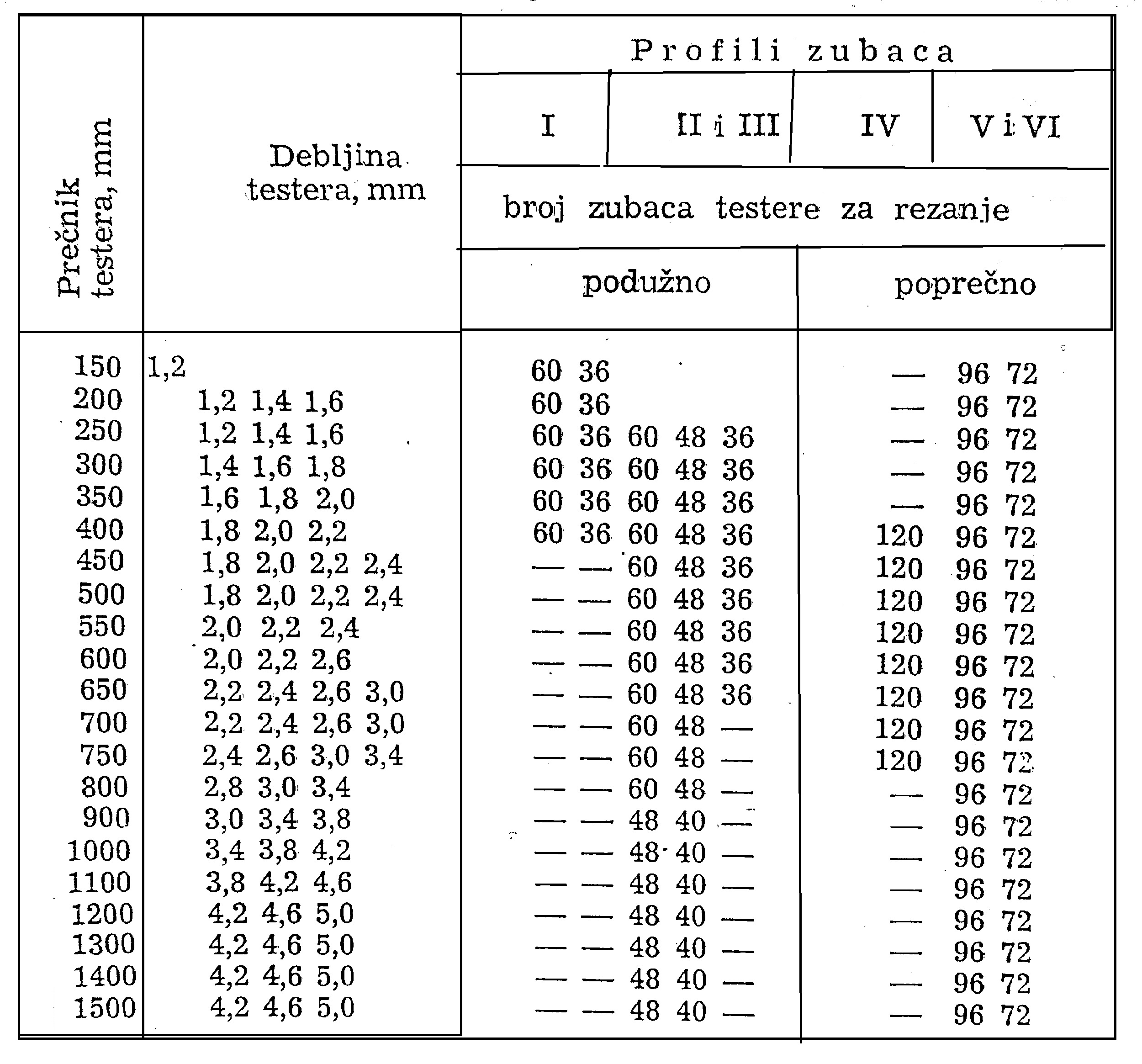
The diameters of the holes for the saw shaft are: 20, 80, 40, 50, 75 and 85 mm. Saw blades are made of 89 brand steel. The profiles and dimensions of the teeth of the blades of flat circular saws for longitudinal and transverse cutting of wood are given in fig. 4. In the table. 3 are the sizes of the angles of the blades of the flat teeth of circular saws. The height of the saw tooth and the radius of rounding of the internal corner are determined from the following ratios: In the case of a saw, longitudinal cutting h = (0,4 / 0,5)t; In the cross-cutting saw h = (0,6 / 0,9)t; For saws for longitudinal and transverse cutting h = (0,1 / 0,15)t.
| Profile of teeth | Angular sizes | ||
|---|---|---|---|
| γ | β | α | |
| Cutting saws | |||
| I II III |
20 35 35 |
40 40 40 |
30 15 15 |
| Cross-cutting saws | |||
| IV V VI |
-25 -15 0 |
50 45 40 |
65 60 50 |
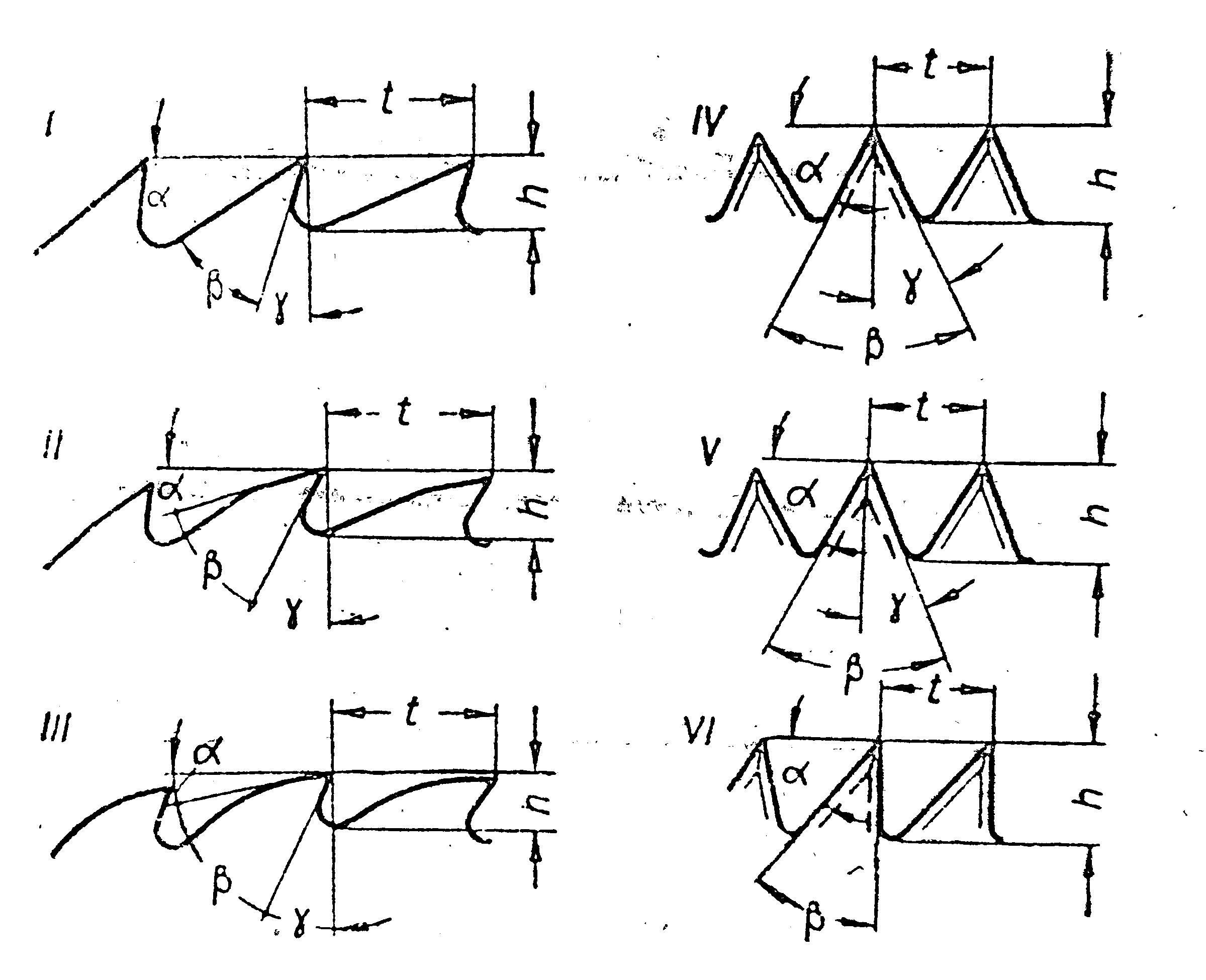
Figure 40: Profile I - IV and tooth dimensions of flat circular saw blades
Historical maintenance and adjustment procedures
Circular saw blades are sharpened on special automatic saw sharpening machines, where neither the profile nor the size of the cutting angle, sharpening, nor the internal and external angle changes. The cutting of new teeth is done by special punching machines with the appropriate head. Controlling the profile of the teeth and the size of the corner elements is done with special templates and protractors.
Instead of sharpening the teeth of gutter, circular and band saws, for longitudinal cutting, their compression is sometimes performed, which consists in expanding the front edge of the teeth. The advantage of compression over flaring consists in the fact that the size of the flaring does not change during operation, the cutting force acts symmetrically on the tooth, and the pile of equal thickness is removed. Over the entire width of the cut, the tooth pitch can be increased by 30 — 40%, without reducing the cutting quality.
During cutting, voltages of different magnitude and direction appear in the saw blade, which lead to the creation of bulges in weak places, etc. Before the saw blade is mounted on the machine shaft, it must be easily hammered, which eliminates the stresses that have arisen in it. An anvil, table for checking saws, hammers, rulers, ruler for checking alignment, etc. are used for this purpose.
Spreading the teeth is done by spreaders. The size of the spread in most cases is taken from 0,6 to 0,75 mm for one side, regardless of the thickness of the saw, but taking into account the type and humidity of the wood. The higher the moisture content of the wood, the greater the swagger of the saw. The size of the spread of the saw teeth is controlled by special templates.
Fitting the saw blade to the machine shaft must be done under the following conditions. The contact surfaces of the side plates of the saw must be strictly perpendicular to the rotating shaft. The center of the saw blade must coincide with the center of the shaft. The fixing of the saw blade by means of the side plates must be secure. The splitting knife must be positioned exactly towards the saw. The guides and inserts in the slot of the table must be adjusted exactly according to the saw. The permissible gap between the saw and the shaft must not be greater than 0,2 mm. If these conditions are not met, low-quality cuts are obtained and in some cases machine malfunctions occur.