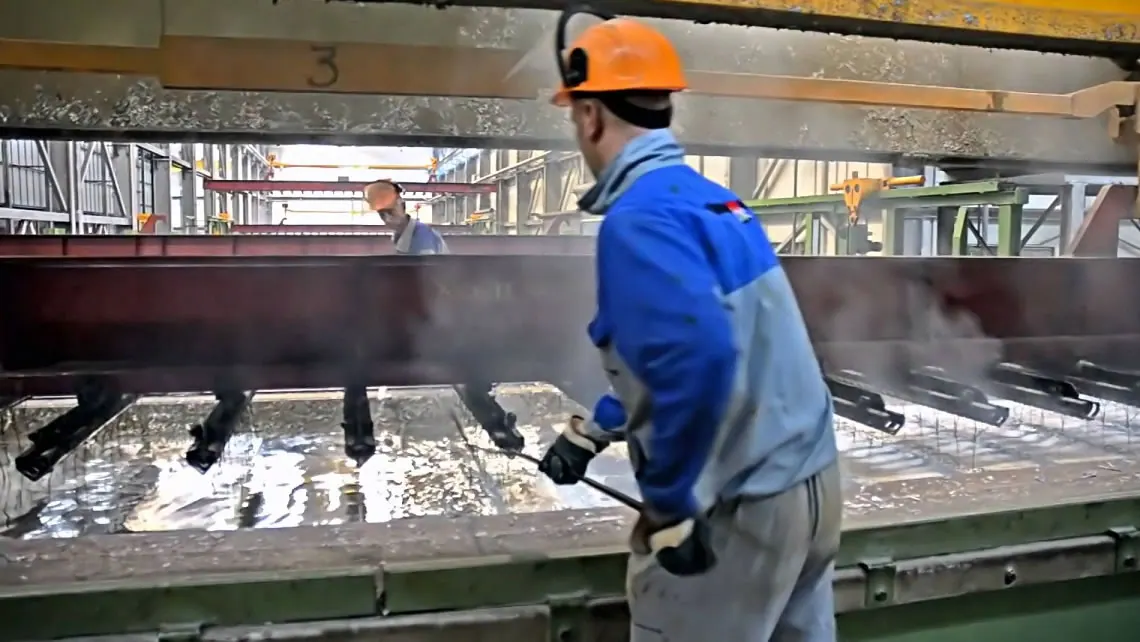
Dangerous historical recipes — do not attempt the described procedures: the article preserves the original archival text and amounts, but is not a laboratory protocol, risk assessment, or modern instruction. It mentions, among other things, hydrogen fluoride or hydrofluoric acid, sodium cyanide, mercury, lead, cadmium and chromium(VI) compounds, nitric, sulfuric and sonic acids, strong alkalis, flammable solvents and baths heated to 150°C. Incorrect concentration, mixing sequence, container, ventilation, temperature or contact can cause fatal poisoning, deep burns, toxic gases, fire, explosion and hazardous waste. Do not prepare or use these mixtures in your home or makeshift workshop. Such work belongs in an authorized industrial or laboratory environment with expert chemical supervision, a closed process, adequate ventilation, an emergency plan, valid safety data sheets and proper waste disposal.
Today, Savo Kusić is focused on wooden windows, wooden-aluminum windows, custom windows, doors and requests for quotation. This article remains as a historical archive and does not represent an offer of chemical metalworking.
Corrosion
Etching is the chemical dissolution of the surface layers of metals. So, for example, when making copper engravings, a copper plate is coated with wax, the desired image or text is drawn with a needle and nitric acid is poured over it. The acid will corrode non-waxed surfaces. A similar procedure is used for glass etching. Corrosive chemicals are very dangerous, so the use of rubber gloves, aprons and safety glasses is essential.
Historic etching solutions
All quantities below are transferred to preserve the original content and not for practical application. In particular, hydrogen fluoride can cause profound damage and systemic poisoning even when pain is not immediately apparent; nitric acid creates very dangerous fumes. Ordinary gloves and goggles are not a sufficient protection system by themselves.
Steel plates are processed with:
120 g of 80% alcohol,
8 g nitric acid i
1 g of silver nitrate, dissolved in water.
Zinc is treated with:
1000 ml of water,
100 g potassium alum,
30-100 ml nitric acid.
For glass etching we use:
1 part of hydrogen fluoride and
1-6 parts of water.
To remove, remove old paint from surfaces:
2 parts of asphalt dissolved in
5 parts of turpentine (cold).
(warm bath):
5 parts of asphalt,
10 parts of wax,
3 parts of the resin,
8 parts of mastic,
2 parts of tallow.
Oxidation
Coating metal surfaces with a protective, oxide layer is called oxidation. Before covering the metal with this layer, which can also be used for decoration, the surfaces must be carefully cleaned of grease.
Corrosion resistance of paint-protected surfaces is usually lower, however, the resistance is increased by filling the fine pores with water glass or clear varnish.
Historical oxidation solutions
Blue coating of brass is done with:
20-30 g / l of lead acetate,
60 g / l of sodium thiosulfate,
30 g / l 95% solution of acetic acid.
Bath temperature: 80°C. Oxidation time: 5 minutes.
Black coating of copper:
9,4 g / l of sodium hydroxide and
3,1 g / l of ammonium persulfate.
Temperature: 100°C, oxidation time: 5 minutes.
Dark painting of steel surfaces:
120-150 g / l sodium hydroxide,
30 g / l of sodium nitrate,
20 g / l carbamide and
We heat 100 ml of water to 140-150°C and carry out oxidation in the course of 20-30 minutes.
Covering copper with a dark color is done with:
40-50 g / l sodium-thioantimonate, at a temperature of 45-50°C.
or with 5-10 g / l of potassium sulfide at 60-80°C in the course of 10-15 minutes.
Blue painting of steel surfaces:
30 g ferric chloride, FeCl3 · 6H20;
30 g mercuric nitrate, Hg(NO3)2;
30g of sodium acid (22B°);
120 g of alcohol;
120 g of water.
Temperature; 20-25°C, time; 20 minutes.
Dark coloring of cadmium-treated steel plate:
62 g / l of potassium bichromate,
3,1 g / l nitric acid (specific density 1,2)
Temperature: 60–70°C.
Special Warning: recipes in this section include lead, mercury, cadmium, and chromium compounds, as well as strong acids and bases at high temperatures. There is no safe “home” substitute for industrial process, exposure and waste controls. Do not heat, stir or try these baths.
Degreasing of metal surfaces
Before applying metal coatings, metal surfaces should be degreased (picture 1).

Figure 1 — historical depiction of several successive baths for surface preparation.
Alkaline solutions for steel and iron:
40 g / l sodium hydroxide, NaOH,
50 g / l of sodium carbonate, Na2CO3 (soda),
4 g / l trisodium phosphate, Na3PO4 12H2O,
1 g / l fatty alcohol sulfate.
Temperature: 80°C.
55 g / l of sodium silicate,
60 g / l trisodium phosphate.
Temperature: 80°C.
Degreasing copper and brass surfaces by heating:
8 g / l sodium hydroxide,
25 g / l of sodium carbonate,
65 g / l trisodium phosphate and
1 g / l fatty alcohol sulfate.
Temperature: 80°C.
Degreasing aluminum and galvanized surfaces by heating
25 g / l of water glass,
60 g / l of sodium carbonate and
20 g / l trisodium phosphate,
Temperature: 80°C.
Degreasing baths without heating.
The listed chemicals are poisonous and extreme caution is recommended. It is forbidden to keep food items in the workshop. Hand washing is mandatory after work. Chemicals, protective gloves, suits, accessories, keep under lock and key.
Sodium cyanide can be lethal and can release hydrogen cyanide gas, especially in contact with acids. Do not acquire, store, mix or use cyanide recipes. If exposure is suspected, do not attempt improvised neutralization or rescue without protection; move away and immediately call the appropriate emergency services according to the local chemical incident plan.
For steel and iron:
85 g / l sodium hydroxide,
45 g / l of sodium cyanide,
75 g / l of sodium carbonate.
For copper and brass:
15 g / l sodium hydroxide,
20 g / l trisodium phosphate,
25 g / l of sodium carbonate and
10 g / l of sodium cyanide.
For aluminium, zinc and tin:
5 g / l of sodium carbonate and
5 g / l trisodium phosphate.
Degreasing is then successful, if a continuous water film forms on the treated surface.
Protective glasses and gloves should be used during alkaline degreasing, as alkalis are corrosive and poisonous substances. For electroless application of metal coatings, we use fireproof glass or enamel containers.
Metal coating
Nickel plating without electricity
20 g / l nickel chloride, NiCl2 · 6H2O,
20 g / l sodium hypophosphite, NaH2PO2H2O,
45 g / l trisodium citrate, Na3C4H3O7 · 5H2O,
30 g / l ammonium chloride, NH4Cl,
50-55 ml 25% ammonium hydroxide solution,
PH: 8-9%. Temperature: 85°C +/- 3%.
Time: for a thickness of 12 micron about 1 hours.
Copper plating without electricity
Place previously well-cleaned steel or iron surfaces in the solution, wash and dry. The solution is composed of:
104 g / l potassium-sodium-tartrate, KNaC4H4O6,
70 g / l sodium hydroxide NaOH,
35 g / l copper sulfate, CuSO4 · 6H2O.
Time: 5 minutes, Temperature: 50°C.
Previously, we put metal objects in a solution made of 20 g / l copper sulfate and sulfuric acid, which are in the ratio 1:1.
Copper plating and nickel plating of aluminum surfaces by dipping
After removing the oxide and fat layer, the objects are placed in the first bath for 4-5 minutes - with constant stirring - then they are washed and dried. The same procedure is carried out in the second bath. The nickel plating process is identical. All operations should be carried out in rubber gloves, with protective glasses, because the mentioned chemicals are very dangerous.
Aluminum copper plating:
1. Put in 1000ml of water
145 ml of sodium acid (20 B°),
35 ml 98%-no sulfuric acid,
15 g of copper sulfate (blue stone).
2. Put in 1000 ml of water
110 g of copper sulfate and
2 g of potassium chloride.
Temperature: room temperature.
Aluminum nickel plating:
In 1000 ml of water put:
15 g of nickel chloride, NiCl2 · 6H2O,
20 g of ammonium chloride, NH4Cl,
3 g of sodium sulfate, Na2SO4,
10 g sodium carbonate, Na2CO3,
10 g of ammonium carbonate, (NH4)2CO3.
Temperature: room temperature.
Coating iron with zinc (Image 2)

Figure 2 — historical depiction of chemically coating iron with zinc.
At 1000 ml of water comes:
10 g of zinc chloride, ZnCl2,
20g of tartaric acid, C4H6O6.
Temperature: 100° C.
Copper galvanizing:
In 1000 ml of water put:
10 g of zinc chloride and
200 g of sodium hydroxide
Temperature: 100°C.
We keep the iron objects, which we want to coat with zinc, for about 10-15 minutes in the bathroom with constant stirring. It happens that we have to remove the failed coatings from the surfaces. The solution for removing nickel from ferrous, steel surfaces is fuming nitric acid (HNO3).
To remove copper from iron surfaces, we use sodium cyanide (NaCN) in a concentration of 200 g / l, at 60-70°C. Sodium cyanide is very poisonous.
The removal of zinc from iron or steel surfaces is carried out at room temperature with 10% sodium acid or with 20% sodium hydroxide solution at 100°C, or at room temperature with chromium trioxide (CrO3) in a concentration of 20 g / l +15 g / l of sulfuric acid.
We remove zinc from copper surfaces with 10% solution of sodium acid.
The methods not listed exceed the possibility of performing them at home, because they require a well-equipped laboratory, i.e. a workshop.
Contemporary conclusion: neither the mentioned methods can be performed in domestic conditions. Surface treatment requires accurately identified chemicals and materials, an expertly designed process, exposure measurement, compatible containers, local ventilation, temperature and pH control, trained workers, emergency equipment, and legally regulated treatment of solutions, leachates, and sediments. For results and to protect people and the environment, use a qualified industrial contractor.