Working with chemicals and plastics
Chemistry was once regarded as “black magic,” whereas today we encounter it everywhere, even in the household. We know that with “Black Bull” or other detergents we can easily wash laundry. Many are aware that tetraethyl lead increases the octane rating of gasoline. Of course, this knowledge does not make a person a chemist. To become one at least a little, let us get acquainted with the basics of chemistry:
Matter that can be separated into other substances with different properties by simple physical methods (sorting, sieving, with a magnet, etc.) is called a mixture. That completely homogeneous substance which cannot be broken down by such simple methods into components with different properties is called a compound.
Compounds are made up of molecules composed of elements that are bound by specific chemical bonds. These bonds do not allow them to be easily split apart. Breaking, severing these bonds requires greater forces, chemical intervention. The molecules then break down into the constituent atoms. For a long time it was thought that atoms could not be divided further. In our century, the earlier assumption was confirmed that atoms consist of even smaller elementary particles that differ from one another both in size and in electric charge. The most positive elementary particles are the positively charged proton, the neutral neutron and the negative electron.
In all compounds of 92 natural elements, only 15 to 20 elements participate.
We measure the weight of atoms of the elements by comparing how many times heavier they are than the atom of the lightest element, hydrogen (by the newer definition, 1/12 of a carbon atom.
No element can combine with another element in arbitrary, whatever quantities. The possibility of chemical bonding of a hydrogen atom is considered unitary. Therefore, the hydrogen atom is monovalent. An atom that forms a compound with one hydrogen atom is also monovalent. If an element bonds two, three, four, etc. hydrogen atoms, then it is di-, tri-, tetra-, etc. valent. Octavalency is the greatest possible valency of an element. However, there are elements with multiple valencies; these are of variable valency.
The main groups of compounds are inorganic and organic compounds. Organic compounds contain carbon, whereas inorganic compounds - with rare exceptions - do not contain carbon.
The reason for the existence of a large number of organic compounds lies in the ability of carbon atoms to bond with one another, that is, in the formation of carbon chains. (The name organic compounds comes from the earlier belief that only living organisms can produce them.)
ACIDS are dangerous corrosive substances that cause severe wounds on the skin or in the stomach, similar to burns. We can easily identify acids with litmus paper, because blue litmus turns red in acid. When working with acids, protective goggles and rubber gloves are essential. If, despite caution, a drop of acid falls on our skin, it should first be wiped off with a dry cloth, then washed under running water, and finally the traces of acid neutralized with a baking soda solution (Fig. 1).

FIGURE 1
BASES are reaction products of metal oxides with water. Bases that are water-soluble and have a corrosive effect are called alkalis. They can be easily recognized because they turn red litmus blue. They are highly corrosive substances. Wounds caused by them heal with difficulty, more so than wounds caused by acids. Occupational safety regulations are the same as for acids. In the event of injury, the skin should be washed with a diluted acid (for example, acetic acid).
SALTS are formed by the reaction of bases and acids. They cause little or no damage to the skin. However, salts should still be handled carefully, because some are poisonous.
Household chemicals
This has long been known, especially in the preservation of food products.
Preservatives can be divided into:
1. Substances that simultaneously impart flavor and preserve products: sugar, salt, vinegar, fat, citric acid, tartaric acid.
2. Materials for destroying microorganisms: saltpeter, glutamic acid, alum, lime milk, salicyl, benzoic acid and sodium benzoate.
3. Gelatinous substances, colors and spices.
Sugar. By adding 55% sugar (sugar =C12H22O11) to a product (from plums, raspberries, apricots, pears, apples) without adding any other chemicals, we have fully preserved it (sweet preserve). It is not advisable to add more than 55% sugar, because the sugar will crystallize. A value lower than 50% sugar does not preserve. When adding sugar to acidic food products, they should be boiled only briefly, because the sugar breaks down.
Salt. Table salt (sodium chloride, NaCl) also gives flavor and at the same time preserves. The preservative effect comes from the hygroscopic nature of salt (it absorbs moisture). If meat is salted, the salt binds a certain amount of water not only from the meat but also from the bacteria, thereby destroying them. Other microorganisms also cannot survive without water.
Saltpeter. (Potassium nitrate, KNO3). A salty, bitter, white crystalline powder. It is neutral. For preserving 2,5 kg meat, dissolve 0,5 grams of potassium nitrate in 100 g of warm water. Moisten the chopped meat with this solution. Care must be taken with exact dosing, because in larger quantities potassium saltpeter is very bitter and poisonous.
Glutamic acid (amino–pyrovinic acid, amino-glutaric acid, НООС-СН2-СН2–СН(NH)2–СООН is an amino acid found in almost all proteins. It is used for preparing concentrates of various soups and broths (Podravka, Knorr, etc.), that is, for preserving meat. For 1 kg of meat, 5 g of dissolved glutamic acid is used.
Alum (potassium–aluminum–sulfate, KAl(SO4)2 is used in its pure state for preserving, or rather for firming up the structure of softer fruit and vegetables so that they do not fall apart or break down during preservation. For 1 kg of fruit or vegetables, 1,4 g of alum is used.
Lime milk. It has the same effect as alum. 0,5 kg of slaked lime is dissolved in 5 liters of water and left to stand overnight, then carefully decanted (about 2/3 of the clear solution is poured off), and in this lime milk [Ca(OH)2] the fruit or vegetables are soaked for 15-20 minuta and finally rinsed with warm water.
Citric acid. Citric acid is very widespread in the plant kingdom. It is found in almost every fruit (oxy–propan–tricarboxylic acid, C6H8O7) Odorless, colorless crystals of citric acid dissolve in warm water. For 1 kg of fruit, 1 to 2 g of acid is needed.
Tartaric acid. Colorless, odorless (C4H6O6), whose potassium salt is found in wine. The action of this acid is similar to that of citric acid.
Acetic acid. Colorless, sharp-smelling, strongly acidic corrosive substance (СН3СООН). It is a major enemy of mold and bacteria. Above a certain concentration, bacteria cannot live in an acidic environment. That is why acetic acid is very often used for preservation. It is found in shops in various concentrations (strengths). For 1 kg of a product, about 2-3 deciliters of a 10%-strength solution of acetic acid are sufficient. Acetic acid destroys a large number of metals (iron, aluminum, copper, zinc). The compound formed with copper or zinc is poisonous, so only a container made of glass, ceramic, enamel, plastic or wood can serve as packaging for acetic acid.
Salicylic acid is a white, needle-shaped crystalline powder, odorless (C6H4(OH)COOH). It is a cell poison and destroys bacteria and spores. In larger quantities it is also toxic to the human body, so for preservation it is used in smaller, precisely specified amounts. For 1 kg of fruit, a maximum of 0,8 g is added.
Benzoic acid is a white, silky, needle-like or plate-like crystalline substance (Н6С5СООН). It destroys bacteria and spores very effectively. In larger quantities it is also harmful to the body, so only 1 kg grams are added per 0,5 of product.
Adhesives
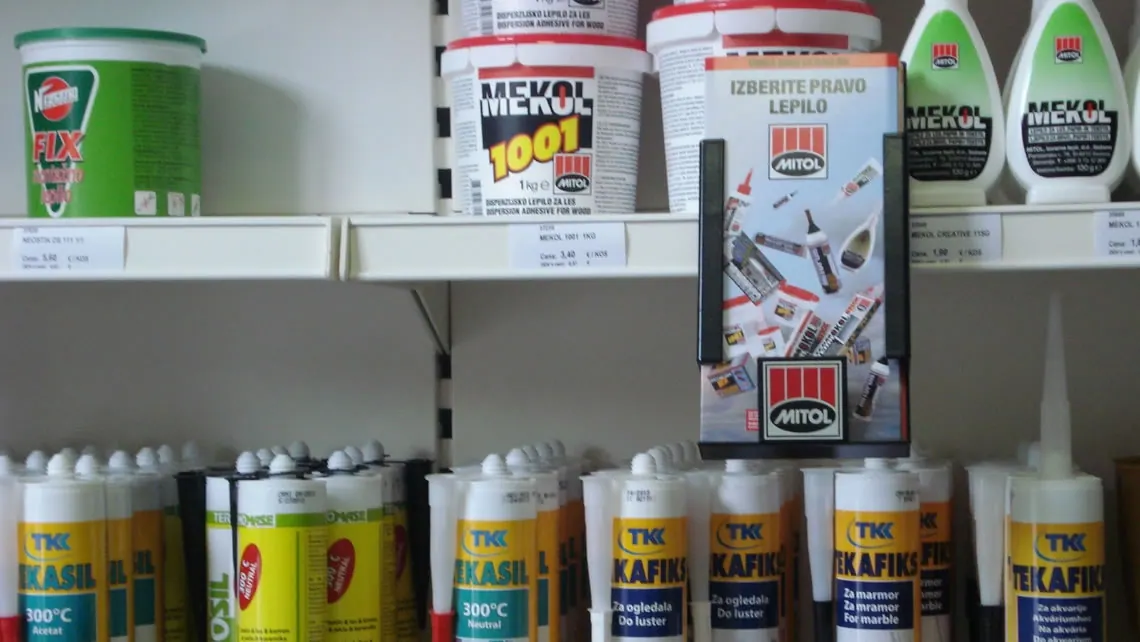
A large number of synthetic adhesives are increasingly conquering the market. However, we should not be misled by the name “universal adhesive.” These adhesives are good, but not universal; they adhere well to some materials, poorly to others.

We will list several of the most important adhesives that can be purchased on the domestic market, with notes on which materials can be best bonded with these adhesives.
Glue, (bone, skin) is used for gluing paper, wood, textiles, cellophane, as well as for bonding these to skin and glass.
Benzol is a solvent for polystyrene, or its adhesive. In addition to bonding polystyrene sheets to each other, plexiglass, celluloid and cellophane are also bonded to polystyrene with benzol.
Water glass is used for bonding glass and hard materials, such as bakelite with textiles, paper, metals, porcelain and ceramics, or for bonding these materials to one another.
Chloroform is a solvent, i.e. an adhesive for plexiglass. Plexiglas can be bonded with chloroform to glass, ceramics, porcelain, polystyrene and celluloid.
Boropor bonds rubber to rubber, rubber to metal, leather, glass, porcelain, wood, textile. It also bonds leather to metal, and more weakly to glass and wood.
Oho “universal” adhesive is successfully used for bonding glass, porcelain, wood, polystyrene, and metal.
Risoprene (synthetic rubber) is primarily used for bonding rubber and leather. It is also recommended for bonding linoleum, podolite, vinaz boards, and parquet to concrete.
Savanol is used for bonding leather, rubber, Ultrapas, carpet, textiles, wood, asbestos-cement boards and galvanized sheet metal.
Neostik un »universal« adhesive. It can be used for bonding various materials; leather, wood, rubber, textiles, etc.
Drvofix is an adhesive for wood, wood-based boards (panel, particleboard, etc.), expanded polystyrene to wood, parquet to wooden substrates, etc.
Teleol (neoprene). Adhesive for bonding leather, rubber, plastics, textiles, wood, PVC floor coverings etc.
Krautoxin (Kunstsoff aus der Tube). A two-component adhesive in which the two components are first mixed and then used within half an hour. Bonds metal, stone, glass, porcelain, thermosetting plastics (Bakelite), etc.
Epoxy adhesives, such as: ARALDIT (Switzerland), ЕРON (Shell), EPILOX (Buna-werke), EPORESIT (Hungary), are occasionally available on the market in the form of powder, paste, sticks, emulsions. They are excellent adhesives, especially for bonding metal to metal, or rubber, leather, etc.
Desmodur, Desmoden are polyurethane adhesives used for bonding metal to rubber, or metal to metal.