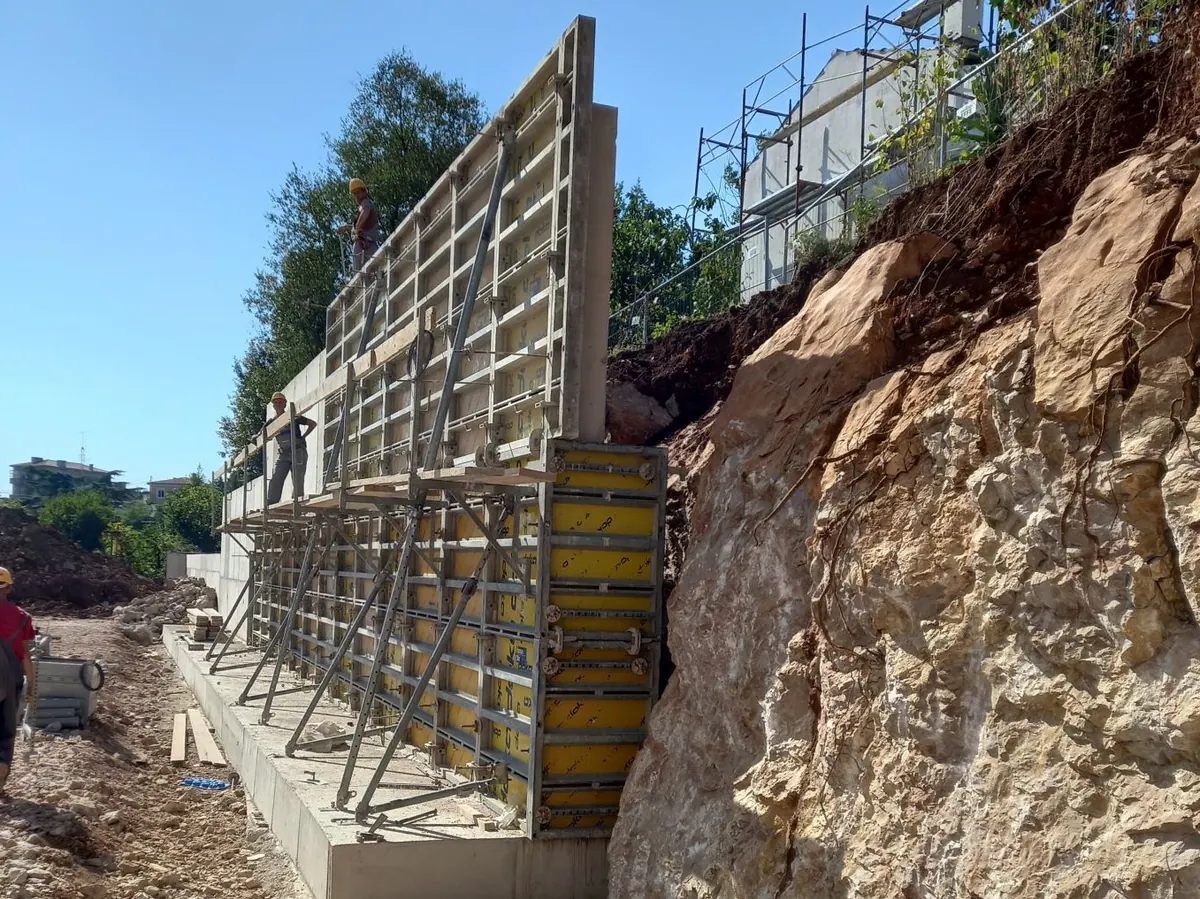
Today, Savo Kusić is focused on wood חלונות, wood-aluminum חלונות, custom חלונות, doors and requests for quotation. This text remains as a geotechnical archive and is not an offer for the design of retaining walls, geotechnical investigations or earthworks.
שיטות לקביעת לחץ אדמה פסיבי
לחץ אדמה פסיבי מופיע רק במקרה שבו העיוות של הקיר לכיוון הקרקע גדול מספיק כדי להפעיל את ההתנגדות הפנימית של הקרקע, המתנגדת לכוח החיצוני. פרנציוס קבע באמצעות ניסויים שכדי להפעיל את לחץ האדמה הפסיבי, יש צורך להזיז את הקיר במקרה של חול רטוב s=30_ח_1,5, ובמקרה של חול מתחת למים s=23ח2,5כאשר תזוזה s היא במ“מ, ו-h הוא גובה הקיר ב-m. לכן, אם גובה הקיר הוא h=3,0 m, על מנת להפעיל את הלחץ הפסיבי, במקרה של חול רטוב, יש צורך להזיז את הקיר לכיוון הקרקע s=156 mm. עם זאת, מכיוון שתנועה כה גדולה של הקיר אסורה ברוב המקרים, היא מטופלת באחת מהדרכים הבאות:
א) אם גובה הקיר קטן, כפי שהוא המקרה של שיעור היסוד CD (איור.1א), לחץ האדמה הפסיבי Ep אינו נלקח בחשבון, כל עוד ניתן לאחר מכן לחפור או לשחוק את שכבת האדמה, מול הקרקע CD, והוא מחושב רק עם לחץ האדמה הפעיל Ea על כל גובה הקיר AB.
ב) במקרה של גובה קיר גבוה יותר (איור.1ב), במקום לחץ האדמה הפסיבי Ep מצד הקיר CD, Ea מאומצת כהתנגדות המתנגדת לכוחות Ea1 ו_Ea2_.
ג) במקרה של תומכים שצריכים לקבל כוחות אופקיים גדולים, נדרש לחץ פסיבי מלא Ep על כל גובה הקיר AB, על מנת להתנגד לכוח התקיפה R (איור.1ג). במקרה כזה, האדמה מעוותת תחילה באמצעות שקעים הידראוליים, ואם האדמה מורכבת מחימר רך או חומר דומה שמתעוות חזק בעומס, חומר זה מוחלף ברוחב הדרוש b בחומר חצץ, שזווית החיכוך הפנימית שלו גדולה וניתן לדחוס אותו בקלות, כך שלא ייכללו עיוותים מאוחרים יותר של הקרקע מתחת לעומס.

Sl.1. מקרים של השפעת לחץ אדמה פסיבי
קיימות מספר שיטות לקביעת לחץ אדמה פסיבי, מהן המוכרות ביותר הן השיטות הגרפיות של קולומב ורבאן-פונסלט.
השיטה הגרפית של קולומב
According to this method, a real sliding surface is adopted, as well as that the internal resistance of the soil consists only of friction, without cohesion (c=0). Since the passive earth pressure appears as a resistive force, these are the angle of internal friction of the soil and the angle of deviation of the force Ep from the normal to the wall of the opposite sign, i.e. -δ and -ϕ (fig. 2a).
If the inner surface of the wall is AB and if we adopt an arbitrary sliding surface AC, the external force Ep is opposed by the weight W of the sliding prism ABCA and the frictional resistance Q along the sliding surface AC. Since the weight W is known by its size, direction and direction, while the forces Q and Ep are known by their direction and direction, it is possible to create a plan of forces (fig. 2b), from which the magnitude of the force Ep is determined.

איור. 2. לחץ כדור הארץ פסיבי בקולומב
However, since the smallest passive pressure Ep,min corresponding to the critical sliding surface AC, on which the sliding prism will most likely form and be pushed out the most under the influence of external force, is required, it is done as follows (Fig. 3).

איור. 3. קביעת לחץ אדמה פסיבי EP על ידי Coulomb
מצוירים מספר משטחי הזזה שרירותיים AC1, AC2, AC3. . . and for each corresponding sliding prism determine the weight W1 = AΔABC1 x 1,00 x γ, W2 = AΔABC2 x 1,00 x γ, W3 = AΔABC3 x 1,00 x γ. Then for each prism, a suitable plan of forces is created and the forces EP1, EP2, EP3 are determined… These forces are applied in a suitable scale to the EP force diagram and the tangent to this diagram parallel to the abscissa axis נותן את הערך הקטן ביותר Ep, המתאים למשטח ההזזה הקריטי AC. החיסרון בשיטה זו הוא שבגלל הפתרון הגרפי שלה היא יכולה לתת כוח Ep החורג מאוד מהמציאות. לכן, בשיטה זו נעשה שימוש לעתים רחוקות.
השיטה הגרפית של קולמן
According to this method, it is assumed that the passive earth pressure Ep acts at an angle -δ with the normal to the retaining wall, that the line of the natural slope of the soil overlaps the angle -ϕ with the horizontal, and that the position line overlaps the angle -(δ+ϕ) with the line of the wall (fig. 4a). במצב של שיווי משקל גבול שלושת הכוחות הפועלים W, Q ו-Ep מצטלבים בנקודה אחת. Since the force W is known by its direction, magnitude and direction, and the forces Q and Ep by its direction and direction, we can draw a plan of forces (fig. 4b). If we turn this triangle of forces by 90°- ϕ in the counterclockwise direction, the force W will fall in the direction of the line of natural slope of the ground AN, the force Q in the direction of the sliding surface AC, and the force Ea in the direction of the position line BH, since the angle between the forces W and Q is α+ϕ, while the angle between Ep and the normal to the wall δ, and the direction of the force Ep coincides with the direction of the position line BH (fig. 4a).

Sl.4. קביעת לחץ אדמה פסיבי על ידי קולומב
ההליך לקביעת לחץ האדמה הפסיבי הוא כדלקמן (איור 4c). From the leg of the wall A, we draw several arbitrary sliding surfaces AC1, AC2, AC3…. Each of these surfaces corresponds to a sliding prism ABC1, ABC2, ABC3…, שאורכו בניצב לציור שאנו מאמצים אליו שווה לאחדות. If the weights of these earth prisms W1 = AΔABC1 x 1,00 x γ, W2 = AΔABC2 x 1,00 x γ, W3 = AΔABC3 x 1,00 x γ, where γ is the volumetric weight of the soil, applied to the line of the natural slope of the soil AN, we will get points I, II, III… By drawing lines parallel to the position line from these points, we get intersection points R1, R2, R3… Triangles A_I_R1, A_II_R2, A_III_R3 are force planes W, Q and Ep למשטחי ההזזה המתאימים. By connecting the points R1, R2, R3… we get the Cullmann line of passive earth pressures, the so-called Cullmann’s Ep Line. The tangent to this line parallel to the line of the natural slope of the soil gives the smallest length KK’, which in relation to the forces W gives the passive earth pressure Ep.
If we extend the direction AK to the intersection with the terrain line, we get the sliding surface of least resistance AC.
שיטת רבהן-פונסלט
According to this method, the procedure is similar to that for determining active earth pressure with the difference that the force Q acts at an angle -ϕ with the normal to the sliding surface, and the force Ep at an angle -δ with the normal to the wall line. לפי Rebhann, AΔABC = AΔACD (איור 5a). ההליך לקביעת לחץ אדמה פסיבי הוא כדלקמן:

איור. 5. קביעת לחץ אדמה פסיבי לפי Rebhann-Poncelet
מבסיס הקיר A נשרטט את קו השיפוע הטבעי של האדמה בזווית -ϕ עם האופקי.
מראש הקיר B נשרטט את קו המיקום BH בזווית -(δ+ϕ). בנקודה M של מפגש המיקום והשיפוע הטבעי של קו הקרקע, הנורמל מורם לצומת L עם חצי עיגול מעל AN כקוטר.
עם פתיחת המצפן AL, נעביר את הנקודה L ל-D (AL=AD).
על ידי ציור מהנקודה D המקבילה לקו המיקום עד למפגש C עם קו השטח, נקבל צד אחד של משולש לחץ האדמה DC = e. העברת הנקודה C ל-F (DC=DF) והורדת ה-CK הרגיל לקו השיפוע הטבעי של הקרקע, נקבל את משולש לחץ האדמה DCF, ממנו נקבל Ep=1/2_γ_ ef, כאשר γ היא צפיפות הנפח של הקרקע.
הקו AC מייצג את משטח ההזזה. דיאגרמת לחץ האדמה הפסיבית היא ba (איור.5ב). זה מתקבל על בסיס טופס
Ep = xh/2, מנין x =2_Ep__/h
נקודת ההתקפה של הכוח Ep היא בגובה מרכז הכובד של המשולש abc. הכוח Ep פועל בזווית -δ עם הנורמלי לקיר התומך.
השיטות, היחידות, הנוסחאות והערכים האמורים מועברים ממקור היסטורי ואינם מהווים תחליף למחקר גיאוטכני, חישוב סטטי, פרויקט קיר תמך או תוכנית ביצוע. האפשרות לגיוס התנגדות פסיבית תלויה בעיוות המותר, פרמטרים בפועל וריבוד של הקרקע, מים תת-קרקעיים ושטחיים, ניקוז, עומסים נוספים, השפעות סיסמיות, שחיקה, חפירה, שלבי בנייה ומבנים סמוכים. הפתרון לשטח ספציפי חייב להיקבע על ידי מחקר מתאים ומומחים גיאוטכניים ובנייה מוסמכים בהתאם לתקנות העדכניות.