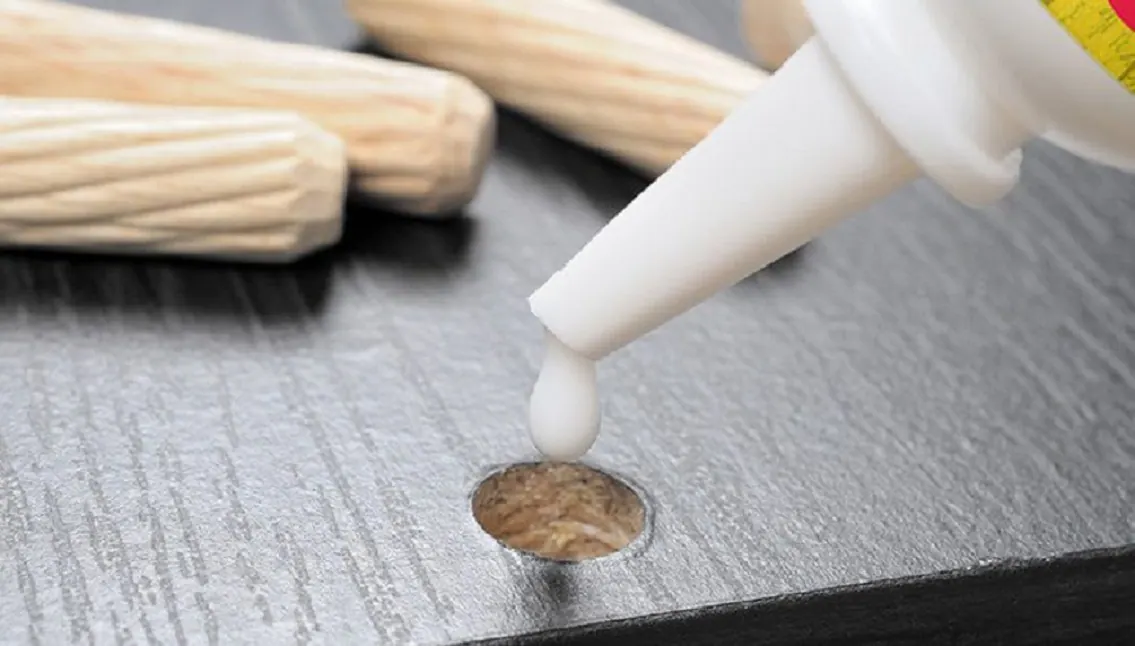
The glues used for gluing wood must be sufficiently stable in water, resistant to fungal infection and must have a high strength of the joint they form. This strength must go up to the ultimate shear strength of the wood being glued.
Classification of adhesives according to origin
According to their origin, adhesives are divided into three groups:
- animal, which are made from proteins of animal origin (milk, blood, bones and skin from animals). This group includes bone (tutkalo), leather, albumin and casein glues;
- herbal, which are made from starch and plant proteins (bean seeds, vetiver, soy yeast, sunflower seeds, etc.). Starch glue also belongs to this group;
- synthetic, obtained chemically from phenol, formaldehyde and carbamide.
Stability in water and behavior at temperature
Adhesives are divided into highly stable in water, stable in water and non-stable in water. Highly resistant adhesives in water withstand the action of water with a temperature of 100oC without a significant decrease in adhesive strength (phenol-formaldehyde adhesives). Adhesives stable in water under the influence of water with a temperature of 18 up to 20oC generally do not significantly reduce the bonding strength (urea resins and albumin adhesives). Adhesives unstable in water lose their adhesive strength under the influence of water (bone, leather, casein-ammonia). Adhesives are also divided into thermoreactive or irreversible and thermoplastic or reversible. Thermoreactive adhesives turn under the influence of temperature into a hard, insoluble and irreversible substance (carbamide and melarnine resin). Under the influence of heat, thermoplastic adhesives melt, and after cooling they harden and do not change their chemical nature (bone and skin tissue). Thermoplastic adhesives are mostly used, especially carpenter’s glue and leather glue. For the production of water-resistant plywood, thermoreactive adhesives are used.
The quality of carpentry glue
The quality of carpentry glue is determined by its solubility, wettability, swelling, colloidity, ability to foam, harden, putrefy, bonding strength and adhesive strength.
Preparation and storage of wood pulp
The solubility of the glue is determined by the temperature of the water. At temperatures below 25oC, the glue does not dissolve. Therefore, the swelling of dry putty in tiles and putty made of fish scales can only be done at a temperature above 25oC. Above 70 - 80oC, the dough should not be heated. The humidity of the pulp should not be above 15 - 17%, therefore it should be stored in dry, well-ventilated places. Felt with humidity over 20% quickly deteriorates (rots) and loses its adhesiveness. The moisture content of the pulp is determined in the same way as the moisture content of the wood. Carpenter’s putty is very hygroscopic. It can absorb water 10 - 15 times its weight. The method of making it is based on this feature of tutkal. The batter in the tiles, placed in a clean vessel, is poured with boiled water at a temperature of 25 - 30 oC and is thus kept for 10 - 12 hours. During this time, the dough absorbs the maximum amount of water needed for its preparation. This swollen dough is placed in a vessel with a double bottom and heated to a temperature of 70 - 80 oC. If a lot of foam forms on the surface during heating, the dough should be boiled for 5 -10 minutes and then the foam should be removed. However, the dough should not usually be allowed to boil, as it loses its viscosity and adhesiveness. Rotting (rottenness) is one of the negative properties of wood pulp. Therefore, the prepared dough should be kept at a temperature of 5 - 10 oC so that it does not spoil. One of the important properties of carpenter’s knot is its ability to change into a pictous state. A high-concentration wax goes into a pictous state at higher temperatures than a low-concentration wax. Very fine weaves change weakly or hardly at all into the pictial state. Such glues are not suitable for high-quality gluing of wood. The basic property of dissolved glue, stickiness, depends on the degree of its concentration. The degree of concentration is determined by the amount of water in the glue solution.
Assessment of joint quality and gluing mode
The character of the shear surface of the standard test tubes determines the quality of the wood bonding. If the shearing is done on the wood, then the quality of gluing is the best, if it is on the wood and on the weave, the quality is worse, and the worst is if the shearing is done on the weave itself. In addition to the quality of the felt and its stickiness, the gluing mode has a great influence on the strength of the wood gluing. In the table. 1 orientational modes of adhesive bonding are given.
| Operations | Workshop temperature, degrees | Glue concentration | Period before pressing, min | Pressure, kg/cm2 |
|---|---|---|---|---|
| Gluing battens | 25 | 25-30 | 2 | 4-5 |
| Gluing stud connections | 25-30 | 30-33 | 3 | 8-10 |
| Veneering and gluing of elements | 30 | 32-40 | – | 8-10 |
| Veneering with thin veneer | 25-30 | 35-40 | 8-15 | 6-8 |
In the room where the gluing is done, the temperature must not be lower than 25oC. Drafts and drafts of cold air created by high-speed woodworking machines located nearby should be avoided. Lowering the temperature of the surfaces to be glued can cause a decrease in the strength of the bonding joint.
Preheating the elements to be glued improves the gluing process.
The resistance of the standard glue solution against rotting (mildew) at 25oC is four days for the best type of bone felt, three days for type I, II and III. The resistance of the standard solution of skin tissue is four days and three days for the best type I, five days for type II - four days, and five days for type III at a temperature of 25o.
The ultimate shear strength of the glued samples is for leather felt, for the best and for the I type 100 kg/cm2, for the II type 75 kg/cm2 and for the III type 60 kg/cm2. For bone marrow, the ultimate shear strength of glued samples is for the best type 90 kg/cm2, for I type 80 kg/cm2, for II type 55 and for III 45 kg/cm2.
Casein glue
Powdered casein glue is a mixture of casein, slaked lime, mineral salts (sodium fluoride, soda, copper sulfate, etc.) and petroleum. It is used to glue wooden elements, wood and fabrics, cardboard, etc. According to the quality of the basic materials and the method of production, there are two types of casein glue: extra (B-107) and ordinary (OB).
This glue must have the appearance of a homogeneous powder without foreign impurities, insects, larvae and traces of mold and must not smell of rot. When 1 parts by weight of this glue and 2,1 parts by weight of water are mixed for one hour at a temperature of 15 - 20oC, a homogeneous solution is obtained, which does not contain lumps and which is suitable for gluing.
When gluing engineering constructions, which work in conditions of smaller temperature differences and less humidity, portland cement brand 400 (up to 75% of the powder weight) is added to this glue to increase its resistance to water and to reduce its cost. For casein glue, its sticking ability is of great importance, that is, the time during which it retains its stickiness, which is favorable for practical work. After 24 hours, the solution of this glue, extra type should have the appearance of an elastic pictium mass, the solution of type OB glue should have a working stickiness of at least 4 hours since it is mixed with water.
The limit strength of the glued connections of ash and oak should be at least 100 kg/cm2 for the type of glue extra, when tested in a dry state, 70 kg/cm2 - after 24 hours of immersion in water; for type OB - 70 kg/cm2 when tested in dry state and 50 kg/cm2 after 24 hour of immersion in water. Testing of the quality indicators of this glue is carried out in laboratories.
When gluing with casein glues, the pressure in the presses ranges from 2 to 15 kg/cm2 according to the type of work for which the element is intended.
When this glue contains rock or caustic soda, it should not be used to glue those types of wood that have tannin in their composition, such as oak tree.
Synthetic adhesives
Synthetic adhesives are completely resistant to water. Cold polymerization phenolformaldehyde glues of the KB - 3 and B - 3 type are mostly used. In the composition of B - 3 there are 10 parts of resin B, one part of thinner and 2 parts of curing filler.
Phenolformaldehyde adhesives are prepared as follows: resin B is placed in a specified amount in a tin mixer vessel where the temperature 15 - 20oC is maintained, then the diluent is added and slowly mixed until a homogeneous composition is obtained. After this, the curing filler is added and mixed for 10 - 15 minutes. The glue made in this way should be stored in a refrigerator, which is actually a vessel through which running water passes. For gluing wood, carbamide glues are also used, the main component of which is carbamide resin, which is obtained from synthetic carbamide and formaldehyde. When gluing with these glues, the wood must have a maximum humidity of 12%. Among the urea formaldehyde glues, K-7 glue should be highlighted, which consists of MF-17 resin, hardener, 10% oxalic acid solution (from 7,5 to 14 parts by weight) and wood flour filler.
For related topics, see wood properties, wood moisture and natural wood drying. If you’re planning new joinery, check out custom wood windows or submit a request for quote.