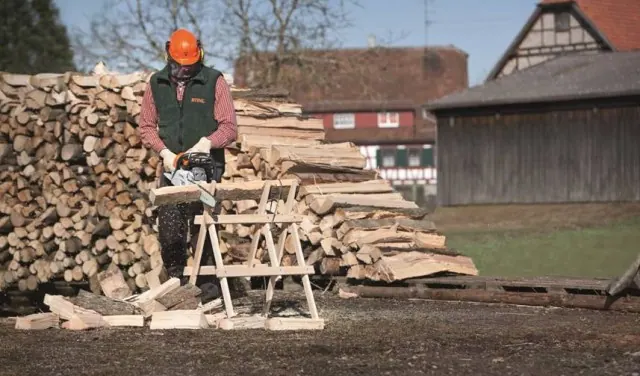
Natural drying consists of stacking the sawn timber that needs to be dried in stacks, in an area specially designated for this purpose, where it remains until it reaches an air-dry condition.
Stacking timber according to airflow
To achieve the most even drying possible and to protect the sawn timber from blue stain, it is arranged in the yard according to the prevailing winds as follows: timber 25 to 45 mm thick is placed on the side from which the wind blows, while timber 50 mm thick and above is placed in the middle of the yard.
The stacks of sawn timber are placed on special base supports. The base supports are made from portable blocks with a base of 60 x 60 cm. Sections of sound logs or boards are used for the supports, and beams 110 to 120 mm thick are laid across them; their upper surfaces must be in the same plane. The clear space beneath the stacks must be 50 to 75 cm high (Fig. 17).

Fig. 17. Supports beneath the bases.
Sawn timber for natural drying should be stacked by wood species, with edged and unedged timber kept separately. Boards of the same thickness may be placed in one stack (Fig. 18).

Fig. 18. Air drying of sawn timber in a stack.
Spacing between rows
The rows of sawn timber along the height of the stack should be separated from one another by thin, dry battens of equal thickness. They are placed directly above the base beams so that all battens lie in a single vertical line. Free spaces must remain between the battens in every row, forming vertical air channels through the height of the stack. Their width should gradually increase from the ends of the stack towards its centre.
For sawn timber 45 mm thick, the end spacing must be 1/3 of the timber width; for timber more than 45 mm thick, it must be 1/5 of the timber width.
The spacing in the middle of the stack must be three times greater than the end spacing. For the sawn timber to dry properly, two horizontal breaks should be made along the height of the stack, at distances of 1 and 2 m from the lowest row of sawn timber in the stack.
Protecting timber during drying
A canopy, or roof, is built above the stack from boards 22 to 25 mm thick. The roof should extend 0.5 m beyond the edge of the stack. To protect the ends of the timber from cracking, they should be coated with a mixture of lime and chalk, or the ends should be protected from the sun by arranging the boards in the stack so that the upper row shields the ends of the boards in the row below.
Limitations of natural drying
The main disadvantage of natural drying is the length of the process and the inability to dry sawn timber to a moisture content of 8 to 10%. However, pre-drying sawn timber before kiln drying is recommended because it shortens the drying time and reduces its cost.
See our range of wooden windows or send us your project details through the request for quotation.