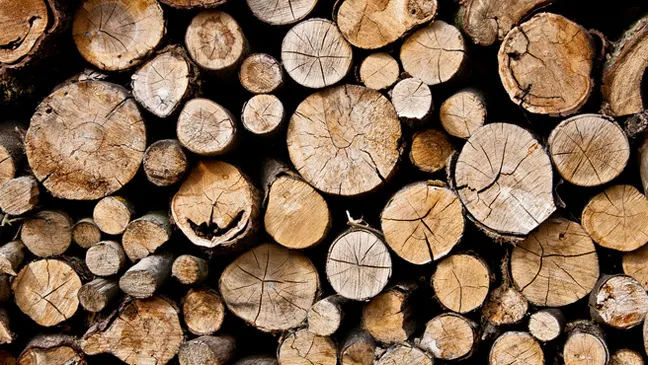
Wood consists of roots, a trunk, branches and leaves. The trunk represents the main mass of the tree and accounts for 50–90% of its volume; the roots and branches make up 10–50% of the mass of the tree.
Main parts of a trunk
A trunk contains the following main parts: pith, wood tissue, cambium and bark. Bark is the outer part of the tree and differs markedly from the wood tissue. Between the bark and the wood tissue is a thin ring, invisible to the naked eye, called the cambium. Through division, cambium cells produce wood-tissue cells towards the inside of the trunk and bark cells towards the outside each year. Because the cambium produces more wood-tissue cells than bark cells, there is much more wood tissue than bark.
The wood tissue is the most valuable part of the trunk; it lies between the pith and the bark. The pith lies at the centre of the trunk. It consists of soft, porous tissue with very weak mechanical properties. When boards, battens or beams contain pith, the material develops cracks over time. The presence of pith in the material is therefore not permitted for many more important elements.
Three principal sections of wood
A proper understanding of wood can be gained by viewing it in three sections: transverse, radial and tangential.
A transverse section is perpendicular to the axis of the trunk; a radial section runs along the trunk through the pith; and a tangential section runs along the trunk outside the pith (Fig. 1).

Fig. 1. Three principal sections of wood: 1 — tangential; 2 — radial; 3 — transverse.
Growth rings, earlywood and latewood
On a transverse section of the trunk, circles can be seen increasing from the centre towards the edge; these are called annual rings, or growth rings. Each annual ring consists of an inner and an outer layer. The inner layer is called earlywood and the outer layer latewood. Earlywood forms in spring, and latewood in summer. Earlywood is porous and consists of hollow tissue through which water passes with dissolved mineral substances needed to nourish the tree. Latewood consists of thick-walled cells that carry the mechanical properties.

Fig. 2. Medullary rays in transverse, radial and tangential sections: 1 — bark; 2 — bast; 3 — growth rings; 4 — pith; 5 and 6 — broad medullary rays.
In a radial section, the annual layers appear as straight longitudinal lines; in a tangential section, they appear as curved lines.
Medullary rays
In addition to the annual layers, medullary rays can be seen in transverse, radial and tangential sections (Fig. 2). In a transverse section they appear as narrow strips; in a tangential section, as dark lines with tapered ends. Medullary rays conduct water and air across the trunk and store reserve nutrients. Their number differs between wood species and amounts to approximately 3,000 per 1 cm² in pine and 143,000 in spruce. In coniferous species, medullary rays occupy 3–10%, and in deciduous trees 9–36%, of the volume of the wood mass.
Medullary rays consist of cells with low mechanical strength, which means that they increase the splitability of wood.
Pith flecks and classification of wood species
In some wood species, such as alder, birch, goat willow, field maple and service tree, white or brown spots can be seen in a transverse section. These spots arise when insects or frost damage the cambium and are called pith flecks. These pith flecks reduce the mechanical strength of the wood. All wood species can be divided into four groups:
- Heartwood species (oak, walnut, black locust, pine, cedar, larch, etc.);
- Species with mature wood tissue (beech, linden, spruce, fir, common Siberian and Caucasian fir, etc.);
- Species with heartwood and mature wood tissue (common ash, elm, etc.);
- Sapwood species (birch, aspen, black and white alder, hornbeam, maple, horse chestnut, field maple, etc.).
Heartwood, sapwood and tyloses
In heartwood species, the darker-coloured central part is called heartwood, while the light-coloured part is called sapwood. In species with mature wood tissue, the central part of the section contains less moisture than the outer part. In a growing tree, the sapwood conducts water and accumulates nutrients. In some wood species, double sapwood can be observed in a transverse section. This is nothing other than an initial stage of wood decay caused by particular wood-destroying fungi.
In terms of mechanical strength, sapwood does not differ from heartwood, but it has low resistance to decay. As the tree grows, the sapwood in heartwood species gradually becomes heartwood. During this transition, special growths called tyloses appear in the vessels of deciduous species and the tracheids of conifers, while the cavities and cell walls fill with cellular and extractive substances.
Tyloses fill the elements of the wood tissue, making it poorly permeable to liquids. The wood tissue is therefore used for making barrels, wooden tanks and similar products. At the same time, wood tissue containing tyloses is very difficult to impregnate with antiseptics. The same applies to beech wood with false heartwood formed because the tree was infected by wood-destroying fungi while growing.
Continue with the articles on wood moisture content and natural drying of wood. If you are planning new joinery, explore custom-made wooden windows or send a request for quotation.