Important Warning: This is a historical archive text, not a current machine specification, risk assessment or drilling and counterboring manual. Models, dimensions, speeds, formulas, tools, processing depths, guides and procedures must be checked according to applicable regulations, manufacturer’s documentation and safe work rules.
This text is not an offer of machines, tools or service documentation of Savo Kusić. The current offer is focused on windows, doors and related solutions.
Types of drilling and boring machines
Boring and countersinking machines are used to drill round holes, which go all the way through the material, or only partially, to make plugs and grooves in the elements that join and continue. Drills are divided: according to the position of the working spindles into vertical and horizontal; according to the number of spindles — single-spindle, three-spindle and multi-spindle; by type of travel — into drills with manual and mechanical travel. Boring machines are divided into chain drills and auger drills; by the number of spindles — single-spindle and multi-spindle; according to the type of movement — on machines with manual and mechanical movement. The working spindles with the drilling tool receive rotary motion from the shaft of the built-in electric motor. With single-spindle chain cutters, the chain cutter moves towards the element to be machined. With multi-spindle machines, the table with the elements to be processed moves towards the boring tool.
Drilling and boring machines with mechanical movement usually have at least two working speeds and one for idle speed. In the case of drilling and countersinking machines, the processing tool is a hollow drill that rotates and is fixed in a holder on the shaft of the electric motor. This construction of the drill makes it possible to make holes of smaller dimensions.
Technical characteristics
The table 1 gives the technical characteristics of the basic types of drilling and deepening machines.
| Indicators | Unit of measure | Horizontal drill SVG-3 | Chain milling machine DCA | Single spindle vertical drill SV-2M |
|---|---|---|---|---|
| Maximum drilling width | mm | 25 | 16 | 50 |
| Maximum drilling depth | mm | 100 | 175 | 120 |
| Material dimensions width thickness |
mm mm |
250 125 |
250 200 |
– – |
| Number of spindle revolutions | min | 3000 | 3000 | 3000 |
| Electric motor power to drive the cutting mechanisms | kW | 2,2 | 3,2 | 2,2 |
| Electromotor power to drive displacement mechanisms | kW | – | 0,52 | – |
In the practical work of woodworking companies in the construction industry, horizontal long-hole drills brand SVGD-3 (fig. 1) are widely used, on which round holes can be drilled and various grooves can be made. Drills for knots on elements for doors and windows (fig. 2), single-spindle chain milling machines with manual or mechanical movement (fig. 3) are also widely used. Holes with a width of 6 to 30 mm and a depth of 175 mm can be made on this machine. The machine table can move vertically and horizontally 225, respectively 400 mm. Holes can also be made at an angle. This is achieved by turning the table 30o on both sides. According to the width of the hole, the power of the motor can be 3,2 or 5,5 kW.
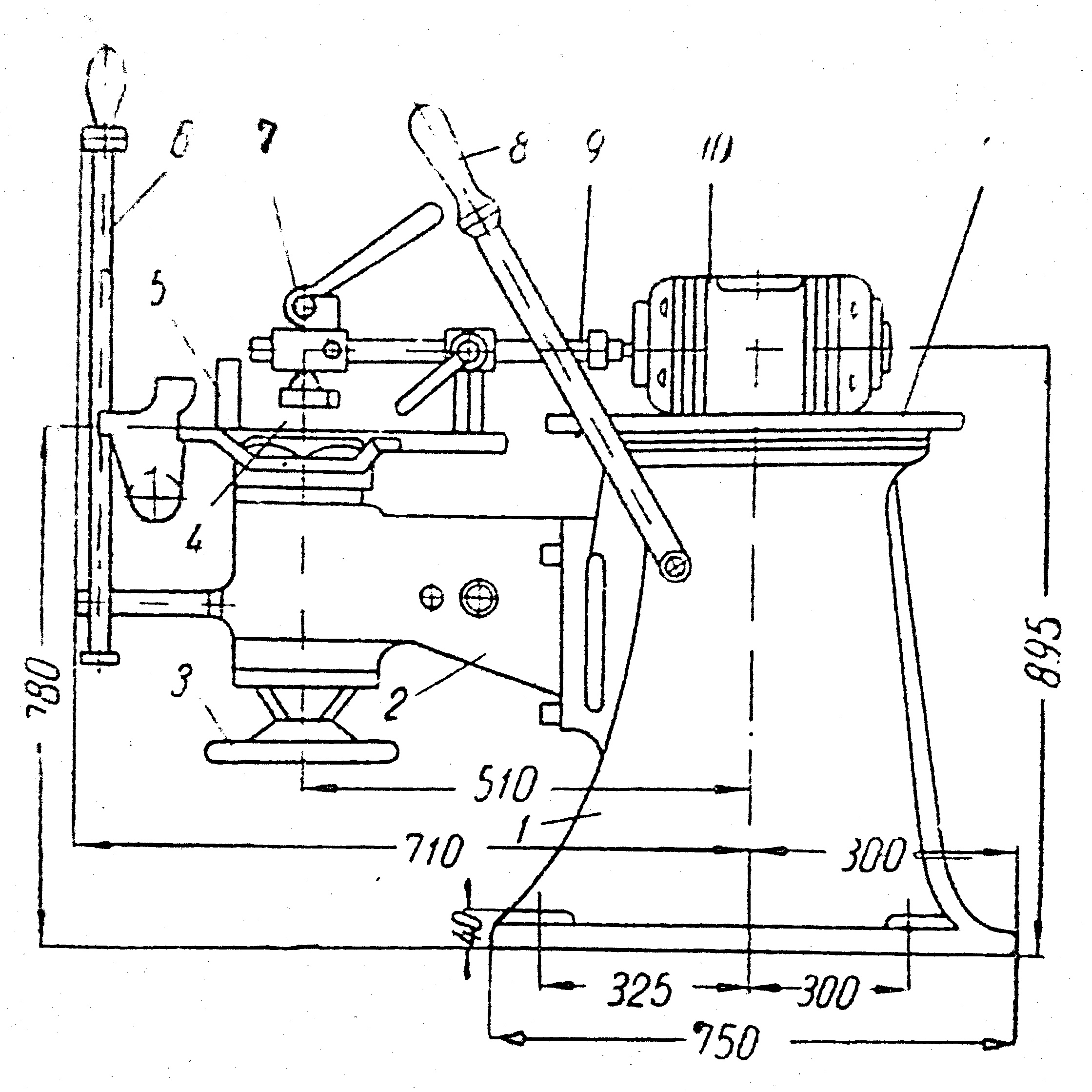
Image 1: Horizontal long hole drill
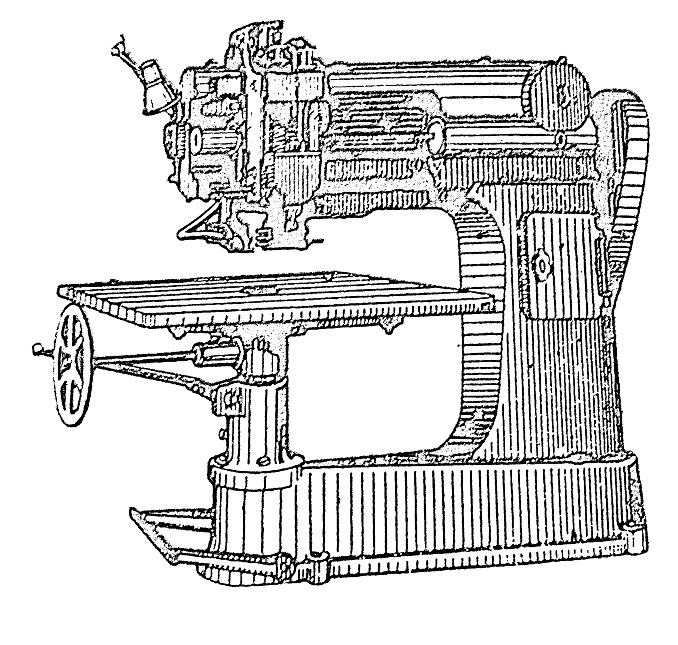
Image 2: SvSA knot drill
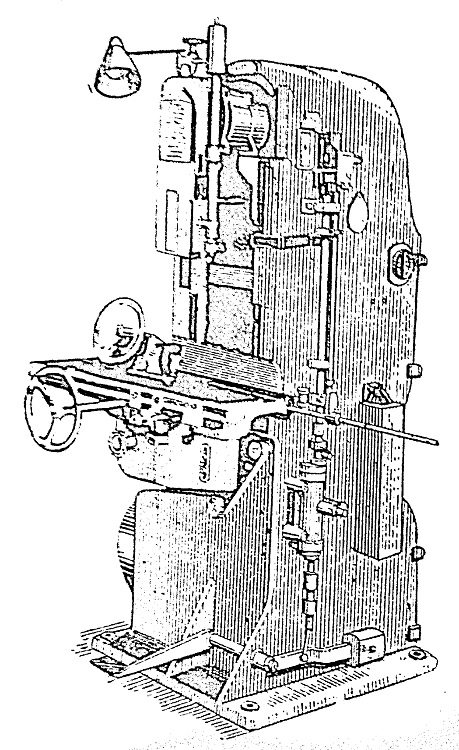
Image 3: Single spindle chain milling machine DCA - 2
Historical description of chain milling machine operation
The chain mirror should be brought closer to the element being processed gradually, without sudden pressure. The feed speed of the chain cutter should slow down as the drilling length increases.
When drilling long holes, the chain cutter is first indented at one end of the hole, then at the other and finally in the middle, after which the entire hole is machined. To maintain the drilling depth during work, a washer is used, which should be fixed in a special holder, which is on the machine. In one movement, the chain should not be indented more than 70 mm. The chain cutter should be no more than 5 - 6 mm from the guide.
The speed of movement of the chain cutter must be 2,5 - 10 m/sec. The speed of vertical movement, when the grinding depth is 60 mm, is 25 to 30 m/min. When the drilling depth is up to 100 mm, the speed for hardwood is 20 to 30 m/min, and when the depth is greater than 100 mm, the speed is 10 to 20 m/min. Horizontal feed rate is 50 to 70% of vertical feed rate.
Historical calculation of productivity
The average orientational productivity of the chain milling machine in pieces of processed holes can be determined according to the formula: Psm = 480 Kd Ks / Tmaš, where Psm is the productivity during one shift, piece; Tmaš- machine time required for drilling one hole, min; Ks - coefficient. utilization of the working day, amounts to 0,9; Kd - coefficient. of machine utilization, equal to 0,7 - 0,8.
The approximate productivity of a long-hole drill in the number of holes for one shift can be determined according to the formula: Psm = 480 60KdKs/Tmaš, where Psm - productivity during one shift, pcs. hole; Tmaš - machine time; Kd - coefficient. utilization of the working day, equal to 0,9; Ks - coefficient. of machine utilization, equal to 0,6 to 0,8.
Drilling and countersinking tools
Drilling tools for chain cutters are chain cutters (fig. 4) that are placed on guides equipped with tensioning devices.
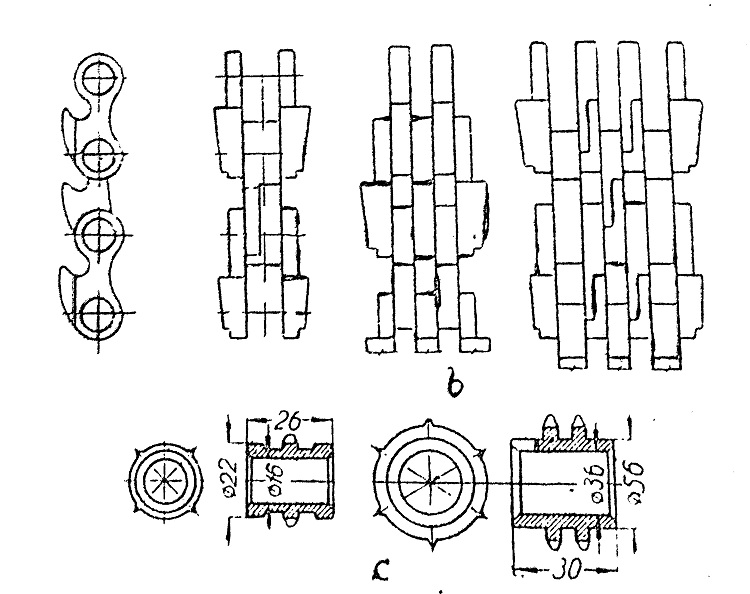
Image 4: Elements of chain cutters
Chain cutters consist of individual joints, joined by rivets. The pitch of a standard chain cutter is 11,3 mm. The dimensions of chain cutters are given in table 2.
Drilling tools and machines - fig. 5. As a rule, drill bits are made in specialized companies. The choice of one or another type of auger depends on what kind of work needs to be done. For example, spoon or spiral drill bits are used for making grooves, spiral, worm and snake drill bits are used for making deep holes; plug drills with cutters are used to make inserts and plugs for openings from dropped knots. Center drills are used to make shallower holes.
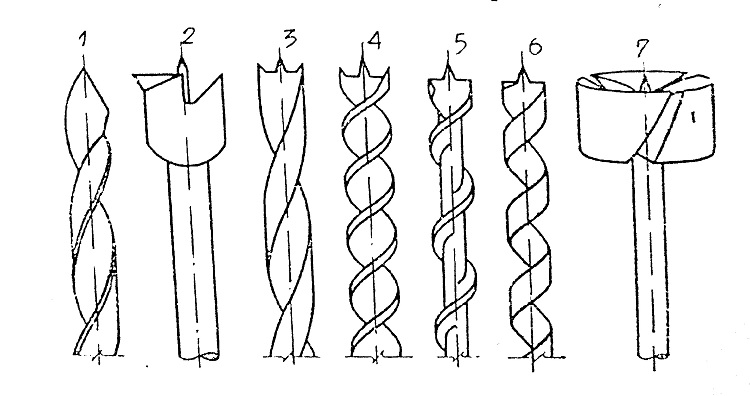
Image 5: Drill bits used in woodworking
| Chain width | 6,8 | 10 | 14,16 | 18 | 20 | 22 | 25 | 30 |
|---|---|---|---|---|---|---|---|---|
| Maximum hole depth | 60 | 125 | – | – | – | 150 | – | – |
| Width of guide and chain | 40 | – | 40,55 | – | – | 55 | – | – |