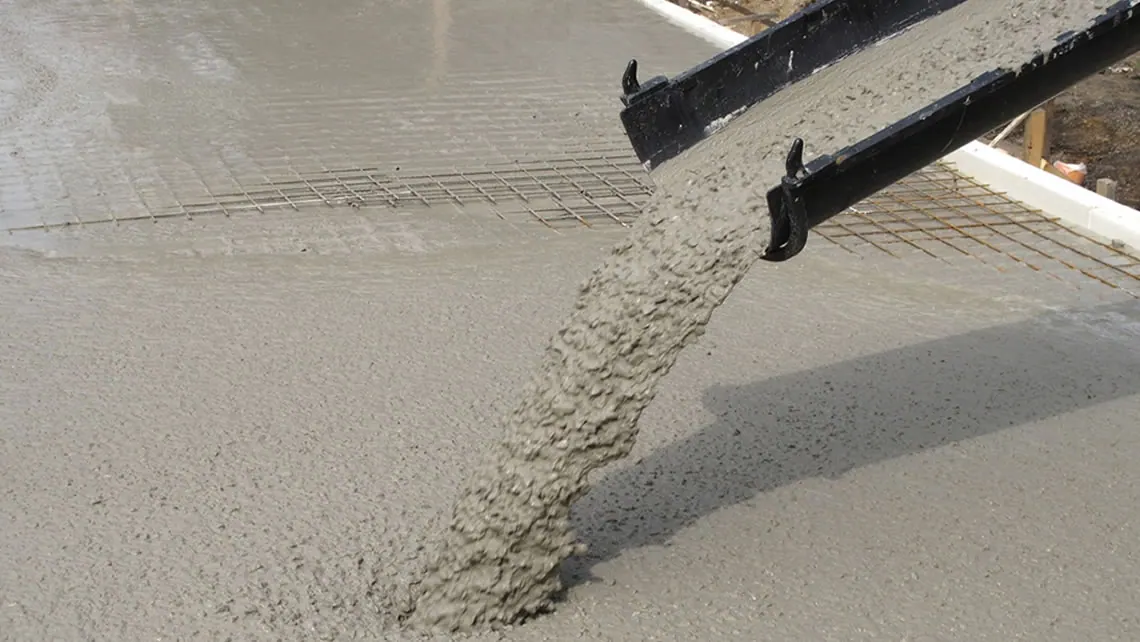
Concrete is a building material that is easy to work with, because it is very “obedient” and suitable for various household jobs and garden work. From concrete one can make a fence, a garden bench, a garden path, a terrace, etc., and it can also be painted.
Basics of concreting
Concrete is an artificial building material; it consists of three main parts: aggregate, cement, and water. The natural aggregates in use are river or quarry gravel, i.e. sandy gravel, and less often crushed stone or stone-like solid material.
Artificial aggregate materials are: boiler slag, blast-furnace slag, perlite and expanded clay. It is important that the aggregate materials have approximately the same grain size, which is ensured by sieving.
The binding material of concrete is cement. According to the strength classification (higher numbers indicate better quality), cement designated 300, 400 and 500 is used. For mixing, both municipal water and river and lake water may be used, but without chemicals harmful to cement (calcium, magnesium, sugar, sulfate mineral waters) and with a pH value not less than 6 and not greater than 8,5). If necessary, concrete may also be given additives to prevent freezing, to accelerate setting, for coloring, etc. The antifreeze agents are calcium chloride and the product called Tricosal S III. These are also setting accelerators. Both agents may be used only according to the given instructions, because they affect the final strength of the concrete and attack the reinforcing steel. A larger quantity of these agents can lead to chemical disintegration of the concrete. (The amount of calcium chloride may be at most 3% of the cement quantity in unreinforced concrete, and in reinforced concrete 1,5%). Setting is increased by the agent Tricosal Normal.
For coloring concrete, oxide or manganese pigments may be used, which are resistant to the chemical action of cement. There is absolutely no need to color the concrete through the full thickness of the layer. Only the outer, facing layer is colored.
The quantity of material for making concrete depends on the quality of the concrete. For concrete used as a base or as infill, quality B 70 is appropriate. For 1 m3 of concrete, 1,1-1,3 m3 of additional material, 150 kg cement 400 and about 130 liters of water are required. The quality of concrete for reinforced-concrete structures should be at least B 140. For this quality of concrete, 1,1-1,3 m3 of gravel, 210 kg cement and 120 liters of water are also required.
Before mixing concrete, the additional material should be sieved so that only material with the same grain size is added in one batch. To this material, still in the dry state, sieved cement without lumps should be added, and before adding water the mixture should be stirred at least three times with a shovel (it is best to mix it on a steel plate or boards): during the repeated two transfers of the gravel and cement mixture with a shovel, the required amount of water should be added from a low height using a watering can with a spray nozzle (so that the water does not wash out the cement). When mixing is finished, the moisture content of the concrete should be identical to that of the soil. (Attention! Apparently dry concrete also moistens on its own!).
Loose and wet ground, as well as impurities from the place where we want to use concrete, should be removed, and the surfaces that will come into contact with the concrete should be moistened. Concrete must not be lowered from a height or thrown. If it is placed in a form, it should be well compacted. For household work, the best is manual tamping. A concrete tamper can be made from a bar with a square or circular cross-section, weighing 10-17 kg, with a handle 1,2 m long. Tamping should be continuous and care should be taken that no parts remain untamped. Thicker concrete sections should be tamped at approximately every 20 cm. More plastic concretes, especially for reinforced-concrete structures, can also be compacted by driving an iron pointed rod of diameter 20–30 mm into the concrete until a viscous plaster-like layer forms on the surface.
The placed concrete should remain constantly moist for at least two days, and therefore it should be sprinkled with water from time to time or covered with a moist blanket. The concrete should be protected from weather conditions, shocks, strong sun, wind, and various chemical influences. All these influences are harmful to the curing process of concrete and, in this regard, also to the strength of the concrete.
Production of colored concrete
When making colored concrete, appropriate pigments and coloring materials are added to the concrete.

Of what - how much?
By adding pigments, the strength of concrete is reduced in any case, and therefore care must be taken and color should be added only in moderate amounts. The added pigment must in no case exceed 10% by weight of the cement. The resulting shade often depends on the amount of pigment added (for example, adding 6% iron-oxide yellow produces a strong yellow, while adding 2% produces a cream color). By mixing several shades, new variants can also be obtained. Thus, for example, adding 4% iron-oxide red and 4% iron-oxide yellow yields a strong red, brick color. Mixing iron-oxide yellow and chromium-oxide green shades will produce a very beautiful shade of green. If ultramarine is used instead of chromium-oxide green, the concrete will be turquoise blue. By adding a small amount of black, all shades are subdued to some extent.
The pigment added to concrete should have good hiding power and tinting power (so that a small amount of pigment produces a uniform tone). The best are organic and some synthetic pigments. A few quantity data: for one bag of cement, 1,5-4,5 kg of pigment is needed. By adding 1 kg of pigment to cement for a covering layer of thickness 1 black (e.g. for a sidewalk), colored concrete is obtained to cover about 1m2 of surface.
Most commonly used paints
Bauxite red is a ground pigment containing about 20% iron oxide. The resistance of this color to weather, light, and temperature is identical to that of iron minium, but it has lower tinting strength.
Cobalt blue is an artificial inorganic pigment containing cobalt oxide and aluminum oxide. A lighter shade of this color is cerulean blue, which contains tin oxide. Because of its low covering power and coloring effect, it should be added to concrete in larger quantities, which can cause cracks. It can be mixed into colors that are resistant to atmospheric influences, light and temperature, and that bind with cement.
Green chromium oxide is an artificial inorganic pigment. It is resistant to light, weathering, temperature, acids and bases. It can be used with cement binder and can be mixed with all pigments. It has excellent hiding and coloring power.
Manganese brown is an artificial inorganic pigment containing 20% manganese oxide. It is resistant to light and weathering and can be used with all binding agents, but when mixed with pigments containing sulfur, it will produce a black tone.
Manganese black is a ground natural inorganic material (earth pigment) containing iron and manganese oxides. It is resistant to lime and cement, to weak acids, to light, and to atmospheric influences. It has excellent covering power and also withstands temperature influences well.
Ochre yellow is a natural inorganic pigment. The tone of this color ranges from light yellow all the way to brown, and it is produced in many shades. It contains hydrated iron oxide (Fe203 - Н2О) and manganese. The iron oxide gives it a red tone, while the manganese gives it a brown tone. It is resistant to light and weathering, but poorly resistant to acids and temperature.
Emerald green (Guignet green) is a hydrate of chromium oxide. It is somewhat more fiery in tone than chromium oxide and has greater temperature resistance.
Spanish red is a natural inorganic pigment obtained by decomposition of hematite (red iron ore). It contains 80-90%% iron oxide. It has excellent covering and coloring power, is resistant to light, weathering and temperature, and can be mixed with all binders.
Ultramarine blue is an artificial inorganic pigment containing sodium and aluminum silicate with sulfur content. It is resistant to light and temperature, but not resistant to atmospheric influences, because flue gases in the air attack it. It cannot be mixed with pigments containing lead, copper, cobalt and iron. It can be mixed with materials that bind with water glass, lime or cement. On surfaces it sometimes causes stains. For coloring cement mortar, only pure ultramarine may be used.
Ultramarine green. Ultramarine blue in the first phase of the production process has a greenish tint and is also sold in this form. The properties of ultramarine green are approximately the same as those of the blue, but its tinting strength and lightfastness are lower.
Umber (velvet brown) is a natural inorganic pigment containing iron and manganese oxides. It is the only brown earth pigment. It is resistant to atmospheric influences and light and has medium temperature resistance. It can be mixed with all binding materials and pigments.
Iron minium (red iron oxide, iron pyrite) is a natural inorganic pigment containing 75% iron oxide (Fe203). It is an earth pigment, but it can also be obtained by roasting iron ore and clay. It is resistant to atmospheric influences, light, temperature and weak acids. It is often used and has excellent covering power.
Black iron oxide is an artificial inorganic substance containing ferrous - (ferric oxide) (Fe304). It is suitable for paints with cementitious binders, resistant to weather, light, temperature, and the effects of weak acids. It has a bluish-black color and good covering power.
Yellow iron oxide (Mars yellow, oxide ochre, etc.) is an artificial production of ochre earth pigments. Their properties are identical.

When making concrete, it is very important that the color be mixed in as thoroughly as possible and, even if it is applied only in the final layer, that it be placed immediately onto the base layer and compacted. It is also important to coat the formwork with paraffin oil so that it can be removed more easily. For making paving slabs, an excellent template can be made using several aluminum strips bent into an L shape, with a width of 10 cm, a thickness of 1-2 mm and a certain length, which can be nailed in the desired shape to a base board.
Attention should be paid to the fact that the color tone after drying is much lighter, so it is advisable to first make a sample of the tone.
Concrete fence

The decorative fence is made of concrete elements placed on a base of two rows of bricks and between brick pillars. The elements are made in molds. The base and frame of the mold are made of planed boards. Two diagonally opposite edges of the mold are fastened together wedge-wise, optionally with nails or screws; the third is fastened with hinged hinges, and in the fourth two screws with ring heads should be placed one below the other (fig. 1, 1 part). In the middle wooden block and in the lower part of the wooden inserts (4 pieces in the shape of the letter L) wooden dowels should be placed, and in the lower board panel appropriate holes should be drilled for assembling the dowels. When making concrete elements, first the wooden inserts should be placed in their positions, the mold closed, and secured with a pin (wooden dowel) placed in the ring head of the screws. Then the mold should be filled with concrete mixed from fine gravel and cement grade 300. If the concrete is half set, the mold should be disassembled, the inserts removed, and production of the next element continued.
If we have already made a sufficient number of concrete elements, we can begin building the fence. On a concrete base or, if possible, on a stone base, lay two courses of bricks and >>raise<< the posts.

FIGURE 1
Concrete elements should be set in cement mortar so that they bond better and are stronger. For greater fence strength, the concrete elements should be “tied” to the brick pillars. Above the row of elements, pieces of strong wire bent into a U-shape should be driven into the pillars, and then tied together with wire above the row of elements. This will ensure sufficient strength (fig. 1, 2. part).
When building, from the second course onward we must use a spirit level and plumb line, because unevenly built fencing gives a very poor aesthetic impression, poses a potential safety hazard, and has a shorter service life.
The joints between the elements should be filled with mortar of a contrasting color and carefully leveled. When the appropriate height has been reached, the tops of the elements and columns should be covered with concrete slabs. When placing the concrete slabs, we must not skimp on the cement mortar, because otherwise the slabs can easily fall.
A decorative concrete fence is durable and attractive. Of course, elements of other shapes can also be made if suitable molds are produced. The decorative effect of the fence can be enhanced with climbing plants.