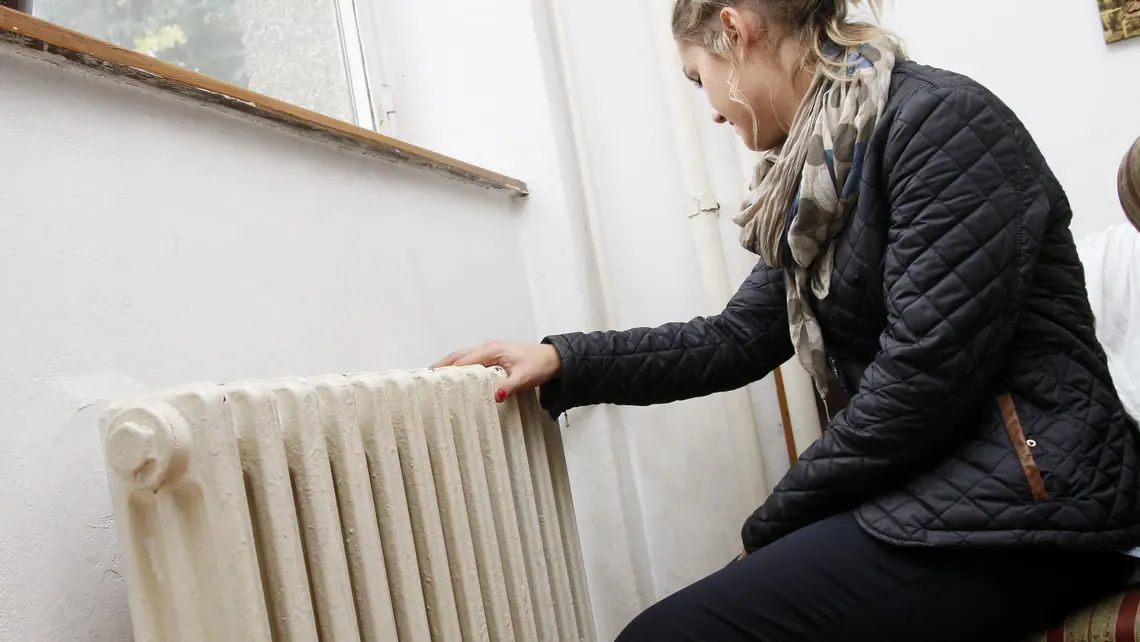
A complete apartment fit-out also includes providing heating. Central heating is the most modern and most economical solution. If the apartment has such heating, all that remains is maintenance of the piping network and heating units. And one more thing - protection of the walls above radiators from black stains caused by burned dust.

To calculate heating demand, it is not enough to know the calorific value of the fuel, because that calculation also depends on many other factors, such as the direction of the winds, the insulating capacity of the walls, etc. The calculation is complicated (and does not give the most accurate result), so the table provides indicative data on the heat required. It should also be known that when using solid fuels, heat losses amount to 20–50%, and when using electricity, liquid fuels and gas 10 20%.
Based on the given data, the required amounts of heat for heating rooms of different areas and positions can also be estimated.
Gas Heating
Although gas heating is modern and inexpensive, there are nevertheless numerous dangers in handling gas appliances and their installation. Of course, this is only the case if these dangers are not sufficiently recognized or are treated carelessly. It is well known that the number of injuries is not highest on roads and in factories, but precisely in households. Among these accidents, most arise from improper use of gas and gas appliances. The “do-it-yourself” rule for gas is not only undesirable, but in most cases strictly prohibited! However, this prohibition does not mean that the house handyman should not concern himself with this “taboo” at all. On the contrary, it is even desirable that he be familiar with this field as well, where a certain level of expertise is required. In this way he will more easily assess the existing dangers and be able to decide how far he may repair and maintain the gas installation on his own.
Although the destructive effect of gas far exceeds that of electric current by many times, gas is not as insidious, because its danger is more easily and quickly noticed. Today three types of gas are in use: gas from the city network, called town gas or illuminating gas; gas extracted from the ground and delivered to consumers through pipelines, natural gas; and finally propane-butane, which is transported in steel cylinders and abbreviated as РВ–gas
The main characteristics of these gases are given in the following table:
Gas Relative specific gravity of air Calorific value
(0 - 1) kilocalorie/m3
City gas 0,64 3600 - 4000
Natural gas 0,62 9000 - 9900
RW - gas 1,89 27000 - 29300
The most important thing is to follow the following instructions: if we smell gas, it is STRICTLY FORBIDDEN to switch on electric lights, light a fire, enter the room wearing shoes with cleats, plug in or unplug a plug, switch on a fan! Steel cylinders of PB gas must not be used or stored in rooms below ground level or next to doors and windows, because the gas cannot later be removed even by ventilation, since it is heavier than air. If there is a suspicion that gas has leaked somewhere, take off your shoes and enter the room, carefully and slowly open the doors and windows.
Piping connections, the rubber hose and the LPG-gas connections, as well as the functionality of the valves, should be checked systematically. None of these parts may leak gas. Checking for leaks with a flame is LIFE-THREATENING and therefore PROHIBITED! The check can be carried out by coating the suspicious parts with strongly soapy water. If bubbles form, that is a sure sign that the part is leaking gas.
It is especially important that our gas stove be kept clean at all times. Burned-on dirt, besides spoiling the stove’s appearance, also affects gas combustion and can even cause the flame to go out and cracks in the supply line. The most important part of the gas stove is the burner or “tube.” The tube is, in fact, a Bunsen burner that works by passing gas through a small nozzle, although the gas pressure is only slightly higher than the surrounding air pressure. Because of the small cross-section of the nozzle, the gas enters the mixer at high speed, which has several holes on the side. Due to the high velocity of gas flow, surrounding air is drawn in, the so-called primary air. (fig. 1, left side).

FIGURE 1
Through the openings in the burner head, therefore, a mixture of gas and air is already flowing, and here it again draws in (now secondary) air from the surroundings. As a result of this double mixing, a soot-free Bunsen flame is formed. The flame burns with a bluish color, giving off almost no light, and its core is distinctly green. If there is a lot of air in the mixture, combustion is unstable, there is soot, and the flame color is yellowish. If there is a lot of gas in the mixture and the flow rate is high, the gas will exit into free space faster than it can burn and will separate from the burner head, causing the flame to go out. This is a very dangerous situation, because even though the flame has gone out, gas continues to escape. But no less dangerous is the situation when, due to too low a flow rate, flashback occurs into the mixer and burns there with crackling and minor explosions (fig. 1, right side). The reason for an excessively high gas flow rate may be an enlarged jet or increased pressure, and for too low a flow rate - a clogged jet or reduced pressure. Pressure is regulated by means of a reducing valve, and this job should be entrusted to a specialist. Replacement of an enlarged jet can also be carried out only by a specialist. A clogged jet can and may be cleaned by probing it with a soft (copper) wire. Care must be taken not to enlarge the jet opening, whose diameter is only a few hundredths of a millimeter. There are two jets in the burner. The upper jet is used for normal operation, and the lower one for a reduced flame. The gas supply from the pipe to the jet is carried out through a conical valve (fig. 2, upper part).
At the lower part of the tube there is a screw for adjusting the flame. It allows us to adjust to a certain extent the distance between the burner and the lower part of the utensil, but attention should be paid to the fact that changing the position of the tube also changes the mutual position between the valve body and the tube, which has a significant effect on the injection-suction effect of the mixer. By lifting the combustion grid, the tube can easily be moved upward and removed. Clogged parts of the tube, the grid and the cover can be cleaned of soot and burnt food residues with a stiff brush. After cleaning, the parts should be thoroughly washed with detergent and returned to their place only after complete drying (fig. 2, center).
In winter, kitchen heating can be solved by the stove flame. This is only apparently favorable and economical. Namely, the combustion of one cubic meter of gas produces 600 grams of water in the room in the form of water vapor. This water settles on the furniture, drips over it and dirties it, and is harmful to health. In addition, the air in the room will be quickly used up, and consequently so will the oxygen. A lack of oxygen can cause headaches and mild poisoning to a lesser extent. but it often happens that the reduced oxygen content is not sufficient for combustion, so the flame goes out, while the gas continues to escape.

FIGURE 2
In such cases, the persons in the room are exposed to the danger of poisoning. If no one is in the room, the entire building may explode when someone enters and switches on the electric light. For this reason, when leaving the apartment, special attention should be paid to making sure that the gas supply is shut off without fail. It should be mentioned that so-called pure-gas burners are used for larger gas appliances. Unlike Bunsen burners, they do not have primary mixing with air, and therefore the flame color in them is yellowish.
Convection heating
Gas is often used for heating. Unfortunately, infrared heating units are very problematic, which is why we recommend them less, while we recommend convective heating. (Convection – circulation of warm air). The advantage of this gas stove is that the air needed for combustion and the products of combustion are drawn in from outside, and the burnt gases are discharged out of the room. Therefore, the stove does not require a chimney, but it does require one free wall of the room that is in contact with the air outside, because the convector can only be installed on such a wall.
The heat generated in a gas convector is transferred to the surrounding air by means of the furnace casing mechanism, and the air, under the influence of heat, circulates. The best place for a convector is below a window, because cold air enters the room there, and the heating effect is greatest at that point. The direct heat effect of the convector by radiation is relatively small.
The combustion chamber of a gas convector is completely enclosed (which means that it is independent of the room air), the combustion air required is taken from outside, and the combustion products also leave through a double pipe into the open air. Backflow is impossible, because the flue gases exit and the air enters under the same pressure, i.e. the process takes place in a space of the same pressure. In this way, a good draft with the heat of the combustion products is ensured in advance (fig. 2, bottom right).
The gas convector valve can be regulated and the unit is equipped with the so-called gas shortage safety device, butterfly burner and ignition flame safeguard. The upper part of the gas convector casing usually has an opening. The convector’s efficiency is very favorable and amounts to about 80 - 85%, which is why it can also be used for heating larger rooms (30-40 m2). Several convectors can be installed in one room if needed. In block or panel elements of buildings in new housing developments, openings for the convector are already made during the manufacture of these elements. This also indicates that convector heating is modern heating.
A prerequisite for installing a convector is the appropriate building permit, and installation may be carried out only by a company or craftsman qualified for this purpose.
We should also note that gas heating consumes the room’s oxygen excessively. If proper ventilation is not provided, the flame will go out due to lack of oxygen, and the poisonous gas will continue to enter the room. (On newer appliances, control valves are already installed which shut off the gas supply if the flame goes out).
It is certain that heating by electricity provides the greatest comfort, but it is also the most expensive. Electric heating appliances of 220 V and 0,5 to 10 kW may be used only in strict compliance with regulations. Installation (assembly) and maintenance of these devices are exclusively the work of specialists. In addition to the fact that modern heating methods are being applied more and more, the conventional method of heating with stoves is still the one most widely used in households. This also includes oil-fired stoves, because they differ from coal stoves only in that they are fired less often and in a different way.
For economical heating, it is necessary to know the calorific value of individual fuels, the required amount of air for combustion, as well as the space needed to store the fuel. Our following table provides data on these values. From an analysis of these data, one may also conclude that “expensive fuel is cheaper.”
