Wood was probably, alongside stone, the first material from which people made tools and implements for themselves. The first implement of prehistoric people could have been nothing other than a club, stake, branch or thorn, whose trace disappeared over the centuries.
Wood did not have an advantage over other materials only in the past; it still holds first place today as the most widely used material. However, as a tool — especially after the emergence of plastics — it has been displaced, because many “wooden” tools, such as tool handles, plane bodies and so on, are now made from plastics. Today wood is mainly used as a material, ranging from roof structures to the skeletons of model aircraft and from partition walls to wooden figures.
Recognising and using wood
At first glance, finding one’s way among wood materials seems very easy. However, this is not so: recognising, classifying, using and processing wood requires a certain amount of specialist knowledge.
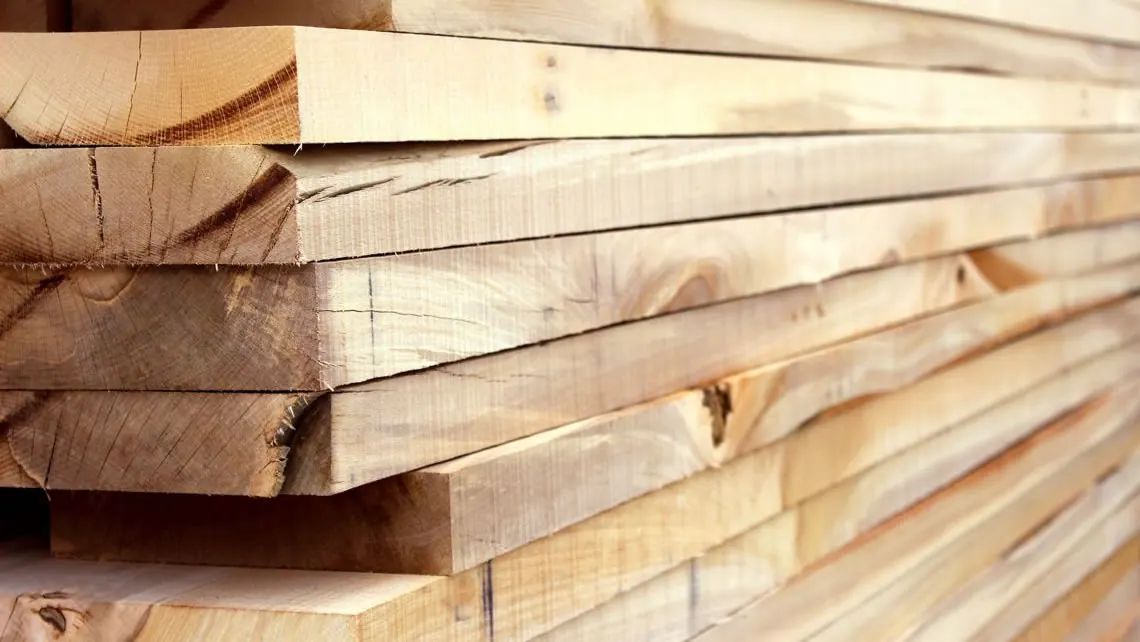
In do-it-yourself work, a person encounters wood as sawn timber, that is, a semi-finished product. Such materials include battens, beams, boards, planks and panels. All these materials can be made from softwood or hardwood. The difference between these materials is considerable, both in processing and in durability.
Softwood
Softwood is recognised by its larger fibres, visibly weak structure and easy compressibility. Fir is almost the most commonly used softwood. Fir wood is light and can be shaped well. In and around the house, it is used to make doors, windows, frames and so on. Older people used to say that softwood accompanies us throughout life, from the making of a cradle to a coffin.
Hardwood
Hardwood is fuller, more solid and heavier. One cubic decimetre of hornbeam weighs 830 g, while the same volume of softwood weighs only 450 g. Hardwood fibres are densely arranged and show fine lines. Hardwood is more difficult to split and produces fewer splinters. A broom handle, handles of various tools and parquet are good examples for demonstrating the properties of hardwood. Evergreen trees with needle-like leaves are softwood, while among deciduous trees birch, poplar, willow and linden are considered soft.
Wood moisture, drying and deformation
Only dry wood with less than 13% moisture is suitable for processing. Wood contains moisture not only when it is processed immediately after felling — it is often jokingly said that “a blackbird recently sang on this wood” — but also when it had the opportunity to absorb moisture during storage.
It is known that wood is hygroscopic, but water that is absorbed quickly evaporates slowly from it. After cutting, softwood must be left for at least two years, and hardwood for four, in order to dry sufficiently for processing. Naturally, this is the case when drying is performed in open conditions, that is, naturally. Modern computer systems and condensation kilns now control the wood-drying process, and the time required for quality drying of wood has been reduced many times over.
When water evaporates from wet wood — especially when it is alternately dried and moistened several times — the wood deforms considerably; it “works”. This is understandable when it is borne in mind that the moisture absorbed by wood can amount to as much as 130% of the dry matter of the wood.
Deformation depends to a large extent on the position, viewed in the cross-section of the tree, from which the timber was cut. So that the understanding of deformation is not left incomplete because of certain terms, let us first become acquainted with the names of the parts that make up the structure of wood, using Figure 1.

Figure 1: Structure of wood
Figure 2 shows how boards and beams cut from individual parts of the trunk deform. The most important property of wood is this: the volume of wet wood decreases as a result of drying. Therefore, when making wooden objects, the elements should be fitted well and cut to slightly larger rather than smaller dimensions.
One obvious example: a householder pours water into a wooden trough that has dried out so that the wood swells and the trough stops leaking. The board absorbs water and swells so much that the cracks “close” and the trough no longer leaks.

Figure 2: Wood deformation during drying
Fibres, knots and strength
A characteristic property of wood is that it is stronger in the direction of the grain, but splits easily, while perpendicular to the grain it breaks easily. Strength changes greatly depending on the density and uniformity of the fibre distribution. Denser fibres provide greater strength, while strength decreases where fibres are loose and unevenly distributed.
Sawn timber is cut lengthwise in the direction of the grain, except when the trunk was curved or branched. The places where branches grew are marked by knots, while twisting and curvature are marked by the fibres.
Forms of sawn timber
If sawn timber is much wider than its thickness, it is called a board up to a thickness of 40 mm, and a plank above that thickness. If the timber has a square, regular polygonal or rectangular cross-section, up to dimensions of 10 × 10 it is called a batten, and above those dimensions a beam. If the cross-section has a more complex shape, such as prepared material for picture frames, it is called a profiled batten.
Timber that has not been sawn along the sides has at least one unfinished side and, as such, cannot be fitted tightly side by side. Planed timber, however, is planed after cutting and therefore has smooth surfaces without splinters.
Veneer, plywood and wood panels
Veneers, plywood and newer blockboards and faced panels are very widespread in practice.
Veneer
Plywood is often incorrectly called veneer. Veneer is usually produced by peeling large trunks that rotate, approximately as wound fabric is unrolled. Sawn veneer is obtained by cutting sheet after sheet along the trunk, while knife-peeled veneer is obtained by cutting sheets with a knife across the length of the trunk. Sheet thickness varies between 0.6 and 1.2 mm.
Veneer without damage or knots and with an attractive texture is face veneer, while less attractive veneer, possibly damaged, joined or glued, is backing veneer. The outer, visible surface of most furniture is covered with face veneer, while the other type of veneer is used, for example, for the backs of furniture.
Plywood
Plywood panels are made by gluing several dry veneer sheets on top of one another. If the directions of the grain are perpendicular or diagonal to one another, the strength and weight exceed the strength and weight of a board of the same thickness several times over. Panel thickness according to the number of layers is 3–5 mm for three-ply, 6–8 mm for five-ply and 9–12 mm for six-ply panels.
Veneer and plywood are made only from hardwood and are therefore heavier than boards of a similar thickness. Their weight is also increased by the glue.
Blockboards and faced panels
Blockboards are made from softwood battens glued between two veneer or plywood sheets. This increases the thickness, produces a hard and attractive surface, and gives them a weight and strength slightly greater than softwood boards of the same thickness. Blockboards have found wide use in the furniture industry.
Faced panels are wood panels — plywood, blockboards, particleboard, hard fibreboard and so on — covered with plastic sheets. One or both sides are smooth, glossy and coloured as desired, for example with the appearance of a wood panel. They are not exactly inexpensive, but have found wide use because of their strength, appearance and easy-to-clean surfaces.
Hard fibreboard and hollow panels
Hard fibreboards — fibreboards — are made from crushed hemp fibres or softwood shavings mixed with synthetic resin, which are heat-treated and then pressed into panels under high pressure. Their specific gravity is high and, with hard panels, can reach as much as 150% of the specific gravity of water. These panels are also often called artificial panels.
This group also includes hollow panels made from a lattice structure of softwood battens covered with panels. Since they cannot be cut, only certain elements, such as doors, are made from these panels.
Wood for windows and doors
If you want to turn knowledge about wood into the right choice of joinery, see our wooden windows, made-to-measure doors and send the dimensions through the contact page.