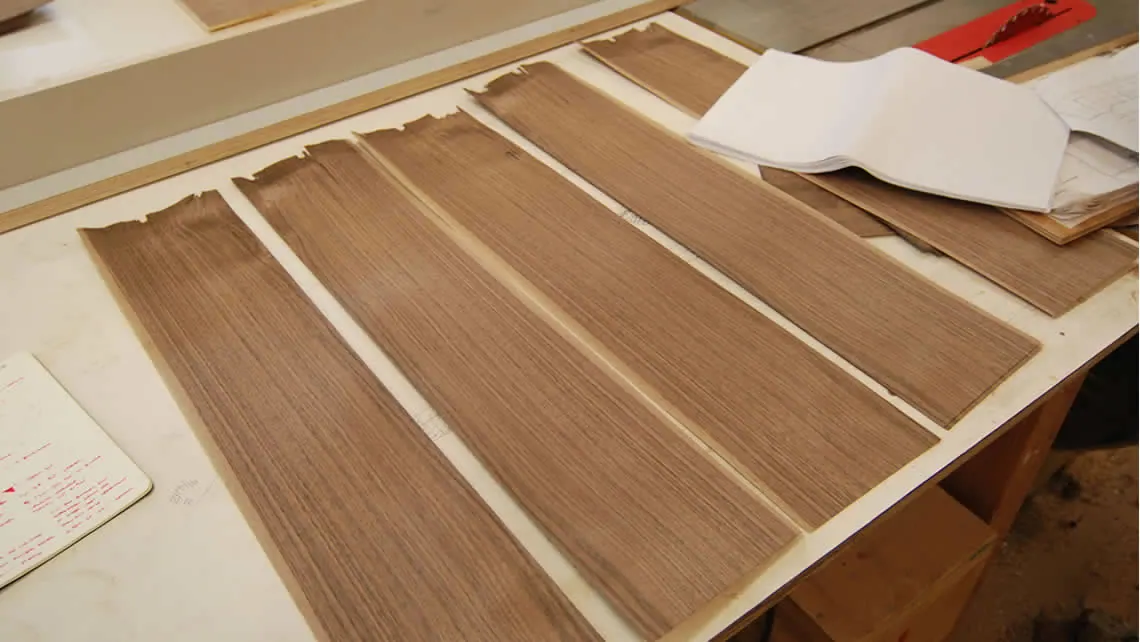
Repairing veneered surfaces
Veneered furniture boards, although not as fragile as glass, are nevertheless easily damaged, swollen, warped or even broken off.
When they swell, the veneer bubble should be cut with a sharp knife, glue should then be injected into the opening, and the area should be covered with a sheet of paper and pressed with a warm iron. If the bulge is sufficiently soaked with glue, the bubble will flatten. If this method does not flatten the bubble, it should be cut around so that it can be lifted, and the excess part should finally be cut off.
Wrinkled strips can be repaired in a similar way. After gluing, for which fish glue is also suitable, the excess glue should be “ironed” out from beneath the strip with the edge of a hammer so that the bond becomes stronger (Figure 1).
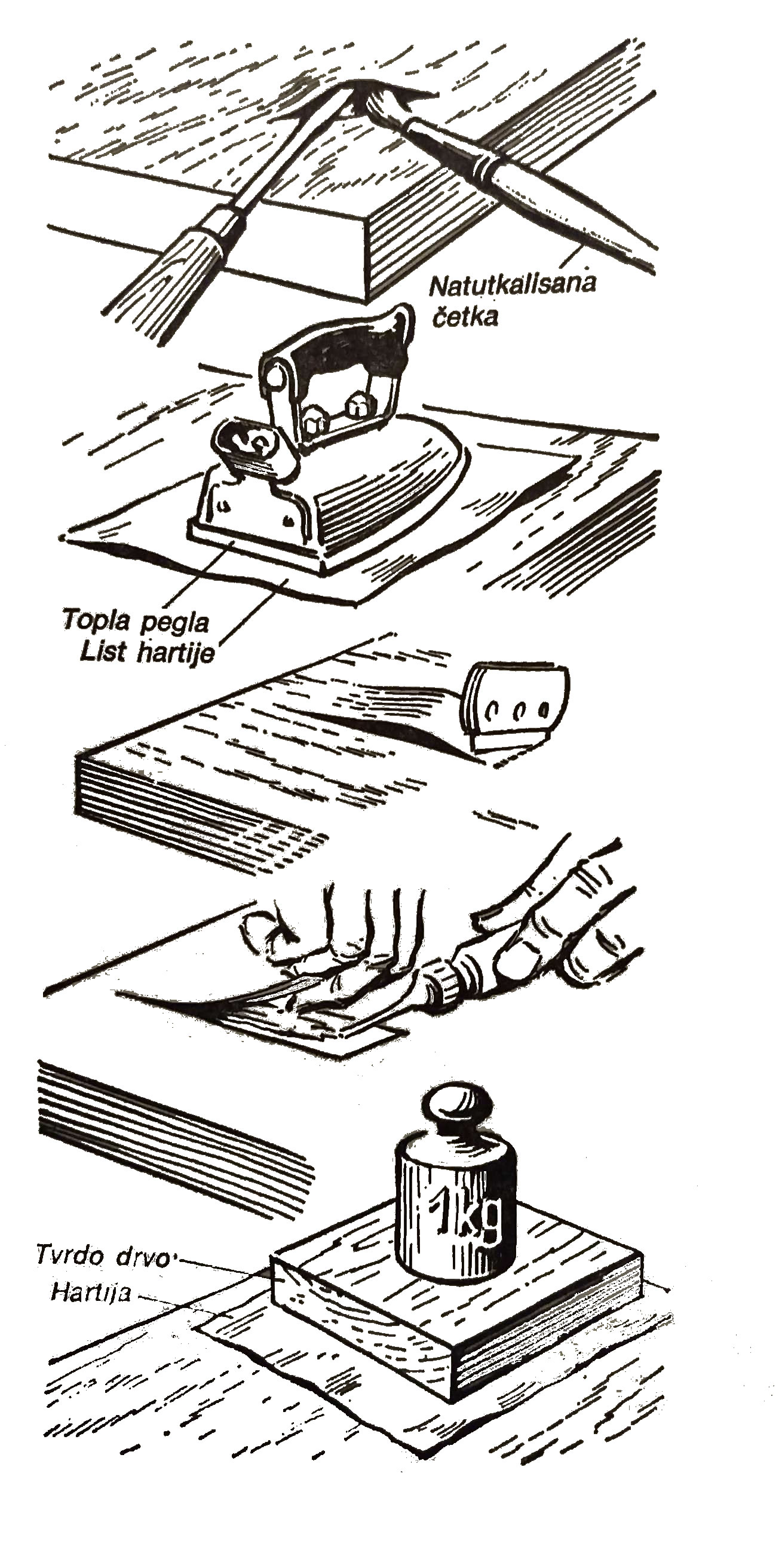
Figure 1 — Procedures for gluing and flattening damaged veneer.
If you believe that you cannot do this yourself, we suggest professional assistance. Learn more about our veneering service.
Wobbly chairs
Chair legs often cause problems. If a chair merely rocks, the damaged leg should be packed underneath. If the joint has come loose, the chair leg should be carefully removed from its socket, and the cylindrical tenon and the opening in the seat should be sanded thoroughly and cleaned of old glue. The freshly glued tenon should then be returned to its place after a glued insert made from a thin veneer sheet has first been placed on both sides of the opening. This reduces the diameter of the opening and makes the joint stronger. The joint will be even stronger if a wood screw is driven from the side, perpendicular to the tenon.
If the chair leg has broken and part of the tenon remains in the seat, it should be removed with a chisel and the remaining part of the tenon should be cut from the end of the leg. Clamp the damaged chair leg in a vice and drill a hole in the damaged end with the same diameter as the old tenon. Then make a new tenon from hardwood, with its ends slightly flattened so that air can escape from the space in front of it when it is driven in. The joint will be stronger if a wood screw is driven opposite the tenon, acting as a wedge and slightly expanding it.
On chairs made of bentwood, the legs are held by a ring. The screw holes used to fasten the ring often widen so much that further tightening becomes impossible. The repair can be carried out by driving glued dowels into the holes left by the removed screws, drilling new places for the screws and finally driving the screws back in.
Loose backrests and joints
The backrests of armchairs and chairs often become loose. A backrest is best repaired by drilling an opening from its upper side and driving a flat-head screw or a hardwood dowel into that point. This operation also damages the surface of the backrest, but the damage can be made “invisible” in several ways. The repaired area is best covered with enamel or oil paint, taking care that its shade matches the backrest. The depression can also be filled with putty, and the patch that is level with the backrest surface should then be concealed by painting.
End-grain tongue joints, especially those under greater load, do not last long if the glue is old. Such joints should be glued again and tightened with a clamp. If, after drying, one or two holes are drilled through the joint and glued dowels are driven into them, the joint will be stronger than “when it was new”.
Something to repair can easily be found in the kitchen as well, for example a loose or broken cross-brace on a kitchen stool. To carry out the repair, first spread the legs to remove the old piece and clean the ends and tenons of dried glue. Place a glued insert made from a thin veneer sheet on both sides of the openings in the legs, and drive glued tenons into these reduced-diameter openings. Before driving in the tenons, file their edges so that the veneer insert is not damaged.
Repairing cabinets
We have bought a new cabinet and enriched our home. But why are its doors so difficult to open? Have they already broken? No: an old problem has appeared. The cabinet legs are not at the same level, so the furniture has deformed almost imperceptibly. To correct the problem, place a wedge made of carefully sanded hardwood beneath the leg on the side where the door touches the cabinet bottom. The wedge will lift the entire cabinet frame and the door will close properly again.
The heavier the cabinet doors, the greater the load on the hinges. It is therefore understandable that the fastening screws become loose after a short time. Remove these loose screws, enlarge the holes with a drill and drive one glued wooden dowel into each hole. Once the glue has dried, drill holes again in the same places, but make their diameter one third smaller than the screw diameter. The screws can then be returned to their places and should remain trouble-free for a long time.
If a cabinet drawer cannot be closed fully, the drawer runner is probably worn. The repair is slightly complicated but not difficult. Mark the worn section with a pencil and work it with a chisel to the maximum depth of wear. Make the missing piece from hardwood, glue it into place and sand it so that it is level with the drawer runner. Any necessary screws may be driven into the added piece only from below, because otherwise the screw head will interfere with the free movement of the drawer.
Shelf support strips also come loose very easily, particularly when they are fastened with only a few nails. It is therefore advisable to attach an added piece to both ends of the strip with a tongue joint. Screws driven into the vertical pieces secure the support strips much more firmly than ordinary nails.
An old, warped clothes rail in a cabinet often needs to be replaced. Replace it by removing one rail support. The load-bearing capacity of the rail can be increased by fitting a small hook at its centre and attaching it to an eye screw placed in the upper part of the cabinet. A broken rail can be repaired by sliding a strong metal tube over the break and driving several wood screws through the wall of the metal tube.
The ball-shaped holders of U-shaped handles on old furniture quickly become loose in the lock fitting. Secure them by removing the lock fitting, flattening the connection opening of the ball holder with a hammer and returning the holder to its place. The end of the handle can then be placed in the ball holder and the quadrangular end of the ball riveted. If the ball holder still falls out of the lock fitting after riveting, the entire handle must be replaced.
Pieces of veneer often fall from old furniture, and only in more fortunate cases are those pieces not lost. If they are lost, they can be replaced with new pieces of the same thickness. As marquetry makers do, place and press a sheet of paper against the damaged area so that the contours of the missing part remain on it. Cut out this paper shape, place it on a veneer sheet of the appropriate thickness, saw out the required piece, sand its edges, coat it with glue and set it in place. Once all this has been done, only polishing remains.
Related topics: veneer, wood screws, wood-joining techniques and veneering service.