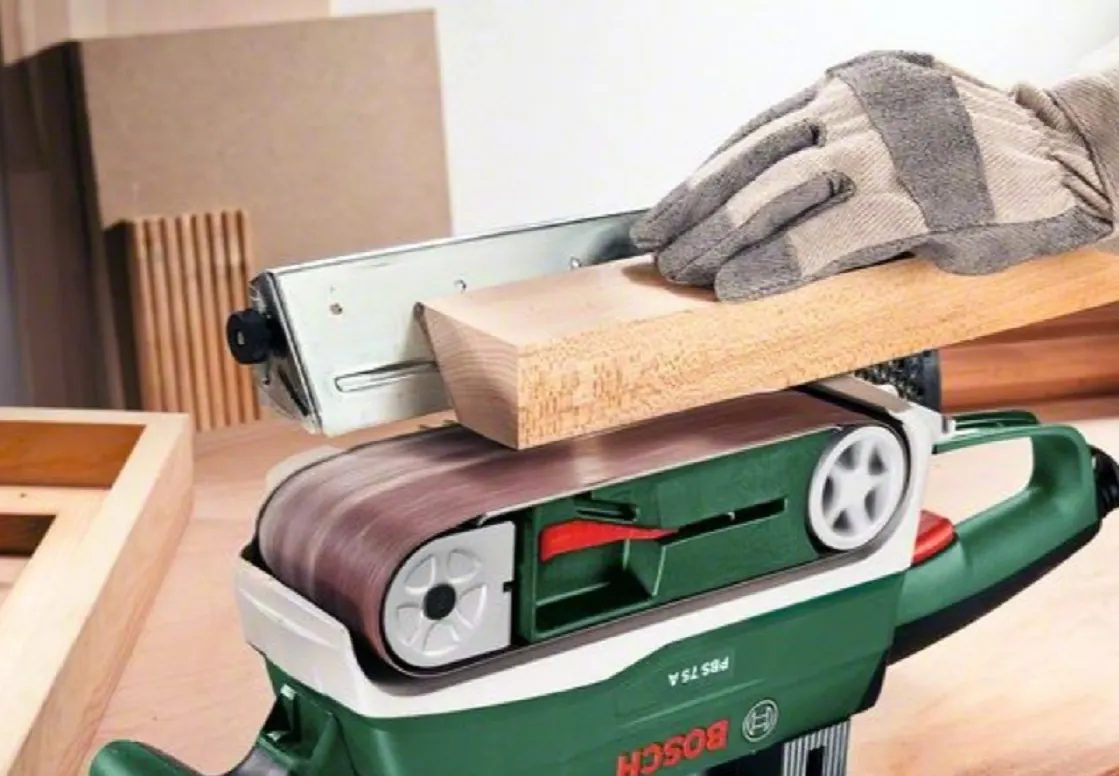
Grinding machines are used to process flat surfaces and details with curves — panels, frames, veneers and similar elements — in order to obtain the required smoothness.
They are divided into belt, disc, combined, cylindrical and profile grinding machines.
Belt grinders
Belt grinders are used for flat, round and curved elements and small products. They are divided into horizontal, vertical and profile grinding machines.
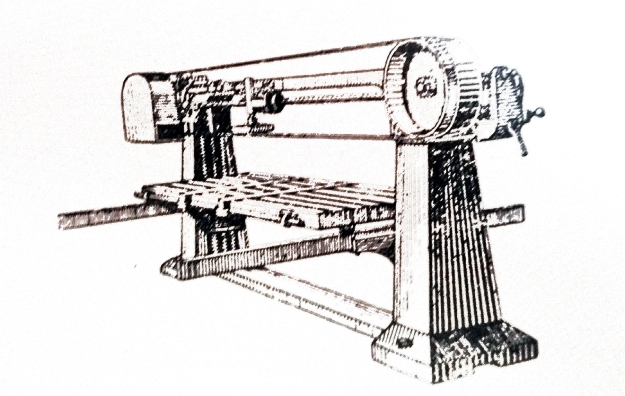
Picture 1: Ironing machine with a movable table brand Š1 PS.
Horizontal grinders are divided into machines with a stationary and a movable horizontal table. Grinders with a stationary table are used for grinding small elements, and grinders with a movable table for larger elements, panels, doors, fillings, veneer and more.
Vertical belt grinders are used for grinding the corners of elements, crates, round elements and more.
Profile grinders are used for grinding small elements with curved surfaces. This type of grinder is not widely used in the construction industry.
In the text, the belt sander with a movable table of the brand Š1 PS is mentioned as the most commonly used (picture 1). Elements, plates and flat products with a length of 1.900 mm, a width of 800 mm and a thickness of 500 mm can be ground on it.
| Technical characteristic Š1 PS | The value |
|---|---|
| Sanding belt width | 150 mm |
| Dimensions of the mobile table | 800 × 2.000 mm |
| Table stroke length | 1.300 mm |
| Vertical stroke of the table | 500 mm |
| Electric motor power | 3,4 kW |
| Number of revolutions of the electric motor | 1.500 rpm |
| Machine weight | 1.050 kg |
Disc and combined grinders
Disc grinders can be equipped with two vertically placed grinding plates or with one horizontally placed grinding plate.

Picture 2: Combined plate-roller grinder brand Š1 DB.
Disc sander with one plate is used for angular sanding and for sanding small products with small surfaces. Disc grinders with two plates are used less.
Combined sanders and profile sanders are used for sanding flat, profiled and elements with curved surfaces. One type of combined grinders is the Š1 DB plate-roller type (picture 2), which consists of a vertical plate and a roller.
A sanding cloth is pulled onto the machine plate and the cylinder (bobbin). The plate and the roller are fixed on the shafts of the electric motor. By means of a special eccentric mechanism, the roller moves parallel to the shaft, back and forth, with an amplitude of 0 to 40 mm. At the vertical plate, a table is placed for elements or small products that need to be sanded; the table can also be placed at an angle to the sanding plate.
| Technical characteristic Š1 DB | The value |
|---|---|
| Plate diameter | 800 mm |
| Diameter of roller | 90 mm |
| Working length of the roller | 210 mm |
| Total length | 240 mm |
| Number of oscillations of the roller | 140 per minute |
| Tilt angle of the table at the plate | 15° up and 45° down |
| Tilt angle of the table at the roller | 15° up and 30° down |
| The strength of the electric motor of the roller | 1,6 kW at 3.000 rpm |
| The strength of the plate’s electric motor | 2,8 kW at 750 rpm |
| Machine weight | 900 kg |
Profile and cylindrical grinders
Profile grinders are used for grinding profiled elements. They consist of a spindle with a working head on which inserts with sanding cloth are fixed around the perimeter. During operation, the inserts elastically adhere the sanding cloth to the profile of the element.
Cylindrical grinders are divided into single-cylinder, two-cylinder, three-cylinder and six-cylinder, with manual and mechanical displacement. Manual movement is performed on single-cylinder grinders, which are most often used for elements with curved surfaces, such as arched profiles.
Multi-cylinder grinders with mechanical displacement are used for grinding boards, veneers and frames. The movement can be done by means of a roller or a rubber conveyor belt. Displacement using a roller is applied when sanding veneers, and displacement by a conveyor belt when sanding panels, doors and frames.
The cylinders of sanding machines are steel tubes with accessories for balancing and tensioning the sanding cloth. They can be whole or cut. The sanding cloth is wound on the entire cylinder in a spiral and fixed on the front of the cylinder with a special tightening tool. On cut cylinders, the sanding cloth is clamped in the slot along the cylinder’s bearing.
Whole cylinders are suitable for tightening the sanding cloth and are easier to balance. They can be located above or below the element being ground, with the upper position being cited as more favorable. In addition to rotary motion, the cylinders also move parallel to their axis, about 100 double strokes per minute at a stroke of 10 mm. The cylinder can be started by a transmission belt or built-in electric motors.
Sanders with only the upper or only the lower position of the cylinder require the elements to be passed twice during double-sided sanding. Six-cylinder grinders with upper and lower cylinder positions grind both sides of the element in one pass.

Figure 3: Kinematic diagram of three-cylinder grinding machine Š1 ZC.
The text mentions a three-cylinder grinding machine with a belt feed Š1 ZC (picture 3), intended for mass grinding of flat elements of frames and plates with a width of up to 1.300 mm and a minimum length of 200 mm.
| Technical characteristic Š1 ZC | The value |
|---|---|
| Displacement mechanism, four degrees | 4, 6, 8 and 12 m/min |
| Cylinder diameter | 280 mm |
| Number of revolutions of the cylinder | 1.500 rpm |
| Number of axial oscillations of the cylinder | about 100 per minute |
| Number of electric motors | 6 |
| Power | 27,8 kW |
| Machine weight | 6.500 kg |
Abrasive cloth and grain sizes
An abrasive cloth is used as an abrasive, which consists of paper or cotton cloth on which sharp grains of hard material are glued. Grinding cloths with grains of glass, flint, quartz, corundum and electrocorundum are listed. According to the coarseness of the grain, sanding cloths are classified into numbers.
The original table lists the numbers of the sanding cloth that was once produced in the USSR:
| Sanding cloth numbers | Grain sizes in diameter, mm | Sanding cloth numbers | Grain sizes in diameter, mm | Sanding cloth numbers | Grain size in diameter |
|---|---|---|---|---|---|
| 12 | 1,68 | 80 | 0,177 | 325 | 0,030 |
| 16 | 1,19 | 100 | 0,149 | M-28 | 0,028 |
| 20 | 0,84 | 120 | 0,126 | M-20 | 0,020 |
| 24 | 0,71 | 140 | 0,105 | M-14 | 0,014 |
| 36 | 0,50 | 170 | 0,088 | M-10 | 0,010 |
| 46 | 0,35 | 200 | 0,074 | ||
| 60 | 0,25 | 280 | 0,063 |
According to the material with which the grains are attached to the substrate, sanding cloths are made for dry and wet sanding. The binding material used for dry sanding is felt, and synthetic adhesives for wet sanding. Sanding cloths with water-resistant synthetic adhesives are used for sanding nitrocellulose varnishes with paste or other sanding materials.
Operating modes of grinding machines
| Mode Indicators | Unit of measure | Machines | ||||
|---|---|---|---|---|---|---|
| Saucer | Tracks | Tracks with tensioning device | Single cylinder | Three-cylinder with mechanical displacement | ||
| Grinding speed | m/sec | 15-20 | 12-20 | 12-20 | 15-23 | 23,5 |
| Specific pressure | kg/cm2 | 0,6-0,7 | 0,3-0,5 | 0,6 | 0,4 | 0,4 |
| Feed rate | m/min | – | – | – | – | 4-12 |