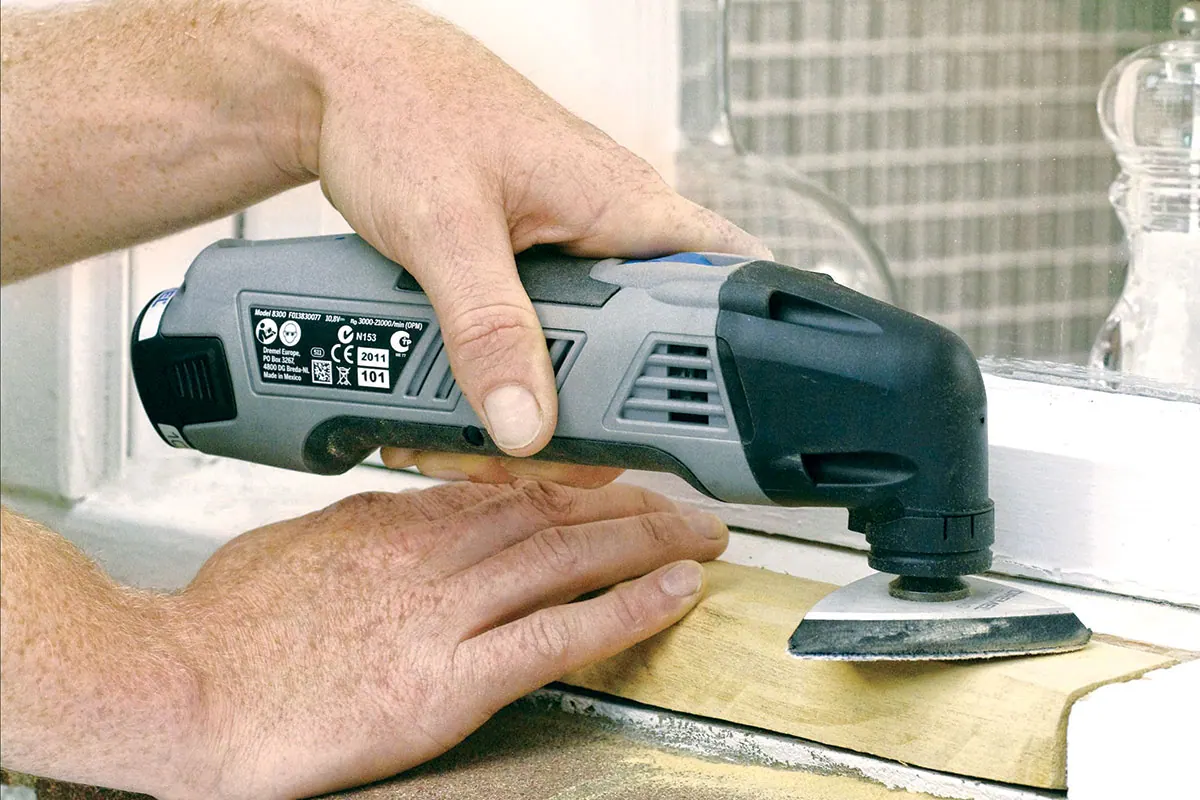
The quality of paint and lacquer coatings depends on the preparation of the wood surface. Before finishing, the moisture content should be checked, an appropriate level of surface cleanliness achieved, irregularities filled and dust removed.
Wood moisture before finishing
Wood intended for painting must be dried to a moisture content of 10–12%, while wood intended for lacquering and polishing is dried to 8%.
Paint and lacquer coatings adhere poorly to wood surfaces with high moisture content, from 20 to 30%, and deteriorate quickly. The reason is that, during drying, wood dimensions decrease in the radial and tangential directions, whereas they increase when the wood becomes moist.
If the dimensions of the wood change within wider limits, the elasticity of the paint or lacquer film becomes insufficient. As the wood dries, the coating wrinkles and flakes; as the wood becomes moist, it separates from the wood or tears in several places.
Planing, sanding and surface-cleanliness classes
The surface is prepared according to the type of finish:
On narrower screens, swipe the table horizontally to see all columns.
| Finish | Planing | Sanding | Surface-cleanliness class |
|---|---|---|---|
| Opaque coatings | Wavelength 4–2.5 mm | Abrasive paper 120 | VI or VII |
| Lacquering | Wavelength up to 2 mm | Abrasive paper 120–140 | VIII or IX |
| Polishing with shellac polish | Wavelength up to 1 mm, followed by a scraper — cycling machine | Abrasive paper 140–170 | X |
Wood to be coated with painting materials that form an opaque film is first processed on planing machines and then sanded to the stated surface-cleanliness class.
Filling irregularities
Before painting, all surface irregularities, including knots, scratches and cuts, should be levelled and filled.
Holes left by fallen knots should be plugged so that the grain direction of the plug matches the grain direction of the element.
Moistening and final sanding
Before polishing and lacquering, the wood surface should be lightly moistened with water. After 2–3 hours of drying, the surface is smoothed with abrasive paper 170–200 placed over a softwood backing block measuring 100 × 100 mm.
Sanding must be carried out along the wood grain with even movements. After sanding, the product or element should be rubbed with a piece of soft cloth and the dust removed with a brush.
Priming and puttying
Before paints and lacquers that form opaque coatings are applied, the wood is primed with an oil-based or another primer. If required, local puttying or puttying of the entire surface is then carried out.
The primer should:
- close the pores;
- bond the coating to the wood;
- improve the adhesion of the coating.
The colour of the primer and the putty should match the colour in which the product will be painted.
When lacquering and polishing, priming is carried out with special transparent primers or with diluted lacquers and polishes that will also be used for finishing. For example, for high-quality finishing with shellac polish, the wood surface is primed with a 10% shellac polish.