Floors are important because they provide not only functionality and protection, but also an aesthetic and comfortable aspect of the living space. The most straightforward classification of floors into types is obtained if the method of floor construction and the types and shapes of the materials used for their making are considered at the same time. In this way the following classification is obtained: stone floors (cobblestones), screeds (coverings), ceramic tile floors, small-tile floors, large-tile floors, wooden floors and cork floors, strip coverings, and floors made of artificial materials applied with a trowel.
Requirements for floors regarding durability and moisture protection
The minimum requirements in terms of compressive strength, flexural tensile strength, and resistance to wear are specified for hard concrete floor toppings in DIN 1100. These values may generally be regarded as the requirements that heavily loaded floors in industrial buildings should meet. DIN 272 sets out minimum values for stone wood (xylolith), which may also apply to lightly loaded floors in industrial buildings, as well as to floors in residential and office buildings.
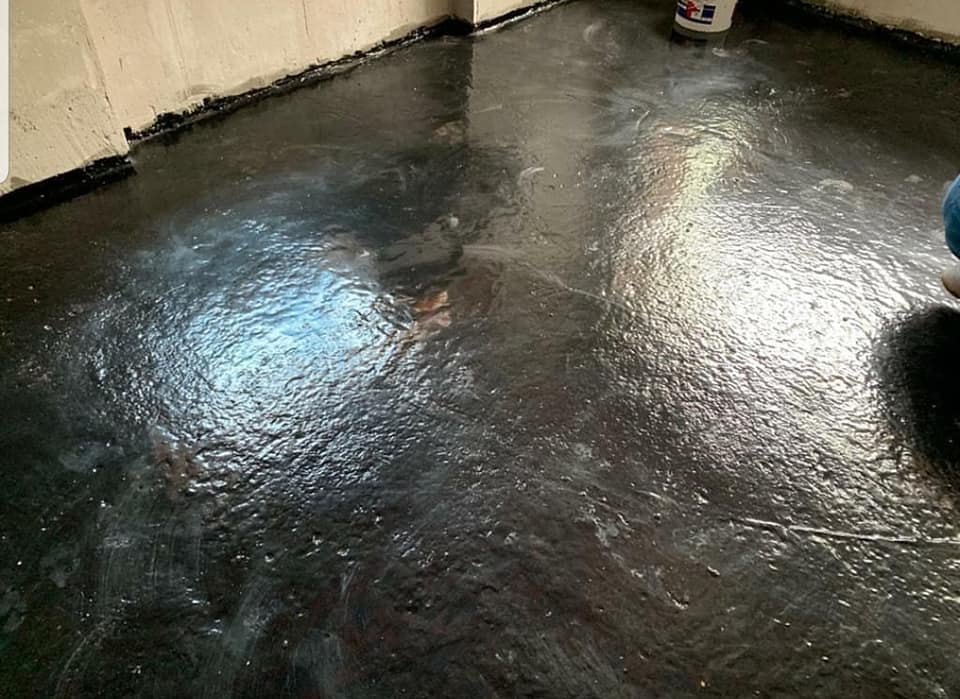 Fig. 1 - Floor waterproofing
Requirements for floors in terms of thermal and sound insulation
Thermal insulation does not depend solely on the floor, but on the entire floor structure system. What matters, however, is the degree to which the floor can draw heat away from the people standing or moving on it. Likewise, as regards sound insulation, the entire floor structure system is of decisive importance. In this respect the floor has a much greater influence – especially if it is made in the form of a floating screed or a floating wooden floor.

Fig. 2 - Sound insulation of the floor
Requirements for fire protection of floors
For floors in the vicinity of fireplaces, as well as for floors under steep roofs and often also in workshops and workshop halls, it must be required that they be designed as fire barriers or as fire-resistant. Further details in DIN 4102.
Requirements for the electrical resistance of floors
The danger to the human body from touching live conductors is relatively high even within the low-voltage range up to 250 volts. The danger increases if the floor on which a person is standing has greater conductivity. According to the regulations of the German Electrotechnical Association (VDE), any floor with resistance lower than 7730 ohms is dangerous. This applies especially to damp and wet floors.
Claddings (jackets)
The most important types of surfacing include: terrazzo floors, concrete surfacing, clay surfacing, mosaic floors, gypsum surfacing, xylolite floors, loam surfacing, and asphalt surfacing.
- Terrazzo floors: Terrazzo floors are durable, impervious to water, and do not produce dust. DIN 1965 Technical regulations for the execution of floor finishes and ceramic work provide more detailed information both on the granulometric composition of the terrazzo aggregate and on the method of execution.
- Concrete coatings: DIN 1965 contains more detailed information on ordinary concrete (formerly cement) coatings, and DIN 1100 on hard concrete coatings. Recently, coatings made of lightweight concrete have also been produced – as well as those made of lightweight porous aggregates and foamed concrete – which serve in particular as substrates for coatings of synthetic materials applied with a trowel.
- Clay linings: They are made from crushed bricks with a lime, cement, or magnesite binding agent. They extract heat less effectively than concrete linings.
- Mosaic floors: Mosaic floors represent the most beautiful and most elegant type of cladding, for which marble, pieces of fired clay, opaque glass or ceramic are used. Because this type of floor requires the manufacturer to have a great deal of artistic sensibility, very few workshops are engaged in its production.
- Gypsum linings: Gypsum linings are fire-resistant. Their method of production is described in DIN 1965. They are made mostly from strongly burned gypsum for linings, either as single-layer over sand, or as double-layer dry linings. Natural anhydrite is also used for gypsum linings.
- Stone wood floors: The properties and method of making stone wood floors (xylolite) are standardized by DIN 272. They are divided into single-layer industrial or tamped floors, two-layer stone wood floors for residential and commercial spaces, as well as single-layer substrates for parquet, strip coverings, etc.
- Clay linings: More detailed information on clay linings - especially for granaries, agricultural warehouses, etc. - is contained in DIN 1965.
- Asphalt finishes: Cast asphalt finishes are used both for making the direct upper wearing layer of the floor and for making underlays for parquet, for strip finishes, finishes of artificial materials applied with a trowel, etc. They do not create dust, do not let water through, are flexible, and above all can be walked on immediately after installation.

Fig. 3 - Wooden mosaic
Ceramic floors
Ceramic floors are made of ceramic tiles. They are practically of unlimited durability, easy to keep clean and do not create dust. For further details see DIN 1965.
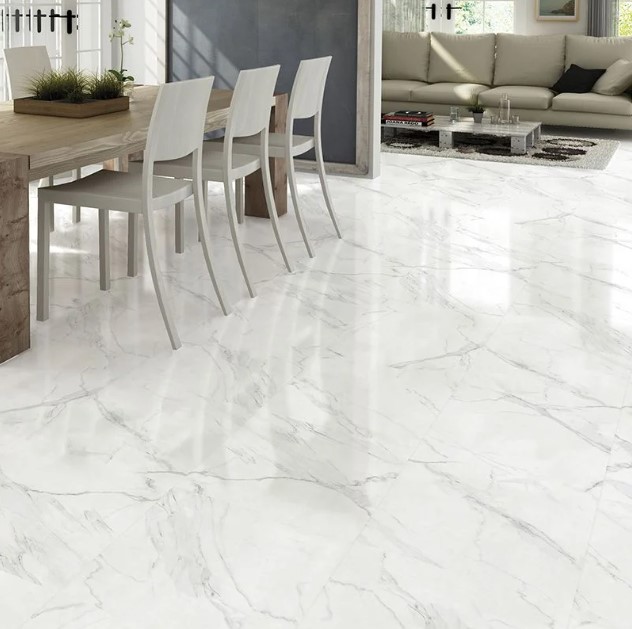
Fig. 4 - Ceramic tiles as an imitation of marble
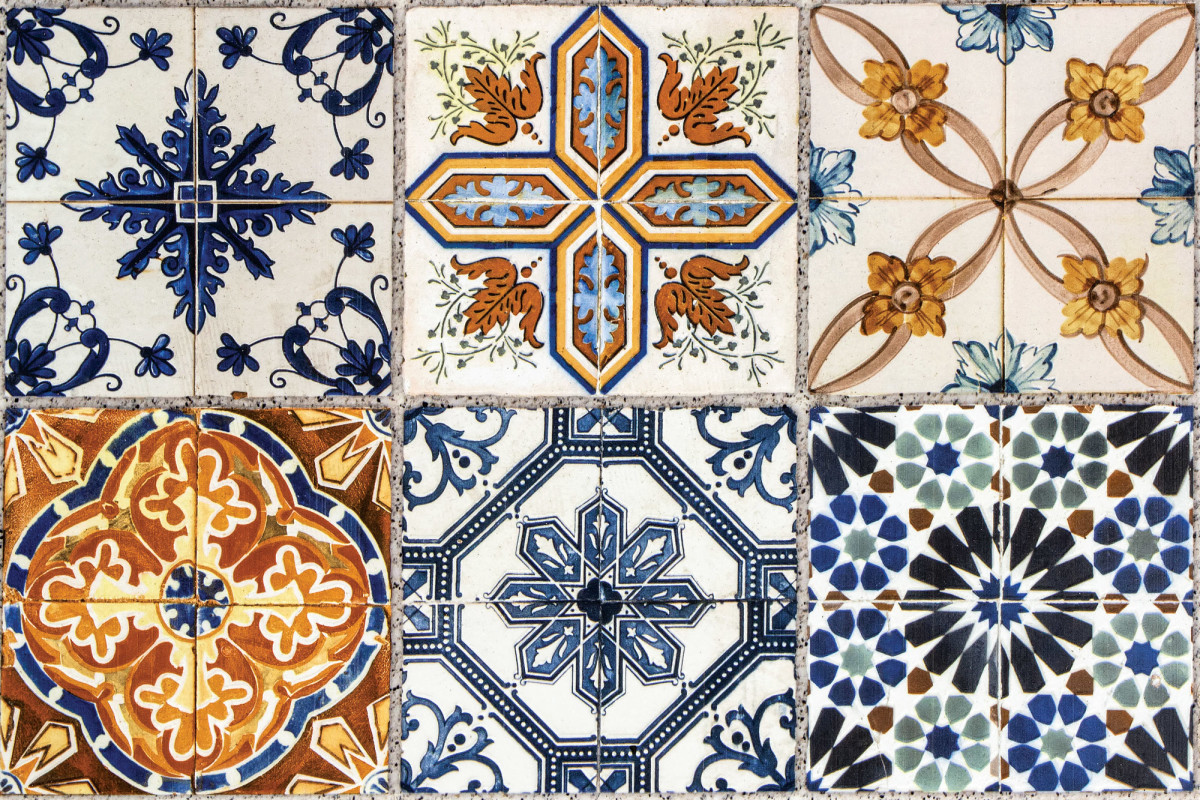
Fig. 5 - Various designs of ceramic tiles
Small-tile floors
Small-tile floors (with an area of about 0,25 m2) are made of tiles of natural stone, concrete, clinker, glass, steel, stone wood, and asphalt and are laid mostly in cement mortar. Tiles made of artificial materials (of synthetic resin, bitumen, and asbestos) are installed by bonding. In terms of their properties, they correspond to coverings made from the same raw materials and the same materials.
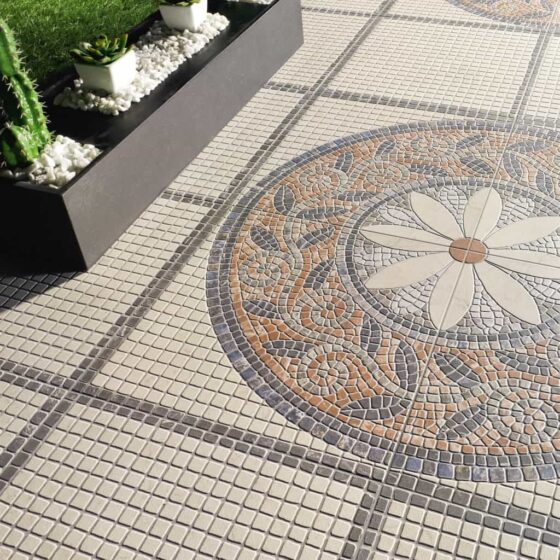
Fig. 6 - Mosaic of small tiles
Floors made of large slabs
For large-panel floors – in addition to corrugated sheets of steel and light metals – the main option is hard wood-fiber boards, which are mostly glued during installation with cold adhesives. They have properties similar to sheet coverings and are used for the same purposes.
Wood and cork flooring
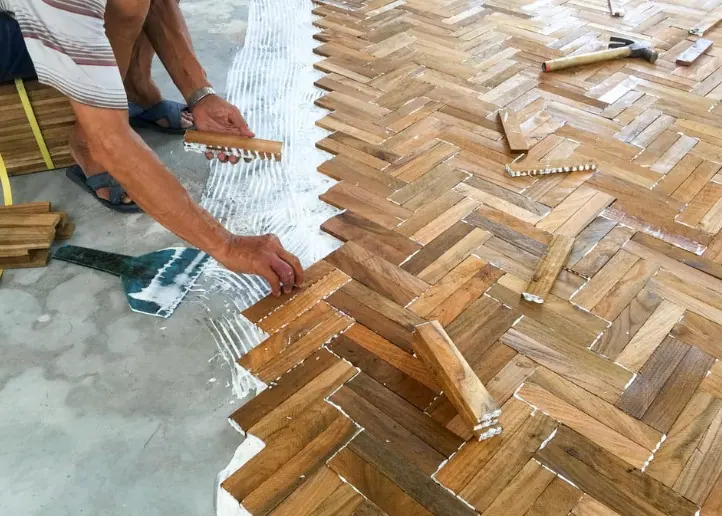
The wooden floor is among the oldest and – apart from carpet coverings and cork floors – is the warmest floor for the feet. These include plank floors made of floorboards, strip parquet and panel parquet, floors of parquet blocks and mosaic parquet.
Properly installed parquet floors generally also provide good insulation against impact noise. Floors made of parquet strips and mosaic are newer types of parquet. For easier maintenance, parquet has recently been sealed with synthetic resins. Cork floors are very warm underfoot, sound-insulating and impermeable to water. Special adhesives are used for bonding.
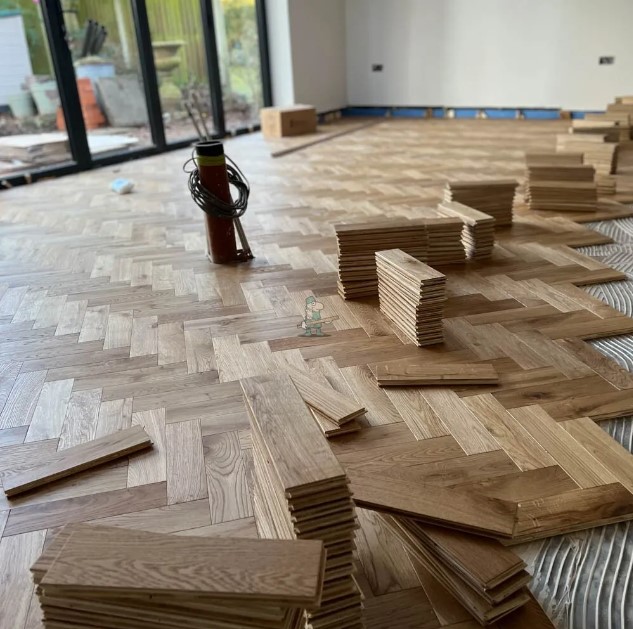
Fig. 7 - Laying parquet
Strip flooring
The following are considered the most important linings in strips:
- Floors of printed wool-felt boards (balatum and stragula)
- Floors made of tensioned fabrics, similar to carpets
- Linoleum floors
- Rubber floors
- Floors made of textile-like synthetic materials (igelit)
- Floors made of boards and strips of polyvinyl chloride (gutasin and mipolan)
While the first two coverings mentioned are simply spread out and tightened only along the edges, all the others made from strip materials are produced by gluing strips together. These coverings are distinguished by the small number of their components and—except for the carpet-like ones—by the fact that they are dust-free, easy to wash, and more or less elastic.

Fig. 8 - Linoleum covering as a laminate imitation
Floors of synthetic materials applied with a trowel
Masses made of artificial materials applied with a trowel are mixtures of synthetic resins (mostly polyvinyl acetates) and added substances. Coatings are made on smooth and even substrates in at least three layers applied with a trowel. After 28 days of air drying, their thickness should be at least 2 mm. Layers thinner than 2 mm are no longer considered coatings, but coverings or paints.