Important scholarly note: This is an archival author’s text based on sources and examples available at the time of publication. It is not a current technical specification, safety instruction, investment advice or confirmation of the current capabilities, speeds, costs or status of the mentioned companies and products. Any application of additive manufacturing today requires a check of the manufacturer’s current documentation, material properties, occupational safety, intellectual property rights and applicable regulations.
Additive manufacturing and printing services are not part of the current public offer of Savo Kusić. Today’s production focus consists of wooden windows, wood-aluminum windows and custom doors.
Needs, technology and production
The new technology of making items using a 3D printer also required our re-examination of this technology, its effects on production and possible new trends and ways of organizing production.
Most texts dealing with the sphere of industry (as well as many other fields) actually begin with the conclusion that “today technology (medicine, chemistry, etc.) is so advanced that …”
This catchphrase, as it happened in the past, will of course remain for many years to come and will probably outlive us, because as it is, on the very day we are reading this text, human society has never been more developed, but it will not be, as it will be tomorrow.
And indeed, the needs created by man differ from day to day and each need conditions a new one, which must be more perfect and better than the previous one. If you would place those needs in the context of e.g. of the computer manufacturing industry, we would see that a computer that could, five years ago and more, do all our jobs is no longer enough for us (new needs require more complete software, which further requires hardware, etc.). Specifically, this phenomenon was described by Gordon Moore, one of the founders of Intel, who says that computer power doubles every 18 to 20 months, which is why this law was named Moore’s Law. So today our mobile phone contains more computing power than the entire NASA organization which is 1969. sent two men to the moon or e.g. video games that consume more computing resources to simulate three-dimensional situations than a single mainframe computer of the previous decade had (Kaku, 2011).
Two things should be separated here immediately. The needs that are everyday today, that computer could not fulfill, but the other side of the story, when viewed in general, that computer, as mentioned, was enough to launch a man to the moon. Thus, the progress of science became free from dependence on the speed of e.g. processors and there is a great deal of emphasis on other branches, which possibly hinder progress. In short, science communicates two-way with the computer and adapts it to itself.
However, needs are not the only ones that “push” humanity forward. The desires that man creates, regardless of whether he needs it or not, opens up a whole new space for industries to race to offer him exactly what he wants or what he would like, without being aware of it yet. We must not forget marketing, which supports the whole story with the fact that it is in fact our needs and what we can’t do without, and not just desires that are not so necessary to us. When we also include man as a social and cultural being, who wants to be different from others and to form his own identity that will reflect his inner spiritual state (which is both a need and a desire to some extent), we get a very complicated picture of today’s customer, from the point of view of e.g. of a company that wants to sell its car, where that company has to spend considerable resources, to research and shape its offer, without even going into the production of that car.
So how do you produce that product and make it something that someone wants? What kind of research is it and what is the best way to conduct it, so that it is a reflection of the real desire of the customer and something that someone will buy, without it sitting in stock and losing value? One of the best ways to make a product is for the customer to say what he expects from the product, and then we can be sure that we will sell it to him. Of course, the other side of the problem is how to achieve all this with as few resources as possible, while respecting each customer individually.
Mass customisation
The first to offer an answer to this question were advocates of a new approach to manufacturing. The approach that appeared some twenty years ago offers a way of thinking and a philosophy for organising manufacturing so that all these requirements can be considered and solutions found for mutual benefit. In other words: produce what each customer wants and can pay for while making a profit. This approach is called mass customisation. The term combines the English words mass and customisation and means individualising products within mass production (according to Suzić, 2014).
Production today
There are many approaches to manufacturing, but the one that has gained the most momentum and is widely applied is customisation. Discussion of customisation is tied to the period in which we live, and it is often assumed to prescribe the best type of production and the way to approach product and production design. Customisation does not prescribe which type of production is best or how to create a product. It is an approach and a way of thinking; manufacturing methods and good practices follow from that approach and from the decision to apply this kind of thinking in production and creation.
All successful companies followed this approach and built successful systems with which they were able to organize their production so that they best respond to the market. Customization was mentioned in order to indicate the need to organize the system in the direction of reducing the input sizes in production, in relation to the output sizes, and thus it played a very significant role as an approach.
This has introduced major changes in the way products are created, but still, at the core, the way of production has not changed. Only better organization is offered.
Adding and subtracting material
The previous production is based on the principle of taking away material. In practice, this means that a piece with larger dimensions than the dimensions of the final product is taken and the material is removed from the piece, until the piece is brought to the final dimensions. This type of production is still dominant in the manufacturing industry today. Of course, there are exceptions, such as products obtained by processes of casting, blowing, embossing, etc., but these methods do not give sufficient “subsequent” freedom in shaping the product, but are limited by previous preparation (templates, material structures, etc.).
The production method offered by 3D printing is exactly the opposite of the mentioned method and offers production by adding materials. This method of production is based on the principle of adding materials until the final dimension is obtained.
3D printing
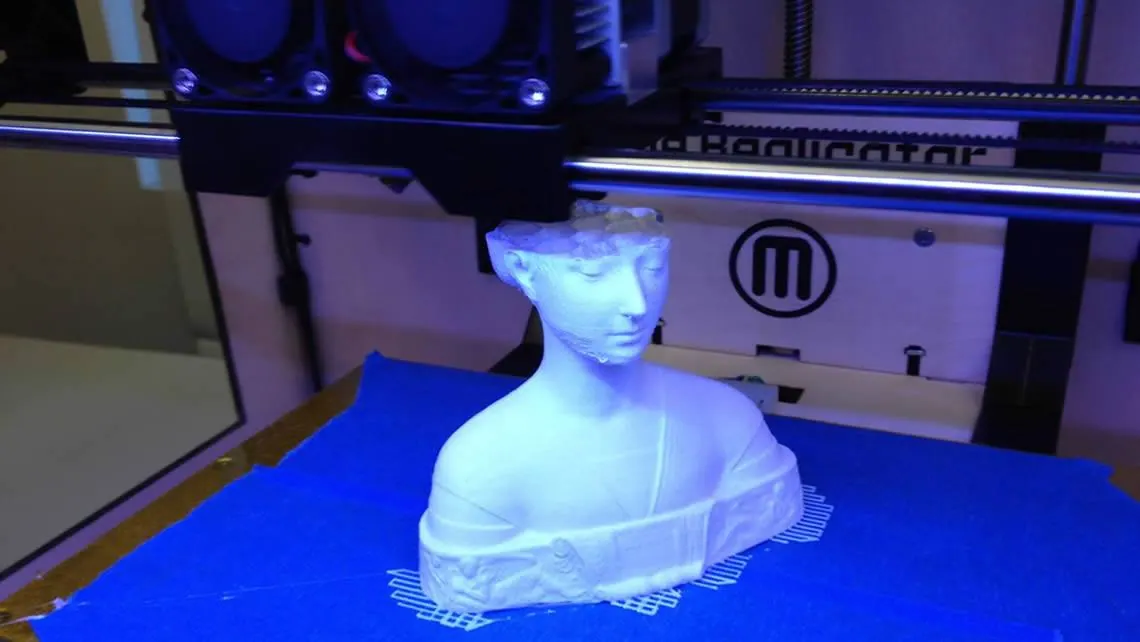
Until a few years ago, this approach seemed like science fiction, but it was engineering that contributed to starting this type of production. In three-dimensional printing, an object is created by successively applying layers of material. It enables the production of parts and assemblies from several different materials, with different mechanical and physical properties (Wikipedia, 2015).
If we delve into the essence of 3D printing, it could have existed since the time of “liquid materials”, but engineering contributed to the fact that the combination of a CNC [1] machine and an ordinary extruder (which can push some material) gives the possibility of creating an object in three dimensions, which is shown in the picture 1.

Picture 1 - Combination of CNC machine and plastic extruder (Cardboard cutting on cnc, 2015) (What’s New in the World of 3D Printing? , 2015) (3D printing, 2015)
Of course, over time, more sophisticated methods of this type and techniques of joining applied layers have been developed, where a better finish is constantly obtained, new materials are introduced and the construction of the printers themselves is improved. We should also mention the then-presented printer of the company Carbon3D, whose constructors were inspired by the movie “Terminator 2”, where an object that is extracted from liquid resin is shaped (picture 2). As one of the creators of this printer, Joseph DeSimone, said, 3D printers are actually 2D printers that repeat the process over and over again, and that process took a long time back then. This printer “simply” pulls the entire object out of the fluid, preformed with the help of light, and according to the source at the time provides 25 to 100 times faster printing (Carbon3D, 2015).

Image 2 - Principle of operation of the 3D printer of Carbon 3D. (Carbon3D, 2015)
3D printing and manufacturing
It can already be seen how the use of 3D printers is spreading across industrial fields, with printed body parts, car bodies, cutlery, clothing and even houses and buildings. For example, the source states that Boeing was printing more than 20 000 parts for its aircraft (DICKEY, 2015).
As this technology becomes cheaper and more accessible, experts in the field predict that this type of production will move from industry to customers. With 3D printers, people will be able to create their own models, modify existing ones and adapt products to their needs. You can already find a lot of free models on the Internet, which can be downloaded and printed directly.
However, to take a simple example, many people have “ordinary” 2D printers at home, yet copy shops still exist and even printer owners use them. It may be similar with 3D printers. There are several reasons for this, including:
- economic reasons, because mass production is still cheaper than individual production;
- better finishing, for which most individuals will not have the conditions as professionals;
- knowledge of material characteristics, construction and processing software;
- creative abilities of the individual;
- physical limitations of the printer.
In terms of meeting the needs of customers, 3D printing provides infinitely greater possibilities of customizing products to the customer’s wishes than traditional production based on subtraction of materials was able to offer. But from the producer’s point of view, it enables production without excess (waste) materials, reduction of the number of machines, lower storage costs, etc. Also, there remains room for the above-mentioned customization, where product platforms can be produced in advance, on which the desired shapes can be printed and additionally meet customers, with delivery speed and the like. Also, the possibility of leaving an unfinished product will be opened, where it will be delivered to the customer as such, and the customer will also be able to print the product with his printer.
Below are a couple of 3D printed examples
Example 1 - The Chinese company WinSun, specialising in building houses with 3D technology, “printed” its first multi-storey building

Image 3 – Printed Building - http://svetzanimljivosti.com/zgrada-iz-stampaca-prva-visespratnica-po-3d-tehnologiji/

Image 4 - Interior of printed building - http://kiko-unico.com.hr/hocemo-li-u-skoroj-buducnosti-printati-stambene-objekte-luksuzne-vile/
Example 2 - Local Motors produced a car whose structural elements and body parts were printed on a 3D printer before additional components were installed

Image 5 - A car whose parts are printed - http://www.b92.net/automobili/razno.php?yyyy=2015&mm=01&nav\_id=946245
Example 3 - 3D-printed rifle and pistol
Picture 6 - 3d Rifle - http://www.dailymail.co.uk/sciencetech/article-2295283/3D-printing-gunsmiths-make-blueprints-available-free-download-granted-firearms-licence.html

Image 7 - http://www.bbc.com/news/science-environment-22421185
Example 4 - 3D-printed hand for people with disabilities

Image 8 - 3D Hand - http://edition.cnn.com/2014/04/14/tech/innovation/carpenter-fingers-robohand-3-d/
Application Note: Historical examples, forecasts, speed comparisons and company statements are not a substitute for an actual technical and commercial comparison. The safety of the process depends on the machine, material, ventilation, temperature, processing, purpose of the part and expert assessment of the specific case.
Sources
3D printing. (2015, 4 14). Retrieved from Wikipedia, the free encyclopedia: http://en.wikipedia.org/wiki/3D_printing
Carbon3D. (2015, 04 5). Retrieved from Carbon3D | CLIP Technology - Breakthrough technology centered on tunable photochemical process for layerless 3D printing:: http://carbon3d.com/
DICKEY, M.R. (2015, 4 15). Hope You Trust 3D Printers — Boeing Uses Them To ‘Print’ Parts For Its Planes. Retrieved from Business Insider: http://www.businessinsider.com/
Kaku, D. M. (2011). Physics of the future.
Cardboard cutting on cnc. (2015, 4 14). Retrieved from elitesecurity.org - web forums: http://www.elitesecurity.org/t415702-0
Suzić, N. (. (n.d.). Novi Sad.
What’s New in the World of 3D Printing? . (2015, 4 14). Retrieved from Brit + co: http://www.brit.co/3d-june/
Wikipedia. (2015, 04 12). 3D printing. Retrieved from Wikipedia: http://sr.wikipedia.org/sr-el/3%D0%94_%D1%88%D1%82%D0%B0%D0%BC%D0%BF%D0%B0
[1] CNC (eng. computer numerical control) is a machine that uses pre-entered coordinates for its movement, which are entered depending on the desired positions in the observed coordinate system.