Content and safety note: This is an archival educational text, not a current technical specification, design or instructions for carrying out work. The statements and numerical values are carried over from the source article and should not be interpreted as having been checked against today’s standards. The selection, testing, storage and use of cement should be aligned with the manufacturer’s instructions, current regulations and a design prepared by a qualified engineer. The photographs are illustrative and do not represent confirmed Savo Kusić projects.
Cement is not part of the company’s new public offer. The current manufacturing focus is on wooden windows, wood-aluminium windows and made-to-measure doors. For a specific project, you can send a request for quotation.
General information
Cements are hydraulic binders: after being mixed with water, they harden over time into a stone-like mass, both under water and in air. In the latter case, complete hardening is achieved only if the mortar is kept moist during hardening, particularly during the first few days.
Clearly expressed and measurable hardening should, even in midsummer, begin only after the cement has been properly mixed. According to the standards cited in the source text, the start of hardening should become noticeable no earlier than one hour after the cement paste has been prepared. At a temperature of 18 to 21 °C, the end of setting generally occurs no earlier than four hours and no later than 12 hours.
When work is carried out at low temperatures, hardening should lag as little as possible behind hardening at the usual temperature, while its acceleration should be limited at high temperatures.
The hardened cement mass should be dimensionally stable. Strength should not decrease over time because of the cement’s composition or the effects of frost, liquids or other factors. Cracks caused by shrinkage of mortar and concrete can be avoided through proper work and curing, while the extent to which these conditions can be met depends on the state of cement technology.
For reinforced-concrete work and bridge construction, the source article states that only standardised cements and high-grade aluminate cements may be used. It also states that cements should be used only when their production is supervised by standards-maintenance institutions and when they carry the protective mark of that institution. For special purposes, such as heavily loaded concrete roads, recognised standardised cements are recommended.
When it is exceptionally necessary to obtain high-grade concrete in a particularly short period, for example when constructing piles, aluminate cement may be considered. Its composition differs considerably from Portland cement, and aluminium oxide (Al₂O₃) is dominant in its chemical composition.

Illustration — aluminate cement powder.
Chemical composition of cement
The table analysing commercial cements presents data on the chemical composition of individual types. It shows that the lime content in iron-rich Portland cement is generally lower than in conventional Portland cement, while blast-furnace cement contains still less lime. White Portland cements are obtained with a very low iron content.

Archival table — analysis of commercial cements from the source article.
Opinions about the most suitable cement composition, whether for general use or for specific construction tasks, often change and differ. Chemical analysis by itself does not provide complete information. In the absence of special agreements, it shows the consumer whether standards or supplementary conditions were observed during production and whether the cement composition is within customary limits or departs from them.
Start and end of setting
If the cement begins to set before the concrete is placed, this can adversely affect the development of the strength of the cement and the concrete itself. To avoid such cases, the source article recommends regularly taking test samples from incoming deliveries and carrying out an improvised test on so-called “patties” in a defined manner.
According to the standards cited in the source text, setting should be tested at an average cement, water and air temperature of 18 to 21 °C. This condition is important when assessing the results, because setting time increases as the temperature falls and decreases as the temperature rises. In special cases, for example in concrete road construction, a supplementary test is carried out in summer at a temperature of 30 to 35 °C.

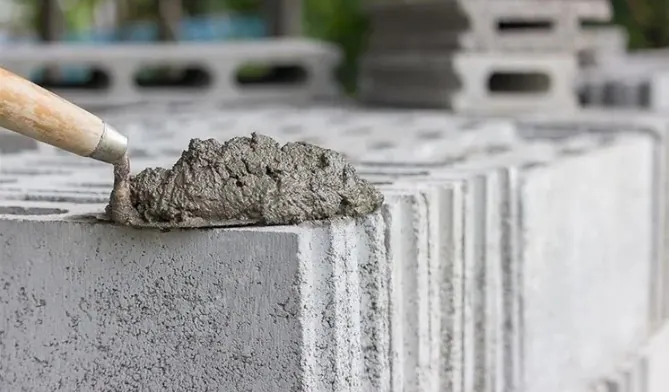
Illustration — placing and levelling a cement mixture.
Cement shrinkage and swelling
Cement paste mixed with the large amount of water needed for concrete in reinforced-concrete structures dries during setting without creating any significant forces in the reinforcement it surrounds. The degree of drying depends on the type of cement, the amount of mixing water, the concrete temperature and other conditions.
When fresh cement was used on various construction sites, cracks and fissures caused by drying in hot, dry and windy weather were observed. After setting, cement shrinks if it dries out, while cement kept moist swells.

Illustration — cracks in a cement surface.
Condition of cement on delivery and during storage
Hot cements
The question is often asked whether hot cements, for example at temperatures of 30 to 80 °C, are inferior to cements at temperatures of 10 to 30 °C. According to the source text, the temperature of the cement itself is of lesser significance if it is handled professionally, that is, if the fresh concrete has the usual temperature of 25 °C.
It is more important whether the hot cement comes from fresh clinker that has not been cooled and aged, or whether its temperature arose only during grinding. For important structures, the use of cement that has aged for at least one week is recommended.
Uniformity
An essential indicator of cement quality is the uniformity of the product’s properties over a longer period, together with constant, gradual improvement in quality.
Stability during storage
Tests with Portland cement, iron-rich Portland cement, blast-furnace cement and aluminate cement have shown, where cements of more recent manufacture are concerned, that dry storage in a cement-plant silo or in bags in dry rooms, as well as storage for several months in special bags and dry work rooms, does not materially affect cement strength.
If bags have been stacked for a long time and the cement has become lumpy, it would be advisable to test the cement subsequently. When it is stored in sheds, protection from rain and wind is essential. If such storage lasts for several months, the bags should be protected on all sides with roofing paper or a similar material. Bags made of bituminised paper or permanent containers are cited as better solutions.

Illustration — cement storage silos.