Bending rods and pipes
Bending flat material
Flat materials up to 5 mm thick can be bent well while cold when first clamped in a vice. They can be bent through a small, effectively sharp angle. When thicker material is bent, cracking or crushing occurs at the bend.
Flexibility depends on the material itself. Steel is harder to bend, while soft aluminium can even be bent by hand. If we want to avoid breakage during bending or straightening, the material first needs to be softened. Soft wire is used, for example, when making a wire fence. Semi-hard wire is supplied commercially and should be softened before use. The coils of wire are first placed on a layer of charcoal and covered with charcoal from above, after which the charcoal is ignited. Once the charcoal has burned and cooled, the coil of wire becomes flexible and suitable for weaving.
If a material is to be bent at a right angle, it must be clamped firmly in a vice between an angle-steel insert and then bent with a fitter’s hammer. Bending can also be done with an object not intended for bending. In this case, we do not strike the material to be bent with the hammer, but strike the auxiliary object. First strike several times above the bend line so that the piece “starts” in the desired direction and arc. Then strike the end of the workpiece farther from the bend line, allowing it to be bent with less force. The angle-steel insert assists bending and protects the vice at the same time.
Before bending material into an L, U or Z shape, the order of bends must be considered carefully. Pieces that seem impossible to bend can also be bent in a vice, provided that we remember the principle: “Think more so that you become angry less.”
It is useful to mark the bend line by scribing before bending, especially on sheet metal. This lets us watch whether the bend is being made at the desired position, while the scribed line itself also assists bending.
Bending pipes
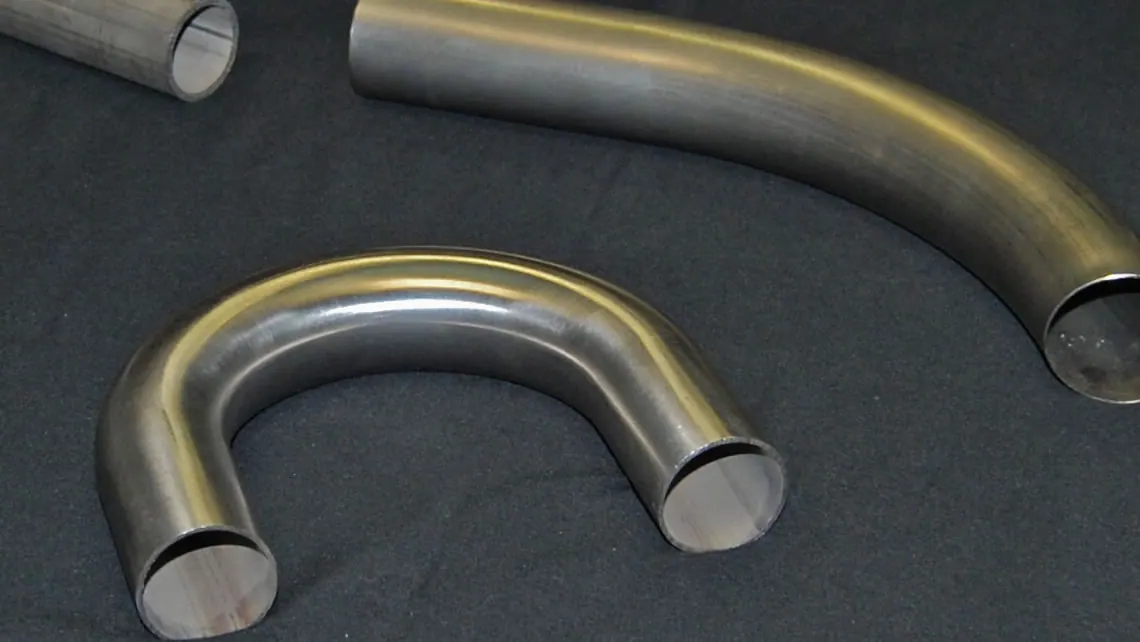
A special case of bending is forming a pipe into an arc. When thin-walled pipes are bent, the walls are crushed on the inside of the bend, while on the outside they crack or the pipe becomes flattened.
Filling a pipe with sand
If the outside diameter of the pipe wall is less than twice the pipe’s inside diameter, bending can be performed by “filling” the pipe. The filling material is fine, clean sand. One end of the pipe is closed securely, the pipe is filled with sand through the other end, and that end is then closed with a long wooden plug. The sand prevents the pipe from becoming indented at the bend. When a pipe is flattened, the circumference of its cross-section remains the same, but the cross-sectional area decreases. If the pipe is filled with sand, the sand does not permit this narrowing because the pipe has no room to “move” in another direction.
Steel coil
Another material for filling a pipe is a steel coil, shown in Figure 1. This is simply a long coiled spring that fits inside the pipe. Using a coil is justified only when a larger number of pipes of the same diameter are to be bent. Before use, it is useful to coat the spring with oil, because otherwise it will not be easy to remove from the bent pipe. The spring should not be pulled out; it should be removed by rotating it in the direction opposite to its winding. Bending can also be assisted by heating the bend area until it is red-hot and then using levers at the ends of the pipe to bend it in that condition.

Bending a pipe with a steel coil and positioning a workpiece for cutting.
One final piece of advice: for bending pipes with an outside diameter greater than 15 mm, assistance should be sought from a qualified person.
Cutting with a cold chisel
Cutting sheet metal and rods
The cutting tools are a flat cold chisel and a hammer. It is very important to support the metal workpiece at the cutting point so that it does not move or bend during the work. The cutting line should be scribed deeply, after which the chisel is held perpendicular to the sheet-metal surface. Start with lighter blows to the chisel, followed by stronger blows that cut the metal. If the material is wider than the chisel, begin cutting alternately from both ends and work towards the middle. When cutting metal rods, first mark the cutting point by notching the rod while rotating it, and then cut through it.
Sheet metal clamped in a vice is cut with the cutting line 1–2 mm above and parallel to the vice jaws. Cutting begins at one end, with the chisel edge guided horizontally along the cutting line. During the work, the chisel should be held at an acute angle to the sheet metal, as shown in Figure 2.

Position of the cold chisel when cutting sheet metal on a support and in a vice.
Cutting out a circular plate
If a larger circular plate needs to be cut from sheet metal, first place the sheet on a flat surface and make interrupted circular cuts with a chisel along the cutting line. Then place the sheet on a support so that the cutting line is one or two centimetres above the table and beside the support, never directly on it. The circular plate can now be broken away with blows from the pointed part of a hammer, rotating the sheet from time to time and always striking beside the support, as shown in Figure 3.

Interrupted cutting and separation of a circular plate from sheet metal.
Related topics: saw cutting, filing and drilling, sheet-metal work and bending, basic tools and processing services.