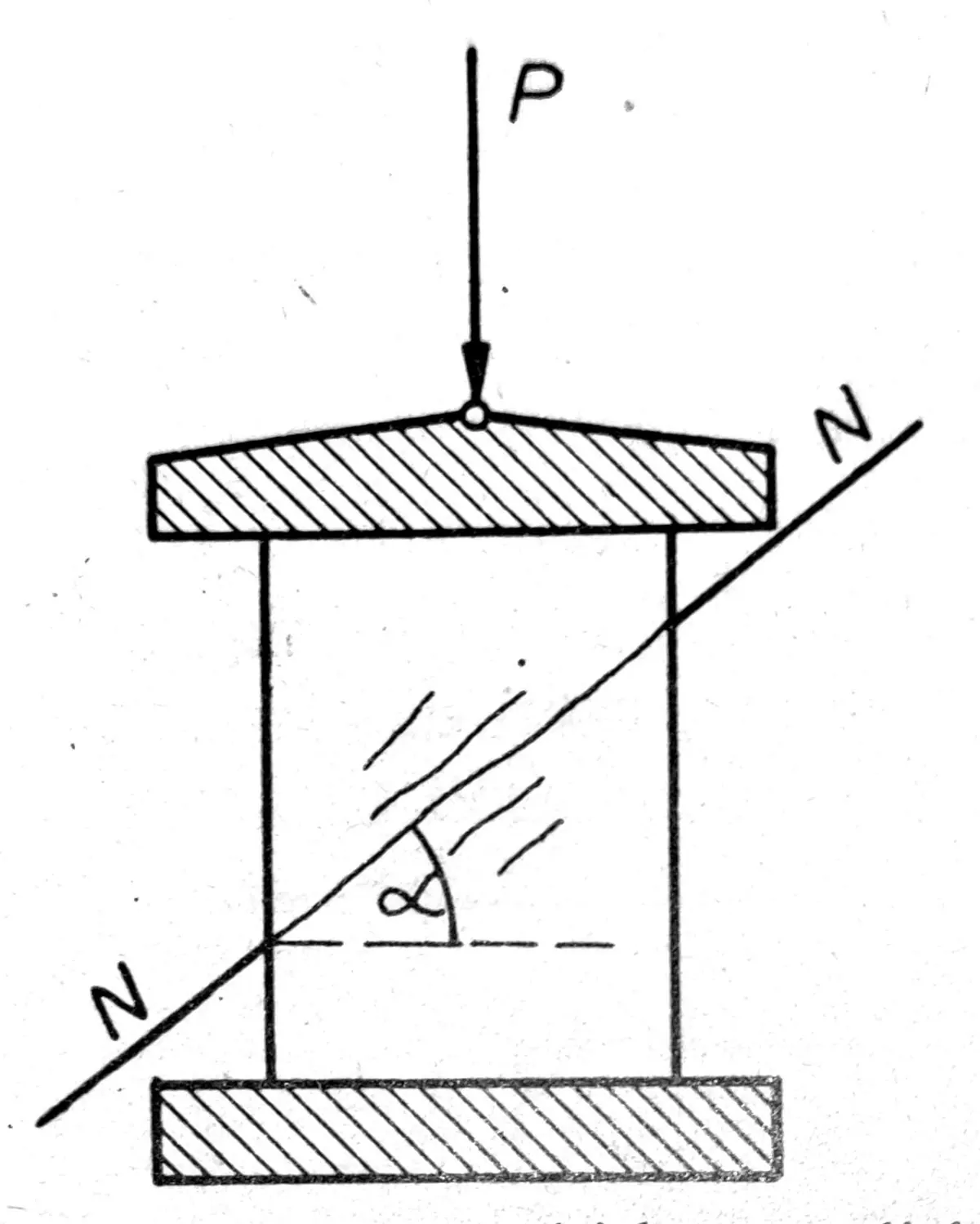
If we cut a cylinder from cohesive soil and place it under the action of a normal pressure P (fig. 1), new stresses will appear in the cylinder, namely the vertical compressive stress σ and the horizontal shear stress . If we gradually increase the pressure P, after some time inclined cracks will appear on the cylinder, and immediately afterward the cylinder will fail. At the moment of failure the cylinder is sheared under the action of the pressure P along the shear plane of least resistance N-N.

Fig. 1. Effect of pressure on a core taken from cohesive soil
The resistance of the soil that the cylinder offered against the action of force P at the moment of failure is called the soil shear resistance, and the angle α of inclination of the plane of least resistance to the horizontal is called the angle of the plane of least soil shear resistance.
The shear resistance of cohesive soil consists of two elementary resistances: internal friction between the solid particles and the cohesion that binds the solid particles. The shear strength of soil is taken to be equal to the maximum shear stress at the moment of failure and is expressed by the equation
τf = c + σ tg_φ_
where: τf soil shear strength [kp/cm2],
c soil cohesion [kp/cm3],
σ normal soil stress [kp/cm3],
φ angle of internal friction of the soil.
The above formula was given by the Frenchman Coulomb 1785. year. According to this formula, for a given soil the cohesion c is constant and independent of the normal pressure, while the frictional resistance σ tg_ϕ_ is directly proportional to the stress σ. In reality, cohesion e is not constant for a given soil, but is also to some extent dependent on the normal stress σ, because under the action of that pressure the thickness of the water film surrounding the solid particles decreases and thus the cohesion increases. Coulomb’s formula applies to permeable soils, in which under the action of normal pressure water is squeezed out of the pores without resistance, which is the case for gravelly and sandy soils, but not for cohesive soil, which is poorly permeable, so that the water from the pores is difficult to expel and remains as pressurized pore water under the action of the load P.
Effective and neutral stresses in soil

Fig. 2. Effective and neutral stress in soil
If we place a soil sample, for example dry sand, at the bottom of a vessel and load it with a mass, for example lead shot weighing W, the entire load of this weight will be carried by the solid particles of the soil. The specific pressure on the surface of the sample p0 = W/A in kp/cm3, where A is the cross-sectional area of the sample, will cause settlement of the sample, i.e. a reduction in its porosity, but it will also cause changes in other physical properties of the sample, such as an increase in shear strength, an increase in the compressibility modulus, and others. The pressure acting at the contact surfaces between particles is called effective or intergranular pressure σ’. When consolidation has been achieved, i.e. when the sample has stopped settling under the load p0, the effective pressure is equal to the total specific pressure acting at the depth at which the soil is observed. In this case, at the depth below the surface of the sample in fig. 2 σ’ = W/A + hzγ where γ is the unit weight of the sample.
However, if instead of lead shot we load the sample in the vessel with water up to the height h, so that it has filled all the pores of the sample, the pressure of the water column above the sample hγw, where γw is the unit weight of water, will not cause settlement of the sample and a reduction of its porosity, nor will it increase its shear strength and compressibility modulus. For this reason the hydrostatic pressure hγw is called neutral pressure. The neutral pressure, denoted by u, is transmitted through the sample in all directions with equal intensity. This pressure will not cause an increase in shear strength, because water itself has no shear strength.
Accordingly, the effective pressure σ’ is transmitted through the contact surfaces between the solid soil particles, while the neutral pressure u is transmitted through the water in the pores. If the lower part of the vessel is filled with a saturated soil sample whose unit weight is γz, and above the surface of the sample up to level N the vessel is filled with water whose unit weight is γw, then the total pressure σ at any point in the sample will be σ = σ’ + u.
At a depth h_z below the surface of the sample, the effective pressure will be σ = σ’ - u
where σ = h γw + h γz
u = (h + hz) γw.
Therefore, σ’ = hz γ’
γ’ is the unit weight of soil submerged in water.
General equation of soil shear strength
If we load a cohesive soil with a load P, this load will cause settlement of the soil and at first the air will be expelled from the pores under its action, so that soon only water remains in the pores. Since, because of the low water permeability of the cohesive soil, the water cannot be expelled immediately, it remains as pressurized water in the pores and initially carries the entire external load P. As time goes on, under the action of the load P, water begins to be expelled from the pores and the solid particles are drawn closer together, and they now take over part of the load P. Then we have τf =c + (σ - u) tg_ϕ,_ where σ is the total pressure from the load P, and u is the pore-water pressure.
Pore water pressure u depends on several factors, such as the time course of consolidation, soil permeability, the magnitude of the soil load, etc. The shear strength of the soil depends on pore water pressure and is greatest for u=0, when soil consolidation occurs.
Colloidal activity of soil
The elements of the soil’s internal resistance, cohesion and friction, can vary and depend greatly on the size of the solid soil particles and its plastic properties. In order to determine the influence of cohesion in relation to the resistance of internal friction of cohesive soil, Skempton introduced the concept of the colloidal activity of soil _K_P, which is represented by the ratio of the plasticity index IP to the amount of particles smaller than 0,002 mm in % by weight of the entire mass. The following criterion was adopted (fig. 3):

Fig. 3. Colloidal activity of soil
For KP < 0,75 the clays are inactive,
for KP = 0,75 – 1,25 are normal clays,
for Kp > 1,25 active clay.
As KP increases, the influence of cohesion grows relative to the internal friction of cohesive soil.
Soil sensitivity
If in cohesive soil we take out a cylinder with a diameter of 3—3,4 cm and a height of ~ 5 cm and load it with a normal load, at the moment of cylinder failure we obtain the compressive strength of the soil in its undisturbed state σ__ₙ:
σn = P/A in kp/cm2,
where A is the cross-section of the cylinder.
After the test is completed, the broken specimen is moved and a cylinder of the same dimensions is made again, using the same cylinder-mold, while its moisture content remains the same as it was during the previous test. Then, immediately after making the remolded cylinder, the test is repeated with it, so that the compressive strength of the soil in the disturbed state σ__ₚ. is obtained.
Sensitivity (sensitiveness) S__ₜ is the ratio of the compressive strength in the undisturbed state to the compressive strength in the disturbed state: St = σn/σp,
According to one criterion, the sensitivity S__ₜ is assessed as follows:
- for S__ₜ = 1 — 2 the clay has low sensitivity,
- for S__ₜ = 2 — 4 is the medium sensitivity of clay,
- for S__ₜ = 4 — 8 there is a high sensitivity of the clay,
- for S__ₜ > 8 is a sensitive clay.
In nature it happens that, due to mechanical action, for example an earthquake, clay soil suddenly loses its strength, which it then regains again when at rest. This property is called soil thixotropy. Many clays have thixotropic properties to a certain extent. There are known cases of slope failures in excavations due to the outflow of thixotropic clay in Norway, Sweden and Finland, where testing established that there was no change in the moisture content of the clay during this process, i.e. that the moisture content of the clay remained constant before and after the outflow.