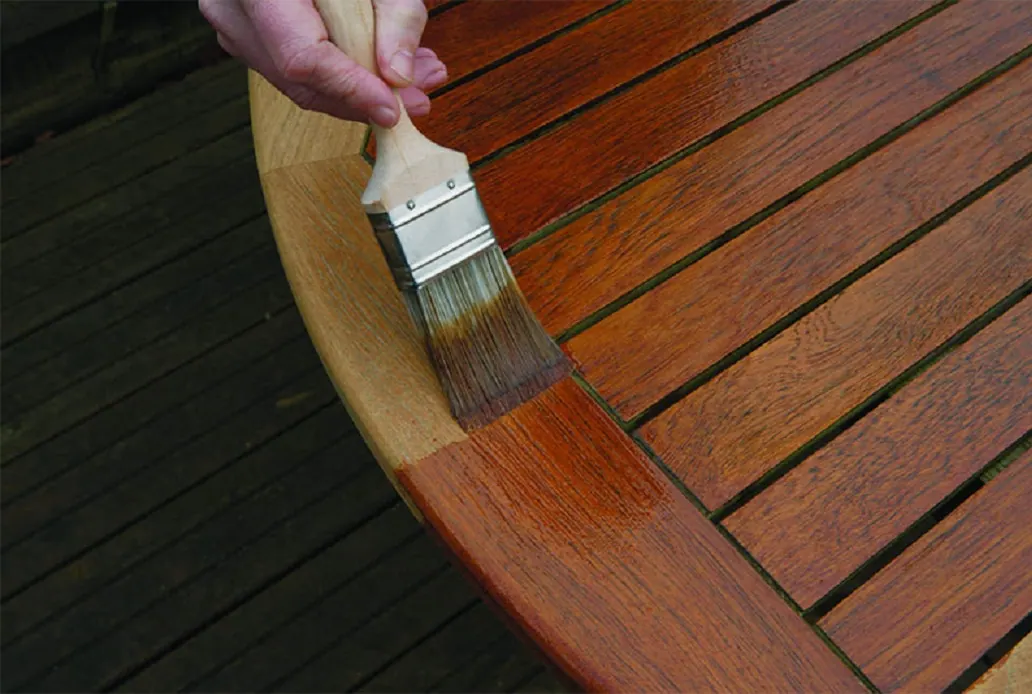
Wood painting is therefore done in order to change the color, gloss, texture and relief of the wood with the help of these paints and varnishes, to give it a beautiful external appearance and to facilitate protection against the effects of atmospheric factors (water, weak acids, alkalis, etc.). It is known that the surface of wood intensively absorbs moisture, as a result of which the elements of the product change their shape and dimensions and get dirty quickly. Paint and varnish coatings prevent this. The external appearance of the coating depends on the quality of the materials used and the quality of the carpentry of the surface of the product or element.
Types of wood coatings
All types of paints and varnishes encountered are divided into transparent, opaque and special.
Transparent coatings
Transparent coatings are obtained by using such materials whose thin layer is transparent (oil-resin and spirit coatings, nitrolacquers, polishes, etc.). Products that are made from noble hard hardwood species with a nice texture are usually coated with various transparent varnishes.
Opaque coatings
Opaque coatings are obtained from such materials whose thin layer is not transparent (oil and enamel paints, nitro enamels, perchlorvinyl enamels, etc.). Materials that form an opaque coating, paints are produced from coniferous and other types of wood (pine, spruce, larch, fir, cedar, etc.).
Special coatings
Special coatings (gilding, silvering, bronzing, metallization, decalcomania) and others. it is applied for coating the entire surface of the element or only some of its parts, according to the order.
The choice of coating according to the conditions of use
The choice of materials for painting and varnishing depends on the conditions of exploitation in which the product or element will be used. According to the conditions of exploitation, carpentry construction products and elements that need to be painted or varnished can be divided into three groups:
- products and elements that are exposed to the influence of changing atmospheric factors (doors and windows, verandas, balcony doors, gates, factory-made house walls, etc.)
- products and bucket elements are exposed to mechanical influences and wear, wetting with water. solutions of weak acids, alkalis, etc. (floors, internal window panes, window sills, kitchen and bathroom doors, toilets and laundry rooms, stairs, balustrades, etc.);
- products and elements. on which periodic hygienic maintenance is performed (walls and ceilings covered with sanded plywood, panels, pilasters, columns, cornices, built-in household furniture, veneered with noble wood, elevator cabins, interior doors, veneered with precious wood, etc.).
The first group of products or elements should be painted with masmrn paints and enamels, perchlorvinyl enamels and fat varnishes; the second group with oil paints, nitroenamel and nitropaints; the third group with resin (alcohol) varnishes, polishes, grease varnishes and nitro varnishes with subsequent polishing of the surface.
Materials for painting and varnishing
Materials for coloring and varnishing include varnishes, coloring substances, fat enamel paints, nitro paints and varnishes.
Firnisi
Firnisi is a product of the processing of vegetable oils, fats and organic products; they do not contain varnish-resins that can form a protective film on the surface after drying and are used for preparing and diluting paints as well as for priming surfaces that need to be painted. According to the basic raw material, firnisis are divided into two types: firnisis made from vegetable oils and fats and firnisis made from organic products. Varnishes made of vegetable oil - linseed and hemp oil are used for the composition of colors that will be used to paint exterior products and elements of buildings of category I.
Semi-natural varnishes (oxol, oxol-mixture, etc.) are used for making oil paints for coloring interior and exterior products and elements made of wood, metal and dry plastered buildings of category II.
Artificial veneers, such as synthol, carbonol, slate veneer, etc. they are used for making colors intended for coloring interior and exterior wooden products. Varnishes of this type have a sharp, unpleasant smell.
Pigments and urine
Dyeing materials are divided into two groups: pigments and pigments.
Natural (earth) and artificial (mineral) pigments are used for the production of oil, enamel and nitrocellulose coloring materials, which form opaque coatings. The following pigments are most often used for the production of oil enamel and nitrocellulose paints:
- zinc bleach
- high quality ocher,
- umbra (dark color).
Pigments of organic origin and metal salts are used for coloring the surfaces of products and wooden elements. Of the organic manures, the synthetic and humus ones are the most widely used. Synthetic urines are divided into soluble in water and soluble in alcohol and other chemical solutions. Direct and acidic water-soluble paints, which are very light-fast and do not fade, are most widely used in painting carpentry products and elements.
Stains are used from humus solutions for wood coloring, which are used to dye the wood in different colors, according to the concentration of the solution and additives, which give the surface to be dyed a given color. Metal salts of iron sulfate, permanganate and potassium bichromate can also be used to color wood surfaces. They provide color that is even in tone and goes deep enough.
The water-soluble stains include chestnut stain for coloring the wood surface in a dark color of different tones and red stain for coloring the wood in a reddish-chestnut color.
Acidic chestnut water for wood (concentration from 1 to 2 %) colors the wood in a chestnut color of different tones.
Mixtures of acid maroon wood stain, acid red and acid orange stain give the wood a mahogany color. A mixture of iron sulfate and potassium dichromate in the ratio 2 : 1 gives beech and oak wood a maroon color. In order to obtain a better depth of color tone, add 10 g of calcined or rock soda to 5% solution of walnut stain per 1 l of urine solution. For fine adjustment of tones, saffron, nigrosin, acid red, as well as other pigments can be used in the amount of 0,5 g per 1 l of coloring solution. To dye wood in different colors, you can also use soluble salts of some metals, which consists in treating the surface first with an aqueous solution of salts of some metals, and after drying with an aqueous solution of developer. By combining different concentrations of metal solutions and developers, the desired color of the wood surface can be obtained. In tab. 1 is a recipe for dissolving metal salts for coloring.
| Color | Concentration of dye solution, % | |
|---|---|---|
| Chemical treatment of wood surface | Developer | |
| For oak | ||
| Maroon | Calcium dichromate 1 to 4 | Maroon chrome K 1 to 2 |
| Brown-gray, walnut imitation | Copper sulfate 2 | Chromium maroon 3K-1 |
| Maroon-red, mahogany imitation | Maroon for furs 0,5 to 1 | Acid orange 1 to 2 and chromic acid potassium 0,7 to 1 |
| For beech | ||
| Maroon | Iron sulfate 2-4 | For surface treatment pure yellow 1 |
| Olive | The same | For surface treatment green 1-1 |
| For pine | ||
| Maroon | Resorcin-1 Resorcin-2 | Potassium dichromate 1-3 |
| Reddish-maroon, mahogany imitation | Maroon for fur 0,5 to 1 | Copper sulfate 1,5 to 3 |
The solution of coloring agents from soluble metal salts and developers should not have a temperature below 25oC
Oil paints
Oil paints are pastes, consisting of pigments and fillers mixed with natural or combined varnishes. In order to obtain a working solution, the paste should be dissolved in firnis until it becomes fine enough to work with. Some paints are produced in the form of ready-to-use solutions. Oil paints are used for painting windows, doors, boxes. cabinets, floors, panels, etc.
To paint products or elements white, use zinc bleach brands M-00, B-2-00, B-2-0 and M-3; the latter is produced ready for use. Zinc bleach of other brands must be dissolved in firnis, which is taken in the amount of 17 to 28% of the weight of the paint. Light ocher is produced ready for use. In order to obtain a working solution of chestnut umber, it should be dissolved in firnis, which is taken in the amount of 35 to 40% of the weight of the paint. The paste that colors the wood in the color of ivory should be diluted in firnis, which is taken in the amount of 35 to 40% of the weight of the paint.
Enamel and nitro paints
Enamel paints are mixtures of pigments with corresponding lacquers, ready for use. According to the composition of the binders, they are divided into oily glyphosate, pentaphthalic, perchlorvinyl and bituminous. Enamel paints _are produced in a wide variety of colors.
Nitro paints (nitro enamels) are colloidal solutions of nitrocellulose, resin and volatile organic solvents with the addition of pigments and plasticizers. They are used for painting wood, metal, dry plastered walls, etc. Unlike oil and enamel paints, they have the property of drying quickly (20 to 30 minutes), are resistant against the influence of water, weak acids and alkalis, as a result of which they are applied by spraying, which increases the productivity of these works 5 to 10 times.
The paint and varnish industry produces nitro paints in a wide variety of colors. In order to obtain a solution, which is suitable to be applied with a sprayer, from 10 to 30% by weight of solvent No 646 should be added to the nitro paint. For priming and puttying wood surfaces before painting, you should use gray primer No 622, primer DD-113, putty AŠ-30 and putty MBŠ. When there is no factory-made primer, nitro paint can be used, to which a pigment of the appropriate color should be added.
Lacquers, polishes and primers
Oil-resin varnishes, nitro varnishes, alcohol varnishes and polishes are used to paint wood in natural color or in color tone; these are transparent coatings, through which the texture of the wood can be seen. Nitro varnishes have the property of drying quickly (20 to 30 minutes), therefore they should be applied in special rooms with ventilation, using a spray gun. Other varnishes and polishes are applied with a brush or pad.
Spirits with a strength of 80 to 90o should be used for making polishes with shellac or for diluting them.
For priming the wood surface when treated with oil-resin and spirit lacquers and nitrolacquers, the following primers can be applied: carpentry (OST 3180), casein (TU MHP 2120-49) and casein-rosin for nitrolacquers (TU MHP 345-41). Wood surface priming for polishing with shellac polish is done with a 10% solution of shellac in spirit.
Finishing of windows and doors
If you are looking for ready-made solutions with a quality finish and wood protection, take a look at our wooden windows, front doors or contact us for a quote.