The process of drying sawn timber or finished parts in kilns takes place under the influence of a specified temperature, humidity and air velocity. Together, these conditions form the drying schedule.
Changes in the schedule during drying
Temperature and air humidity change during the process:
- at the beginning of drying, a low temperature and high air humidity are generally established, with a small difference between the dry-bulb and wet-bulb thermometer readings;
- at the end of drying, a high temperature and low air humidity are applied, with a large difference between the dry-bulb and wet-bulb thermometer readings.
The greater the difference between the dry-bulb and wet-bulb thermometer readings, the harsher the drying schedule — under the same conditions of material dimensions, species and condition, kiln design and requirements concerning the quality of the dried material.
The harshness of the schedule can be assessed by comparing it with the standard drying time. If the drying time under a given schedule is shorter than the standard time, the schedule is harsher.
Controlling moisture and stresses in wood
The moisture content and stress state of the wood must be controlled during drying.
Moisture content is checked by periodically measuring a control wood sample kept in the kiln. Tensile or compressive stresses are checked by observing test forks cut from the control sample.
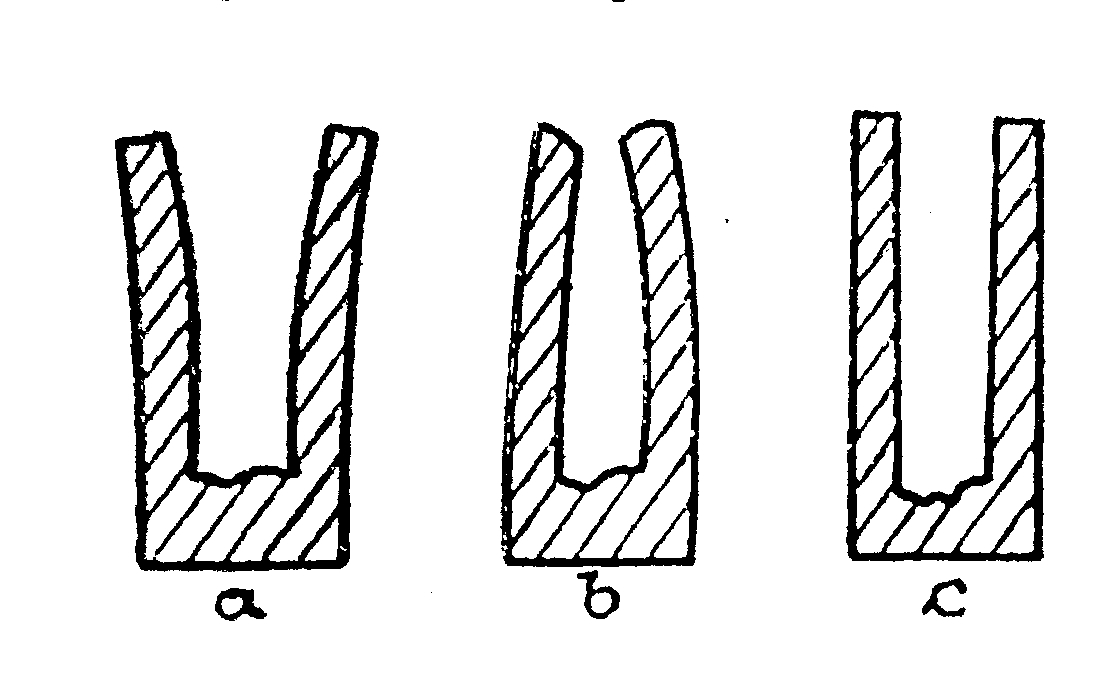
Figure 1. Test forks: a — tensile stresses in the outer layers and compressive stresses in the inner layers; b — compression at the surface and tension in the central zone; c — normal sample.
An appropriate hydrothermal treatment of the wood is applied according to the stress state of the material. Tensile stresses that cause external cracks occur most often. In that case, the material is treated with air at increased humidity and elevated temperature.
As a rule, this treatment is carried out after the wood reaches a moisture content of 23 to 30%. Air at increased humidity and elevated temperature is used when drying hard hardwood species, as well as large-section material made from softwood species.
The approximate duration of this intermediate treatment is:
- for pine and spruce wood: 4–5 hours for every 25 mm of thickness;
- for birch wood: 6–8 hours.
Measuring temperature and air humidity
The temperature and humidity of the hot air in the kiln are measured with a psychrometer. It consists of two thermometers — dry-bulb and wet-bulb — and air humidity is determined from their readings with the aid of special charts or tables.
Conditions for proper kiln operation
The specified schedule can be maintained if heat is not lost and if the supply of fresh air and extraction of air saturated with water vapour operate normally.
The kiln must therefore close hermetically. Doors, walls and the ceiling should retain heat, while supply and exhaust ducts must continuously bring in fresh air and remove air saturated with water vapour.
Choosing a rational design for the kiln door and closing fittings, systematic maintenance and organised planned preventive repairs ensure economical and normal drying of the material.