Archival Professional Content: the article preserves historical claims, tables and diagrams about cement mortar and concrete, but is not a mix design, material specification, concreting plan, structural calculation, test guide or evaluation of an existing element. The composition, properties, exposure class, consistency, method of installation, care, quality control and design values must be determined by responsible experts according to the specific object, declared materials and valid standards.
Today, Savo Kusić is focused on wooden windows, wooden-aluminum windows, custom windows, doors and requests for quotation. This article remains as a historical archive and does not represent an offer to design, manufacture, test or perform concrete structures.
General information
The composition of the cement mortar or the composition of the concrete of a pillar, reinforced concrete mezzanine structure, processed concrete element, sidewalk slab, bridge arch or concrete road, will be considered to be satisfactory, as a rule, if the construction element in question is made with the least amount of material and labor in such a way that it is sufficiently durable and suitable for the purpose. What should be considered permanent and fit for purpose must be defined on a case-by-case basis: therefore, before starting the construction of a building, it is necessary to determine what properties mortar and concrete must have in terms of compressive strength, flexural strength, resistance to weathering, watertightness, etc. There are many different instructions for this in the building regulations, as well as many numerical limitations.
The task of the construction contractor is to ensure that the values of individual properties meet the required values. The properties of concrete can be greatly influenced if knowledge available today is used.
Conditions for making concrete with homogeneous properties
If the compressive strength of a building element after 28 days should be 40 MPa, or if for the concrete of a pavement structure it is required that the flexural strength after 28 days must be 4,5 MPa, then these limit values must not be exceeded in any place; the lower limit value may be close to the conditional value. If narrower limits are met during the execution of the object, the better the contractor performs his task. It is very harmful if the conditioned values fall far short of certain - even if only a few - places.
Historical Values and Recipes: The figures, proportions, markings, care procedures and limits below have been carried over from the original article to preserve the content. They should not be used as a modern recipe, acceptance criteria or substitute for the mix design, laboratory tests, material declarations, technological plan and applicable regulations.
Compressive strength of cement mortar and concrete
The size of the compressive strength largely depends on the properties of the cement, the amount of cement, the amount and composition of sand and aggregates, the amount of water in the concrete during installation, the method of installation, etc.
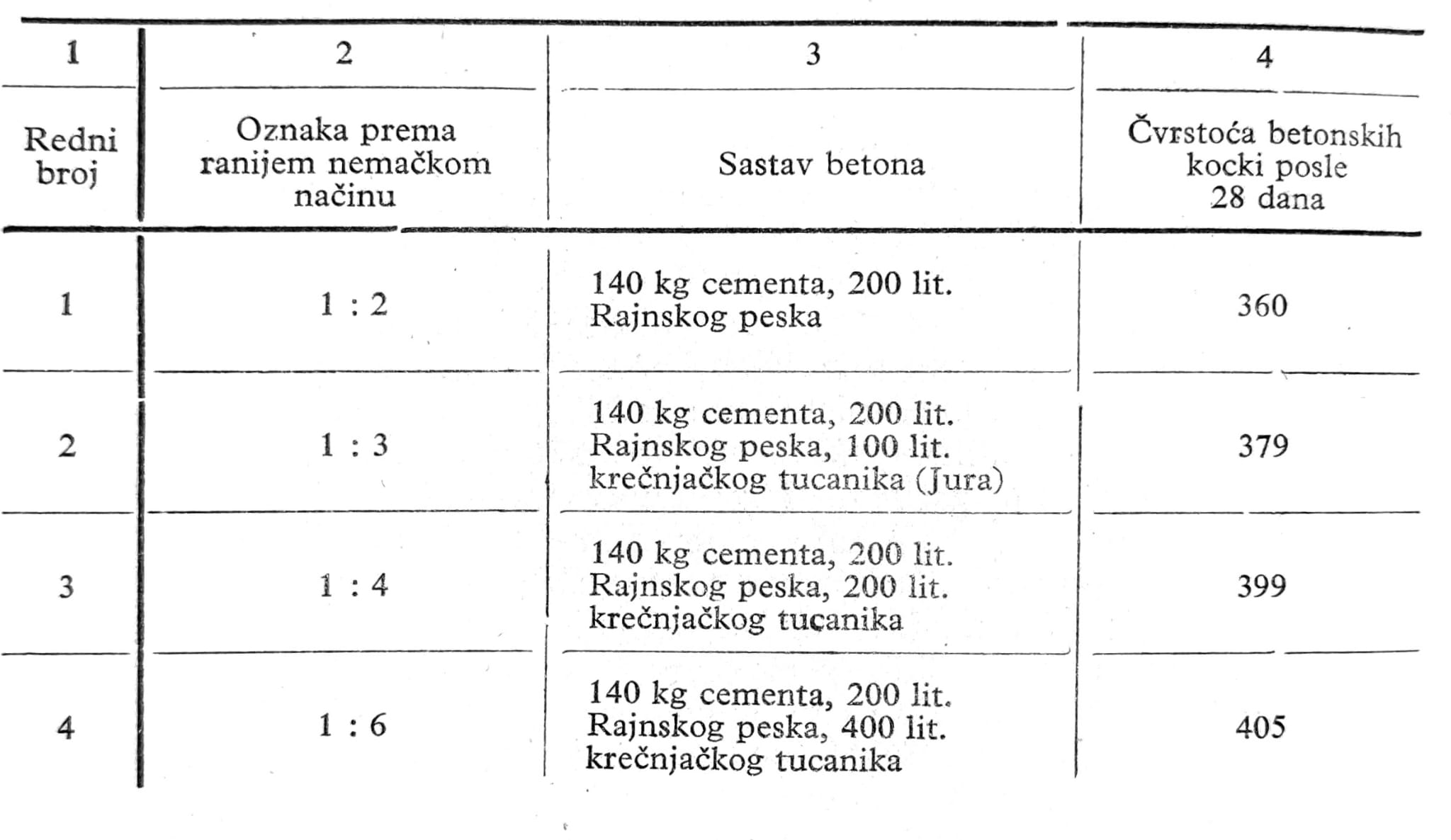
Table 1. Effect of the aggregate quantity with the same mortar quantity.
1. Cement
The compressive strengths of cement mortar and concrete have been determined by previous observations and are defined by regulations.
2. Amount of cement
According to fig. 1a, the compressive strength increases with an increase in the amount of cement if the proportion of mortar in the concrete remains the same, while the amount of cement in the mortar increases and the consistency of the concrete is kept constantly unchanged. If the amount of mortar remains unchanged and only the amount of aggregate increases or decreases, the strength will change only slightly as long as the amount of mortar is sufficient to contain all the aggregate grains. The compressive strength of concrete will not increase indefinitely with an increase in the amount of cement - only up to a certain limit. After that limit, the increase in strength will be insignificant in relation to the price, which will increase significantly with the increase in the amount of cement. The optimal amount of cement for 1 m3 of concrete is 300-350 kg.

Table 2. Effect of the sand quantity in concrete.
3. Amount of mortar in concrete
The compressive strength of concrete is determined by the strength of the mortar, as confirmed by tables 1 and 2. This is only valid if the strength of the aggregate is greater than the strength of the mortar and if the amount of mortar is sufficient to comprehensively cover the coarse grains of the aggregate.
4. Granulometric composition of aggregates
The utilization of the binder will be achieved to the full extent if the granulometric composition of the aggregates in the concrete corresponds to the proportions shown graphically in the figure 2. In Figure 2, the fully extended curve applies to river and crushed gravels. This curve shows that 25% of the total aggregate must pass through a sieve with an opening #0,2mm; through a sieve with a diameter of #3mm, 65% must pass. The upper limit for the aggregate is determined by a sieve with a diameter of #7mm.
Today’s standards for determining the granulometric composition of aggregates are different. There are four aggregate fractions: 0/4mm, 4/8 mm, 8/16mm and 16/31,5mm. Aggregate categories are determined depending on the amount of overweight and underweight grains.

Fig. 1.
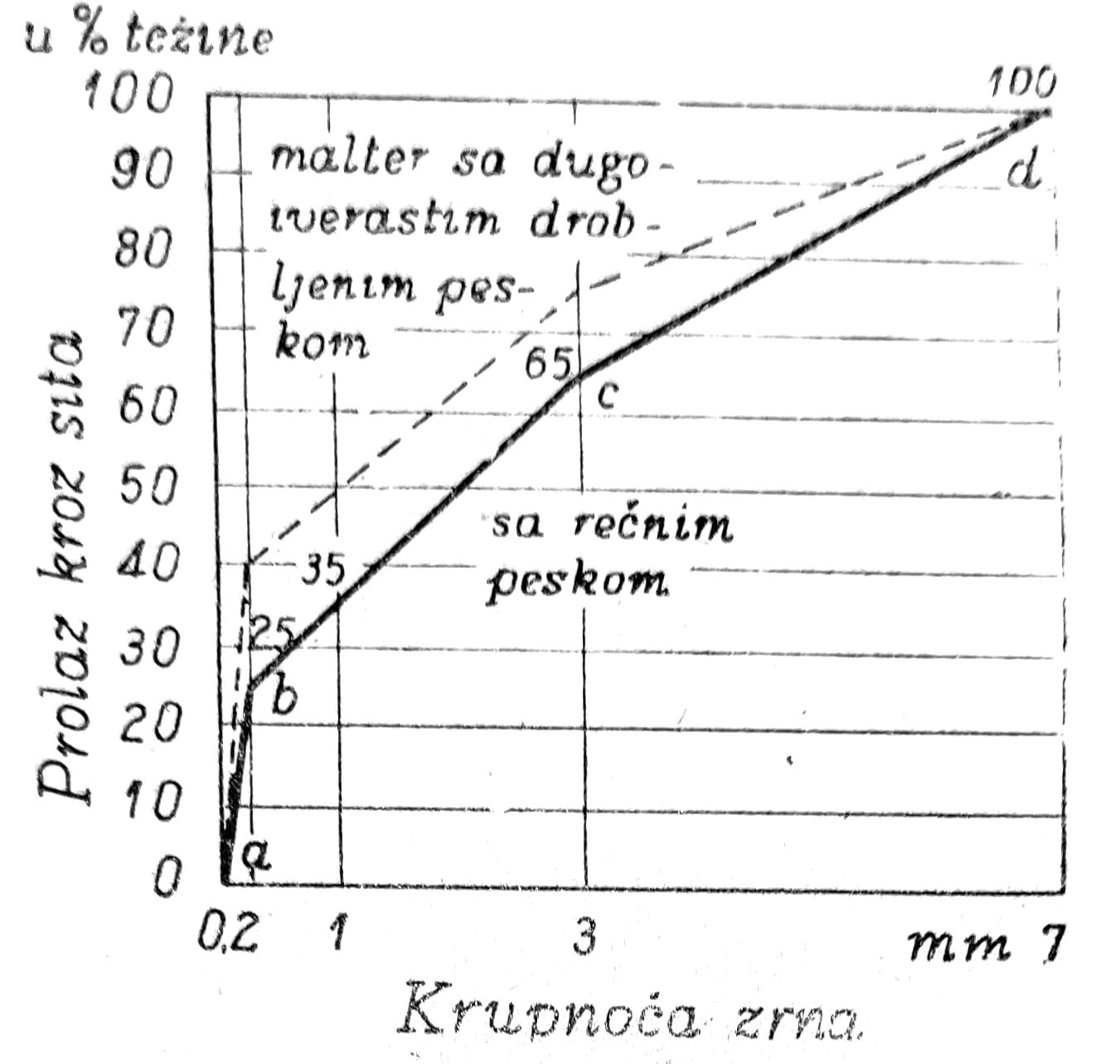
Fig. 2.
5. Effect of amount of water on fresh concrete
The compressive strength of concrete depends to a large extent on the amount of added water. The smallest amount of water at which the concrete achieves the highest strength is obtained when, during compaction or vibration of the concrete, signs of clearly noticeable “sweating” appear, i.e. when a thin layer of cement milk is formed during compaction. With a further increase in the amount of water, the compressive strength decreases. In this case, the water-cement factor is in the first place - the ratio of the mass of water and the mass of cement per 1 m3 of concrete. The optimal water-cement factor for achieving complete hydration is 0,38 - 0,42. In practice, this is difficult to achieve and these values are derived experimentally, but it is certainly aimed at. If the amount of water is insufficient, the cement will not be able to fully hydrate and the concrete will not reach the designed strength. Adding water when not needed also “suffocates” the concrete so that it does not reach its design strength. After the concrete is installed, it is necessary to care for it regularly for the next seven days. Conditioning involves spraying/watering the concrete surface in order to compensate for the evaporated water and so that the cement can hydrate according to the plan.
6. Effect of temperature
When constructing buildings in the cold season, the concrete should be stored so that it is not exposed to frost before hardening has progressed to the extent that the compressive strength is at least 10 MPa. If this procedure is carried out without further ado, the necessary effect can be achieved first of all by adding antifreeze, accelerator, etc. Antifreeze prevents freezing of water in the prepared concrete, and accelerators speed up the hydration process, which is extremely slow in winter. Aluminate cement can also be used, which is particularly suitable for works in frost, if it is a question of smaller buildings. If concrete in a water-saturated state is frequently exposed to repeated freezing and thawing (eg in the case of hydrotechnical facilities), then destruction can be expected if the concrete at the beginning of freezing has a compressive strength of less than 15 MPa. In the case of high air and material temperatures, the concrete must be constantly kept moist and cool. It is also mandatory to cover the fresh concrete mass with any material that will prevent the heating of the concrete surface. Under the influence of high temperatures (over 50 °C), the development of the compressive strength of concrete is unpredictable if care is not adequate.
Safety and performance: cement dust and fresh concrete can damage the eyes, skin and respiratory tract, and mixers, pumps, vibrators, formwork, props and heavy elements carry additional mechanical risks. Additives are not added arbitrarily, nor are historical cold and warm weather references used without an approved recipe, technical sheets, concreting plan, protective equipment and supervision.
Tensile strength of concrete
The tensile strength of concrete largely depends on the cross-sectional size of the test specimens. By increasing the cross-section of the test specimens, a lower tensile strength was obtained. When testing the prisms with a section of 400 cm2, which were made of the usual mix for reinforced concrete and had aged for about three months in humid air, tensile strengths of about 1,2-2 MPa were obtained. Special mixtures for pipes, etc. they gave up to about 4 MPa and even more, if the thickness of the test bodies corresponded to the thickness used in practice. For sprayed concrete (shotcrete prepared on the construction site), up to 3,6 MPa was obtained. Elongation of concrete to failure measured in millimeters per 1m was found to be on average 0,07-0,13 mm/m.
The tensile strength of concrete is negligible compared to its compressive strength. In almost all cases, reinforced concrete is used, which has reinforcement designed to carry the tension forces in the element. It is considered that concrete does not bear anything in tension, so that designers are on the side of safety. The tensile strength of concrete is ten times lower than the compressive strength of concrete.
Tensile strength of concrete when bending
The bending strength of concrete beams with rectangular sections is greater than the tensile strength of bodies of the same dimensions. This is primarily due to the fact that the elongation coefficient of concrete grows faster than the load, so that the stress distribution that is assumed by the usual method of calculation is not realized. In a beam exposed to bending, the highest tensile stress occurs only in the boundary plane of the tensioned belt, and when the load is in the middle of the beam even only on the outer edge of one section.
The magnitude of the flexural strength of bodies 28 days old, made of soft or liquid concrete, was determined to be 2-6 MPa; beams made of compacted concrete, samples of sprayed concrete as well as samples of shotcrete concrete, old for several months and stored first in a wet and then in a dry state, gave results of flexural strength of 3,2 MPa. For plates made of the same material that were kept under water for 8 days, the flexural strength value of 6,3 MPa was determined.
Shrinkage, swelling and creep of concrete
Shrinking and swelling. Shrinkage cracks. Shrinkage Stresses. If concrete bodies which have been maintained in a wet condition are exposed to drying, the drying will begin at the surface and progress towards the interior. On the outside, concrete can be almost air dry while its core is still moist. The dry layer tends to shrink, the moist core will not, or will shrink only to a small extent. As a result, in such a concrete body, tensile stresses appear on the outer surfaces, and compressive stresses in the core.
If the tensile stresses exceed the tensile strength of the concrete, shrinkage cracks will appear that penetrate deeper or shallower towards the core, and appear in places of lower strength. As drying progresses, the core gradually shrinks, the tensile stresses on the outer surfaces decrease.
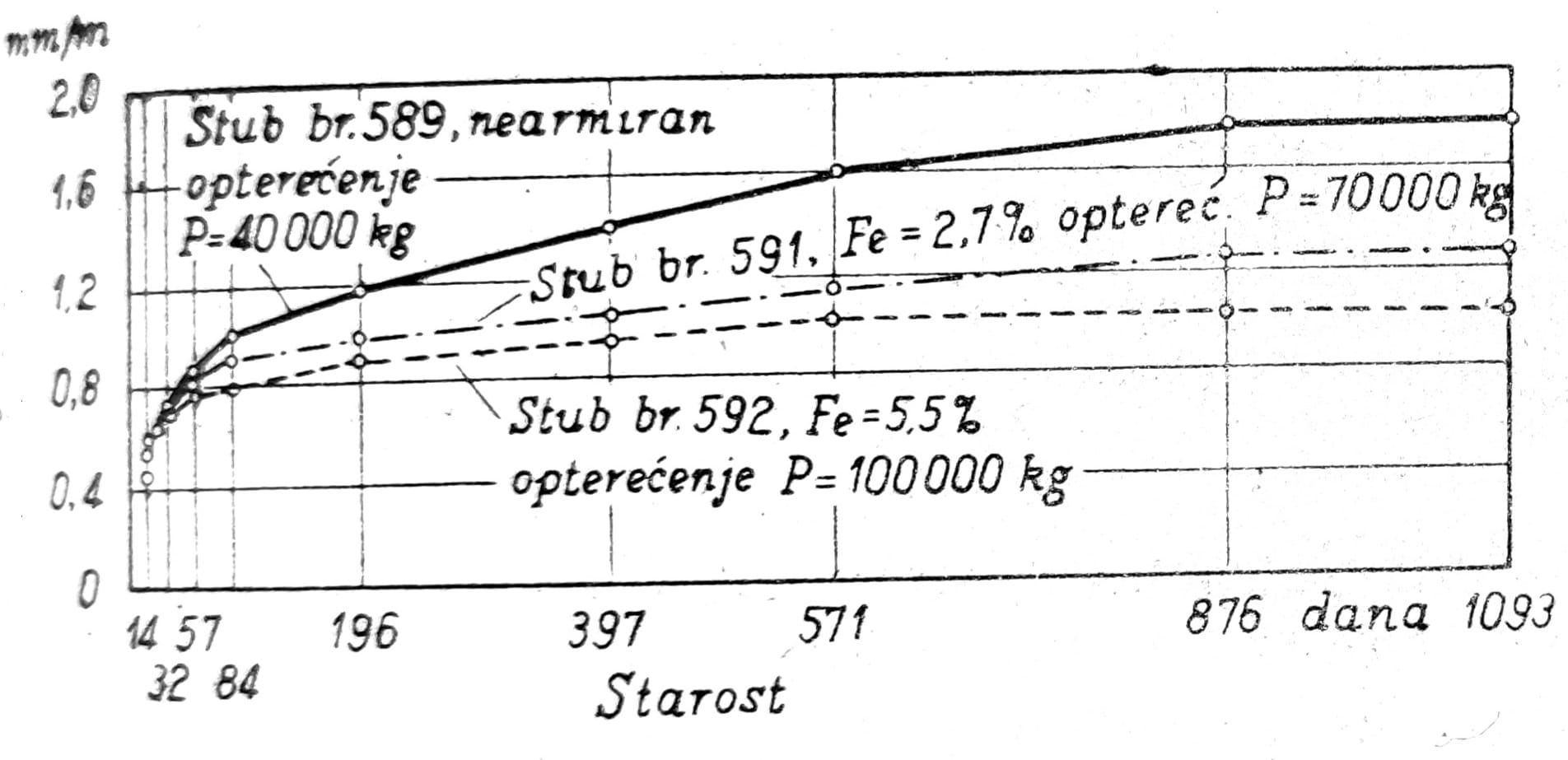
Fig. 3.
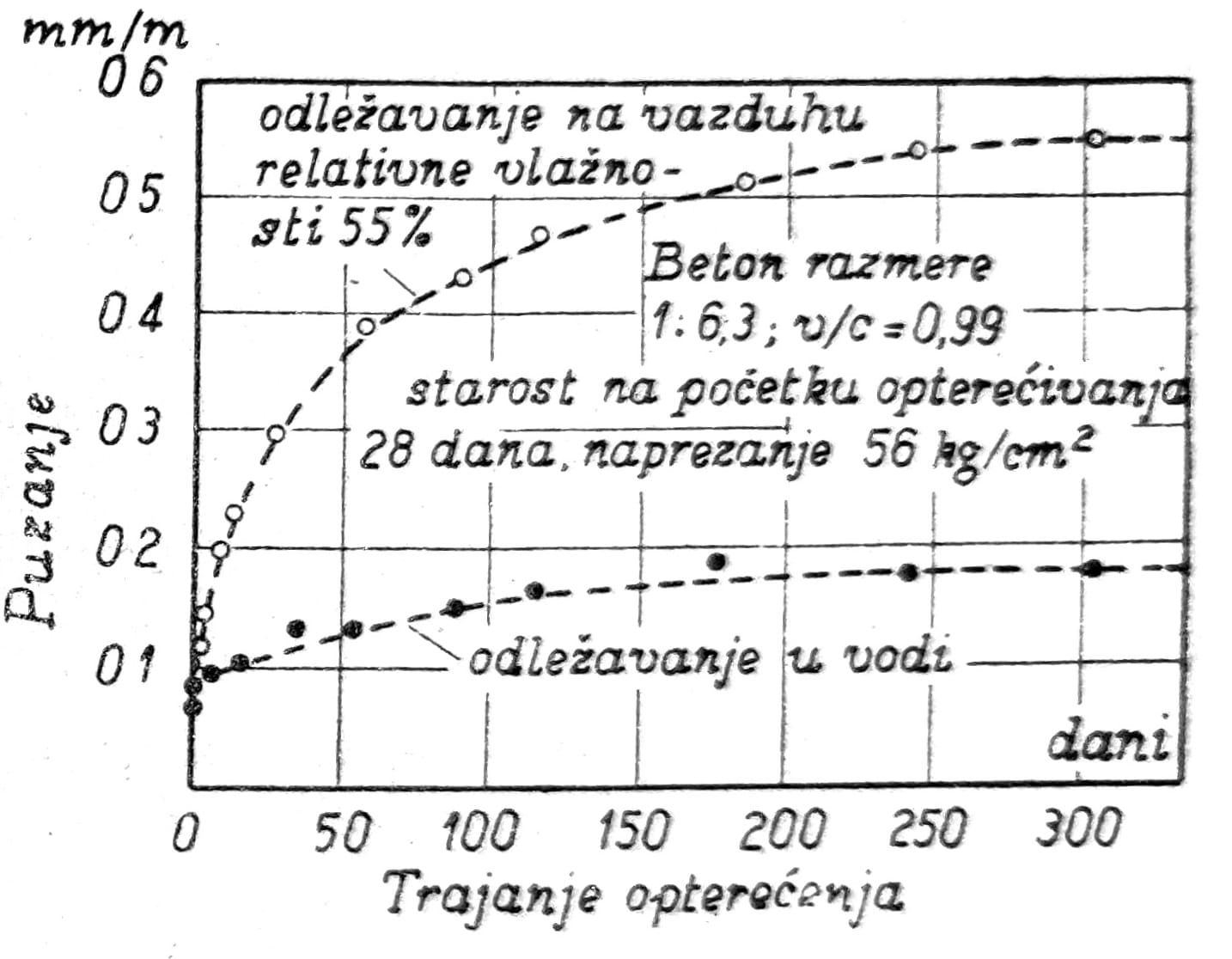
Fig. 4.
The amount of concrete shrinkage depends on the type of cement, the amount of cement, the amount of water during preparation, on the granulometric composition and elasticity of the stone aggregate, as well as on the age, especially on the way of maintenance and climate, and to a significant extent on the dimensions of the concrete element.
Longitudinal changes of concrete in columns and beams exposed to long-term loading. Concrete creep. Columns that stood under the permissible load in a dry basement space for three years, and were made of concrete of ordinary composition, were constantly shortened according to fig. 3, and significantly more than equal but unloaded columns. These deformations, which take place slowly, overcoming the degree of shrinkage of unloaded concrete, are called “creep”. The degree of creep depends on the composition of the concrete, the size and duration of the load, as well as on the humidity of the concrete. Wet concrete creeps to a much lesser extent than dry concrete, fig. 4. Concrete that has been dried for a long time without exposure to load creeps only slightly under load. During tension loading, creep occurs to a similar extent as during compression loading, fig. 5.
Concrete creep, i.e. the constant yielding of concrete under load results in an increase in the share of reinforcement in receiving the load in reinforced concrete, which in the case of heavily reinforced columns can lead to a significant relief of the concrete itself.

Fig. 5.
Cracks and deformations: the shrinkage and creep trends shown are not a sufficient basis for evaluating cracks, deflections, bearing capacity or durability of a specific object. An inspection, documentation, measurements and calculations are required for the existing construction; for a new construction, the project, material properties, environmental conditions, sequence of construction and valid regulations are relevant.
Slip resistance between reinforcement and concrete
Reinforcement in reinforced concrete constructions should fully receive tensile forces when the resistance of the concrete is exceeded during tension due to shrinkage of the concrete and the influence of external forces. For this purpose, it is necessary for the reinforcement to be able to transfer its loads to the concrete through the contact surfaces with the concrete, and in such a way that the anchorage of the reinforcement does not break under the permitted loads. Anchoring is secured by hooks at the end of the bars. Types of reinforcing bars that exist, and the division is made on the basis of transverse ribs, are: B500A (smooth bar), B500B (bar with ribs in one direction) and B500C (bar with ribs in two directions).
Reinforcement and protective layer: historical markings, description of ribs and method of anchoring are not the basis for the selection or detailing of today’s reinforcement. The type of steel, diameter, connection, anchoring, overlap, distance, protective layer and installation are determined by the project and confirmed by traceable documentation and control at the construction site.
Resistance of cement mortar and concrete to wear
Mortars according to fig. 18 are also particularly good in this respect; as far as the granulometric composition is concerned, the instructions given above regarding the compressive strength should generally be followed. In addition, a stone that shows high resistance to wear and impact is recommended. Admixtures that are more resistant than good hard stone increase the wear resistance of concrete if they have a suitable grain size and shape. Wet concrete wears out faster than dry concrete; moisture aids sanding.
Resistance of concrete to weathering
When it is necessary to set the conditions for the production of weather-resistant concrete, one should first of all start from the experience gained on previously constructed structures. First of all, attention should be paid to the following:
- How to choose a stone? - There are often difficulties when choosing stone for reasons of economy, whether it is necessary to use a stone that, like crushed sand or crushed stone, would turn out to be flat and thereby cause poor embedding of concrete, or whether it is a stone with insufficient resistance to weather influences. In this regard, strict requirements must be set, that only stone with good weather resistance is used for external concrete
- What amount of cement is needed for concrete? - On external surfaces, the concrete must be sufficiently impermeable to water. For this purpose, what has been determined about the influence of the granulometric composition of concrete on water permeability can be used and based on that, the required amount of cement can be determined. Some optimal amounts of cement range between 300-350 kg per m3 of concrete, but this can vary a lot from case to case (it depends on many factors).
- What kind of granulation and which properties of the granular composition of concrete should we strive for? - It depends on case by case - river aggregate is more favorable, uneven composition; crushed aggregate can be of better quality in some aspects, but it has sharp grains that could be harmful in some concrete mixes.
- What concrete strength is required? - This question is much more difficult to answer than the ones that have already been discussed. Therefore, all previous proposals refer to limited opportunities. In order to solve this problem, several tests were carried out that showed what strength concrete should have in order to remain resistant to cyclic freezing and thawing for a long time. It was concluded that concrete, before being repeatedly exposed to freezing and thawing, should show a compressive strength of at least 15 MPa. If the concrete is processed from the outside, higher strengths are needed; in such a case it is recommended to provide at least 25 MPa.
- What consistency of concrete is suitable? - As for the consistency of the concrete, there is currently an understanding that one should be careful with cast concrete, since with its large amount of water, it helps excretion, the consequences of which are manifested in the way that a more or less pronounced layer of fine-grained and water-rich mortar appears on each poured layer. That mortar has less strength, greater power to absorb water, etc.
- To what extent should the shape of the object be taken into account? - If, for example, the outer surface is graded, then more snow and ice is retained on a significant part of the concrete than when the wall is treated with smooth surfaces. Soaking can last a long time, and therefore freezing and thawing in a wet state is more common. The goal is to keep snow, ice and debris on the building as short as possible.
In the event that the concrete is processed from the outside, it should be borne in mind that as a result the water permeability as a rule becomes higher and that large pieces of aggregate lying on the surface are broken up with the stone cutter’s tool. If the treated concrete contains reinforcement, special caution is required to sufficiently preserve the protective effect of the concrete (protective layer) for the reinforcement. The penetration of water into concrete can be prevented to a certain extent by coatings/additives.
Durability is not determined by a single value: exposure to water, frost, salts, wear and tear and chemical action requires a coordinated selection of materials, a designed protective layer, controlled installation and care, solved drainage, regular inspections and maintenance. A coating or additive alone cannot compensate for incorrect composition, poor installation, cracks, insufficient protective layer or unresolved water retention.