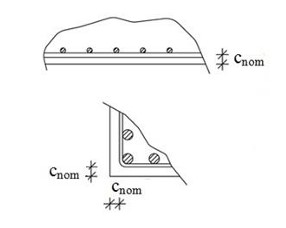
Protection of reinforcement against corrosion
According to current Eurocodes, the minimum thickness of the concrete cover (cnom) is prescribed. The thickness of such a concrete cover is the minimum distance from the outer surface of the reinforced concrete element to the first reinforcement. In linear elements, this is the stirrup, and in surface elements it is the lower longitudinal reinforcement. The nominal cover is defined as: cnom = cmin + Δcdev
cmin is the minimum prescribed cover, whose value depends on the bond conditions of concrete and reinforcement, environmental conditions, reinforcement coating, etc. Δcdev is the value representing deviation in execution. Depending on the exposure class of the reinforced-concrete element, there are different values of the nominal cover; it most often ranges from 2,5 cm to 3,5 cm. For foundations it is taken to be 5cm.
Behavior of cement mortar and concrete during repeated heating and cooling
The strength of fresh concrete can be increased rapidly by gradually heating it with steam or keeping it in progressively heated water, followed by slow cooling. In this way, after a one-day process, strengths are achieved that in the usual process are obtained only after several weeks. The degree of effect depends on the cement and the type of aggregate, while much better results are obtained with lean concrete than with rich concrete.
If heating and cooling are carried out over wide ranges, considerable stresses will arise in a concrete element if the heating and cooling are performed rapidly. In such a case, and especially with frequent repetition, cracking must be expected, with cracks penetrating from the outside toward the interior and affecting the mechanical properties of the concrete. Different cements behave differently in this respect, which is why careful selection of the cement is recommended for practical use.
Thermal conductivity of concrete
The thermal conductivity coefficient of concrete depends on the properties of the aggregate and cement, on the amount of cement, the amount of mixing water, the moisture content of the concrete, as well as on the temperature level. Tests with slabs 10 cm thick and made of heavily dried concrete determined the thermal conductivity coefficient λ to be 1,163 W/mK at 10 oC, and with slabs of concrete that had been stored in water it amounts to up to 2,326 W/mK. Thicker slabs gave higher thermal conductivity coefficients; the highest value was 2,38 W/mK.
Expansion of concrete due to heat
Expansion depends largely on the aggregate, then on the moisture of the concrete, and also on the cement itself. The previously known limit values at 0 to 40 oC are about 6 to 13*10-6 m/m for each degree.
Resistance to repeated loading
1. Compressive fatigue strength. The term fatigue strength is used here in a general sense; for technical application, one should always specify the fatigue strengths (compression, tension, alternating compression and tension, bending, shear, pure shear, buckling) as well as the type of loading (only steady, only repeated, partly steady and partly repeated).
Compressive strength under fatigue due to steady loading: it should be expected that resistance to long-term loading is at least ¾ of the strength obtained in the usual compression test.
Compressive fatigue strength under repeated loading (basic dynamic strength): the basic dynamic compressive strength of concrete columns of different composition, especially with different amounts of cement and different gradations, has been shown to be at least 0,5 of the prism strength under ordinary loading to failure. In this case 260 loading cycles per minute were performed; the total number of cycles for which this basic dynamic strength was determined was two million. With an increase in the number of cycles per minute (it was tested with 10 to 450 cycles per minute), the number of repetitions leading to failure also increased.
Compressive fatigue strength under the simultaneous action of steady and repeated loads: When steady loads are added to repeated loads, the values of the amplitudes of the repeated loads, which were otherwise repeated two million times, decrease as the steady loads increase. For example, fig. 1 shows that the amplitudes of the repeated loads S were:
- under steady loading for σu = 6 kg/cm2 S = 109 kg/cm2
- under steady loading for σu = 118 kg/cm2 S = 39 kg/cm2
- under static loading for σu = 157 kg/cm2 S = 8 kg/cm2
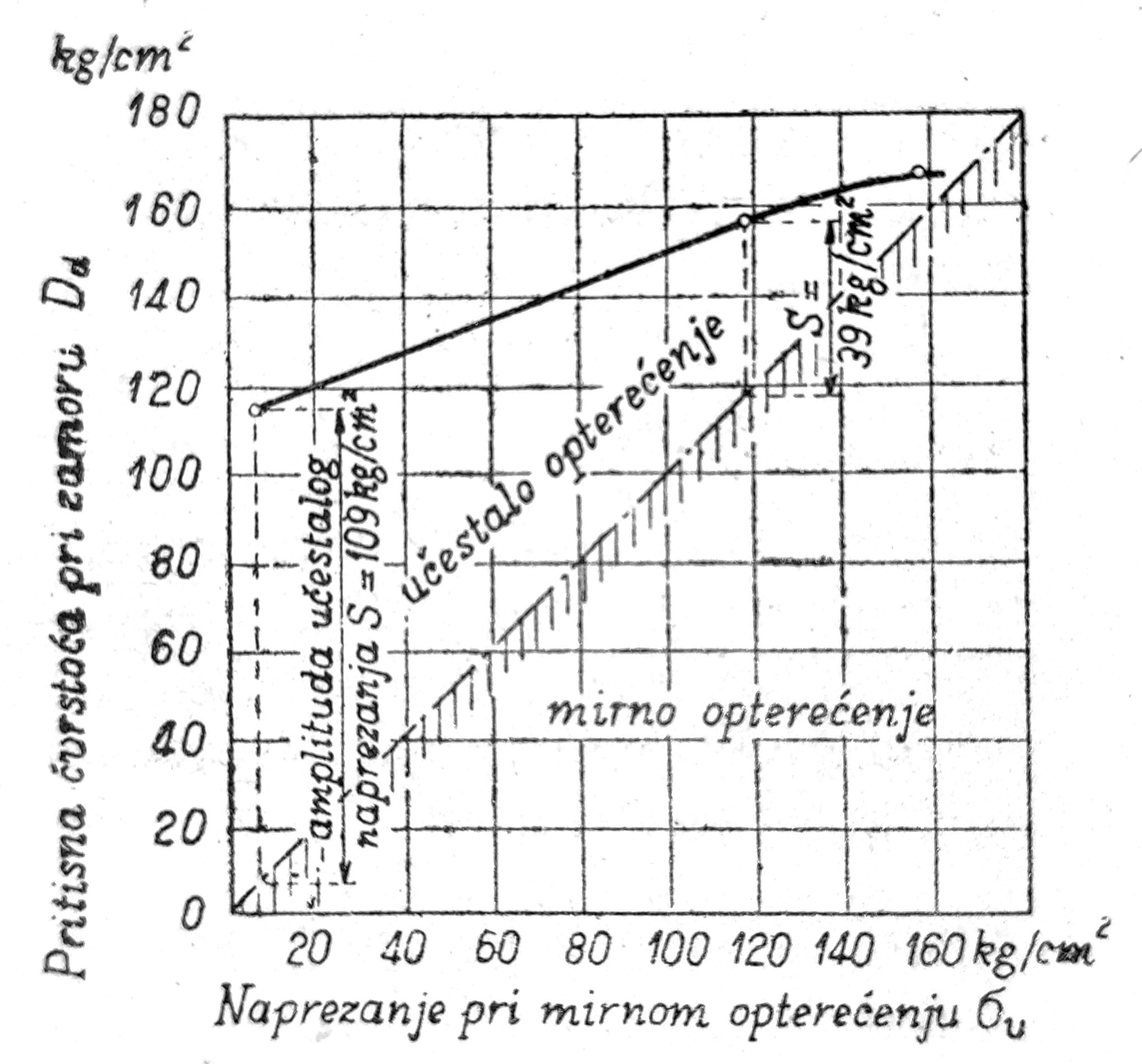
Fig. 1
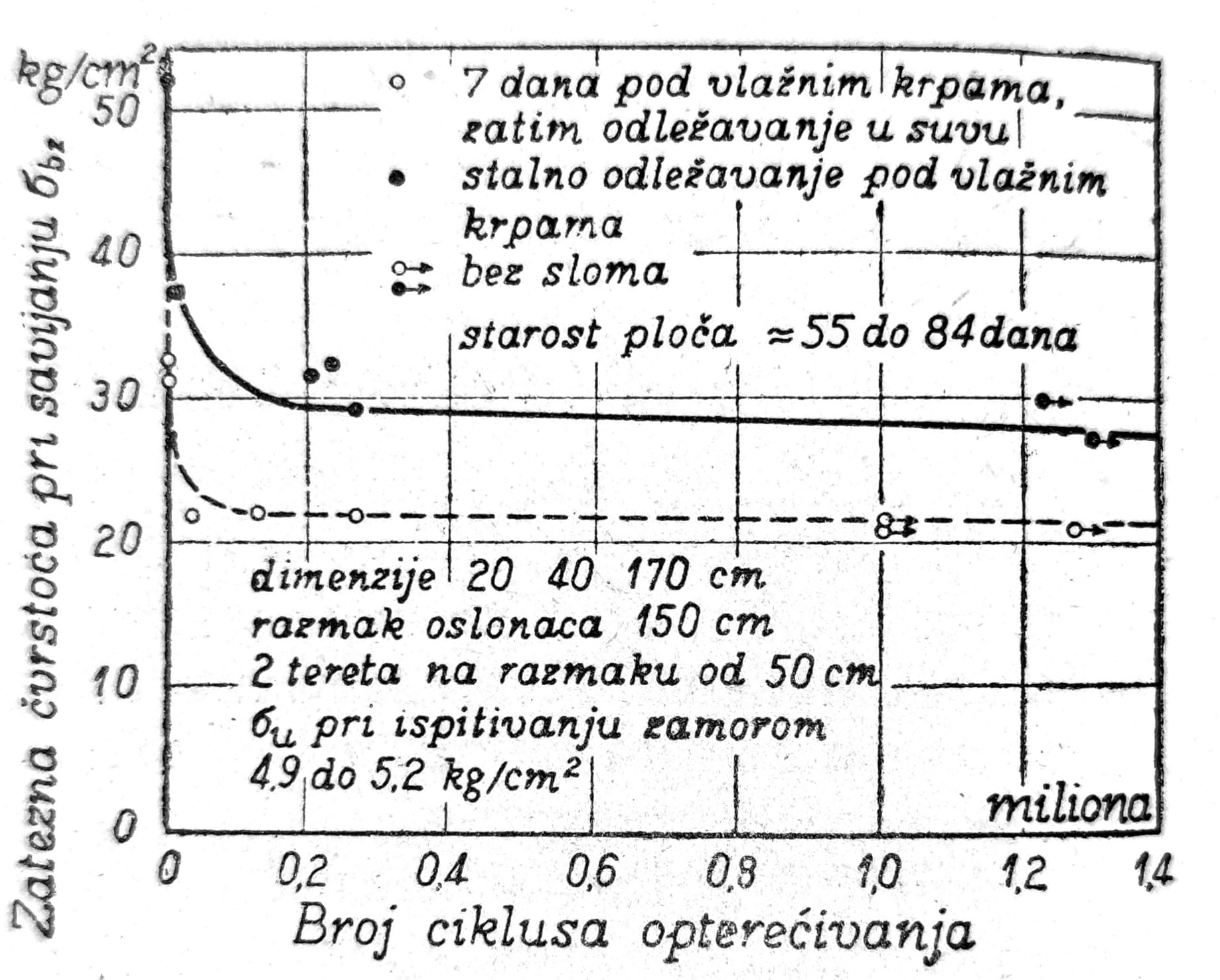
Fig. 2
2. Fatigue flexural strength of concrete. Tests shown in fig. 2 for beams kept permanently in a moist condition showed, under basic dynamic loading, that the fatigue flexural strength is 28 kg/cm2, while the ordinary flexural strength was 53 kg/cm2, which corresponds to the ratio 0,53.
Lightweight concrete
Lightweight concrete (concrete with a weight below 18 kN/m3) is obtained by using light, porous aggregates such as pumice, blast-furnace slag, boiler slag, and also by using mortars made of natural or artificial sand and flour with additives that generate gas during mortar preparation (aerated concrete) or cause foaming in the mortar (foamed concrete).
Lightweight concrete, among other things, is widely used for making masonry blocks and pumice slabs for walls and roofs; in dry condition it is a poor conductor of heat; its strength is moderate, but it is easy to adapt, so that lightweight blocks for load-bearing walls of residential buildings can be produced with confidence.
Aluminum powder is used as the gas-forming agent in aerated concrete. Depending on the amount of additives as well as other conditions, a more or less porous material is obtained, with a dry weight of about 3 kN/m3 and above.
1. Bulk density of lightweight concrete. With natural pumice, bulk densities can be guaranteed – assuming the oven-dried state at 105 °C – starting from 7 kN/m3 upward, with compressive strengths of 2 MPa. The bulk density that can be expected is approximately the sum of the aggregate and cement in loose state. Cellular concrete with bulk densities above 8 kN/m3 is generally technically unsuitable.
2. Compressive strength of lightweight concrete. For poured concrete, without any special measures, strengths of 8 MPa can be achieved, and with gravel even up to 12 MPa. Constant suitability testing is required. Porous concrete (aerated concrete and foamed concrete) is suitable for load-bearing walls only after hardening under steam pressure. With suitable raw materials, bulk densities of 6 kN/m3 and compressive strengths of 5 MPa can be ensured.
3. Flexural strength of lightweight concrete. The ratio between flexural and compressive strength proved, within practical requirements, to be relatively high, and as the strengths increase this ratio decreases.
4. Shrinkage of lightweight concrete. The degree of shrinkage depends mainly on the elasticity of the aggregate, as well as on the amount of hardened cement paste; shrinkage of lightweight concrete is greater than that of gravel concrete. Brick rubble concrete showed a total shrinkage of about 0,65 mm/m over the course of one year. Freshly delivered elements made of natural pumice, over 14 m months, shortened by about 0,8 mm/m. Samples of aerated concrete and foamed concrete that hardened in air showed even greater shrinkage, even over 2 mm/m. It should not be forgotten that every concrete, when moistened by rain and melting snow, swells, and when it later dries, shrinks again.
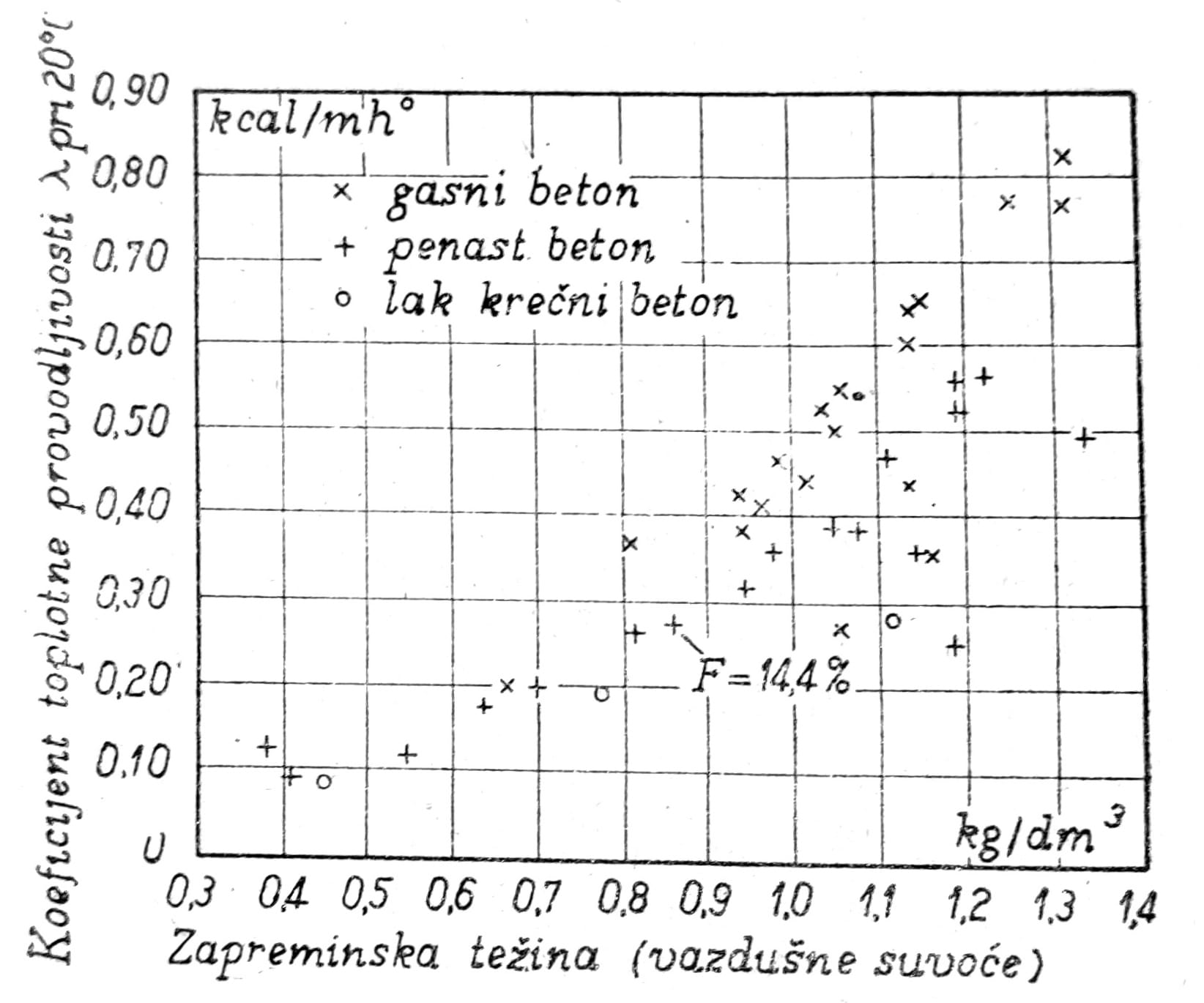
Fig. 3
5. Thermal conductivity coefficient. The thermal conductivity coefficient decreases with bulk density, and under otherwise identical conditions becomes the smaller the smaller and more uniformly distributed its air pores are. For air-dry lean concrete it was (λ = 0,4625 for 9 kN/m3; λ = 0,58 – 0,7 for 12 kN/m3; λ = 0,81 – 1,05 for 16 kN/m3). For air-dry cellular concrete, data are given in fig. 3.
NOTE:
- 0,1 kcal/mhoC = 0,1163 W/mK
- 0,1 kg/dm3 = 100 kg/m3 = 1 kN/m3