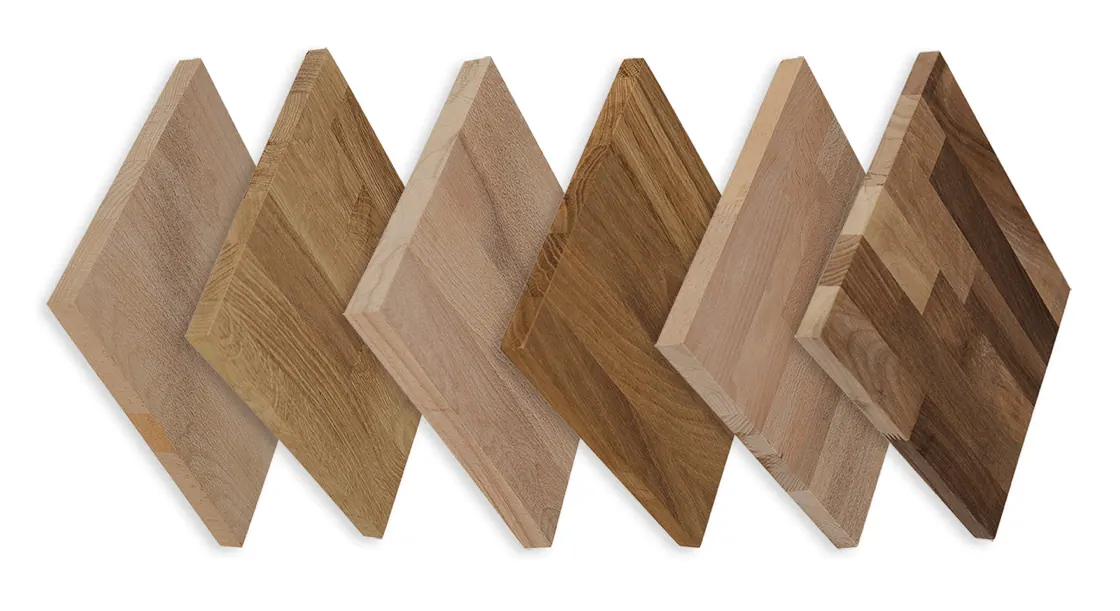
Wood species differ in structure, colour, strength, machinability, appearance, growth and durability under specific conditions of use. These differences are important when selecting material for construction and joinery products.
Most commonly used wood species
Softwood species are used for load-bearing structural elements:
- fir;
- spruce;
- pine;
- larch.
Oak and beech are particularly suitable for stairs, floors and similar applications.
How wood species are distinguished
The structure and colour of the wood, the growth of the trunk and branches, the bark, leaves and needles are distinguishing characteristics of a wood species.
A technician distinguishes wood on the basis of:
- its structure — heartwood, sapwood, growth-ring width, the proportion of latewood and the condition of earlywood;
- strength and machinability;
- appearance and growth, including knot content;
- the durability of the wood under the conditions prevailing in each specific case.
Fir and pine with very wide growth rings contain proportionally less latewood than wood with narrower rings. Such wood is less strong and easier to machine.
Beech with wide growth rings is most often considerably more resistant than wood with narrow rings. Straight-grained wood with few knots is technically more valuable than crooked, very knotty wood. Good pine withstands weathering longer than beech.
Wood structure
Growth rings, earlywood and latewood
Growth rings are usually clearly visible in a cross-section of a trunk. As a rule, each growth ring formed over one year.

Figure 1. The boundary zone between two pine growth rings under high magnification.
A growth ring begins with wide, thin-walled cells that appear light under ordinary observation — earlywood. It ends with narrow, thick-walled cells that appear dark — latewood.
According to Figure 1, it can be expected that, under otherwise identical conditions, wood with a higher proportion of latewood has greater load-bearing capacity and is more difficult to machine.
Pores in hardwood species
Figure 1 is characteristic of softwood. In hardwood, a distinction is made between wood with ring-distributed pores, such as ash in Figure 2, and wood with scattered pores, such as beech in Figure 3.

Figure 2. Ash with pores arranged in rings.

Figure 3. Beech with scattered pores.
Load-bearing capacity also decreases as the proportion of wide pores increases.
In addition to the cells already mentioned, which lie like tubes parallel to the axis of the trunk, Figures 1–3 also show medullary rays marked with the letter m. They extend radially from the centre of the trunk towards the bark. The number and thickness of the medullary rays affect the resistance of the wood across the axis of the trunk.
Growth-ring width
Growth-ring width varies greatly within each tree and even more between different trees. According to statistical data, in pine with particularly high weight, growth-ring width is approximately 1–2 mm.
However, it is not appropriate to classify pine with narrower or wider growth rings as less valuable. Strength is generally lower only in cases of very narrow and exceptionally wide growth rings, and often changes only slightly as a result of ring width.