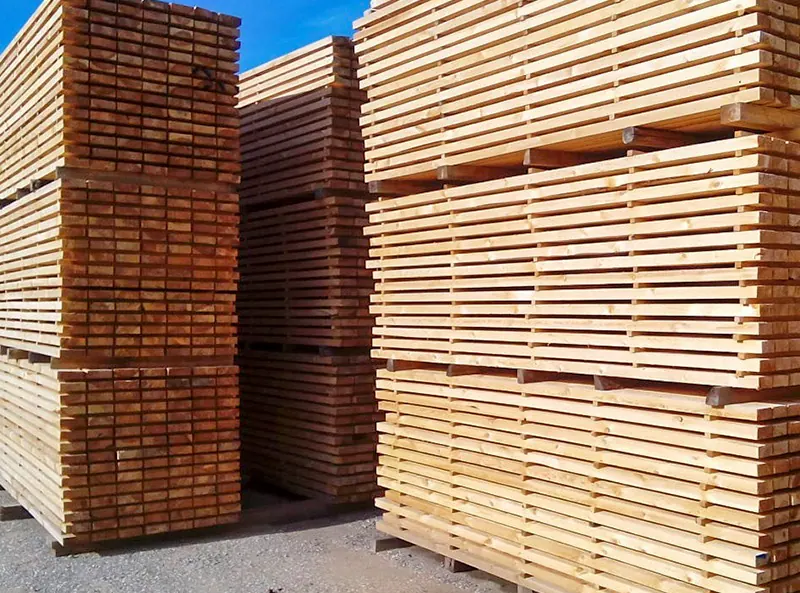
Division of sawn timber
Sawn timber means boards and slats of conifer species up to 100 mm thick, which are intended for use as a whole and for processing into parts and finished products in construction.
Sawn lumber is divided into boards, whose width is more than twice the thickness, and laths, whose width is not more than twice the thickness. The thickness of thin boards goes up to 35 mm, and thick ones over 35 mm.
According to the nature of processing, sawn lumber is divided into trimmed, where both narrow sides are trimmed along their entire length or each of them at least half of the length, and untrimmed, where the narrow sides are not trimmed at all or are trimmed less than half of the length. Both wide sides of both trimmed and untrimmed lumber must be machined along their entire length.
According to the quality of the wood and its processing, sawn timber is divided into the following classes: prima-extra, I, II, III, IV and V.
Classes of sawn timber according to purpose
| For construction | I, II, III, IV, V |
|---|---|
| For shipbuilding | I, II, III |
| For wagon building | I, II, III |
| For bridge construction | I, II, III |
| For building cars | I, II, III |
| For the construction of freight cars | II, III, IV |
| For making furniture | I, II, III, IV |
| For making parts for ships | I, II, III |
| For making wooden pipes | I, II |
| For making wooden packaging | II, III, IV, V |
The lumber class for timber structures must correspond to the design norms.
Sawn lumber of coniferous species
Sawn timber is produced from pine, spruce, larch, cedar and fir wood. The length of sawn timber ranges from 1 to 6,5 m with an increase of 0,25 m, and for shipbuilding and bridge construction up to 9,5 m with the same length increase.
Dimensions of boards and billets
| Element | Thickness | Width |
|---|---|---|
| Boards | 13, 16, 19, 22, 25, 30, 35, 40, 45, 50, 55, 60, 65, 70, 75, 85, 90 and 100 mm | From 50 to 260 mm, increasing by 10 mm |
| Beds | 25, 30, 35, 40, 45, 50, 55, 60, 65, 70, 75, 80, 90 and 100 mm | From 50 to 200 mm, increasing by 10 mm |
Widths and thicknesses of sawn timber are determined for wood with a moisture content of 15%. When the humidity is higher, sawn timber of all types of wood, except larch, must have an excess due to drying according to the current standard. For larch wood, the excess weighting due to drying increases by 30% of the sizes from the norms related to pine, spruce and cedar.
Dimensional deviations of sawn timber
| Measure | Determined deviation |
|---|---|
| Length | ±5 cm |
| Thickness up to 35 mm | ±1 mm |
| Thickness and width from 40 to 100 mm | ±2″ |
| Width from 105 to 210 mm | ±3″ |
| Width over 210 mm | ±4″ |
The moisture content of sawn timber is not standardized.
Beams of coniferous species
Coniferous beams, four-sided and double-sided, have a thickness of 110 to 240 mm. For four-sided beams, all four sides must be processed, and for double-sided beams, only two sides.
The length of beams is determined from 1 to 6,5 m, with an increase of 0,25 m, and for shipbuilding and bridge construction up to 9,5 m with the same length increase. Beams used for railway bridges have a length of 3,2; 4,2 and 5,2 m.
The width and thickness of the four-sided beams ranges from 110 to 240 mm. Beams for railway bridges are made in thicknesses and widths of 200 × 240, 220 × 260 and 220 × 280 mm. The width of the cut sides of double-sided beams is not standardized.
Beam dimensions are determined for wood with a moisture content of 15%. When humidity is higher, beams of all types, except larch, must have an excess due to drying according to the current standard. For beams made of larch wood, excess measurements due to drying increase compared to the norms prescribed for pine, spruce, cedar and fir. Beams for railway bridges can also be made of oak wood.
According to the quality of the wood, the beams are divided into four classes: I, II, III and IV. Which class will be used for certain engineering constructions and elements is prescribed by the appropriate standards and technical conditions for constructions and elements.
Class I beams are used for railway bridges and agricultural machinery. Class I and II beams should not be delivered before they have been aged in winches for less than 30 days.
Sawn lumber of hardwood species
In terms of quality, the wood must meet the requirements of the standard. Boards, slats and beams made of hardwood species are used both whole and in shorter pieces for various elements in various industrial production and construction.
Sawn timber is made from oak, ash, beech, birch, chub, hornbeam, elm, alder, aspen, linden, poplar, etc. It is divided into planks, whose width is greater than twice the thickness, laths, whose width is not greater than twice the thickness, and beams, where both thickness and width are greater than 100 mm. By thickness, sawn timber is divided into thin, up to 35 mm, and thick, 35–40 mm.
Processing of hardwood sawn timber
According to the nature of processing, sawn timber is divided into:
- trimmed, where all four sides are processed, and the size of the untrimmed sides is not larger than the permitted dimensions;
- untrimmed, where the wider sides are trimmed, and the narrow ones are untrimmed, or where the dimensions of the untrimmed narrower and wider sides are larger than allowed.
Dimensions and humidity
The dimensions of the sawn timber are as follows:
- length from 1 to 6,5 m, increasing by 0,1 m;
- thickness 7, 10, 13, 16, 19, 22 and 25–50 mm, with an increase of 5 mm, and 50–130 mm, increasing by 10 mm;
- width of 50 mm and more, with an increase of 10 mm.
The width of the unfinished material is the half sum of the widths of the two wider sides, measured in the middle of the length of the given material, whereby parts up to 0,5 cm are not included, and 0,5 cm and more are counted as 1 cm.
The dimensions of sawn timber in terms of thickness and width are determined for wood humidity 15%. When the humidity is higher, the sawn timber must have excess due to drying.
The moisture content of sawn timber should not be higher than 25% abs. According to wood defects, purity of processing and degree of accuracy, sawn timber is made into four classes: I, II, III and IV.
Related topics: lumber, wood moisture, wood drying, woodworking machines and tools and wooden window and door production.