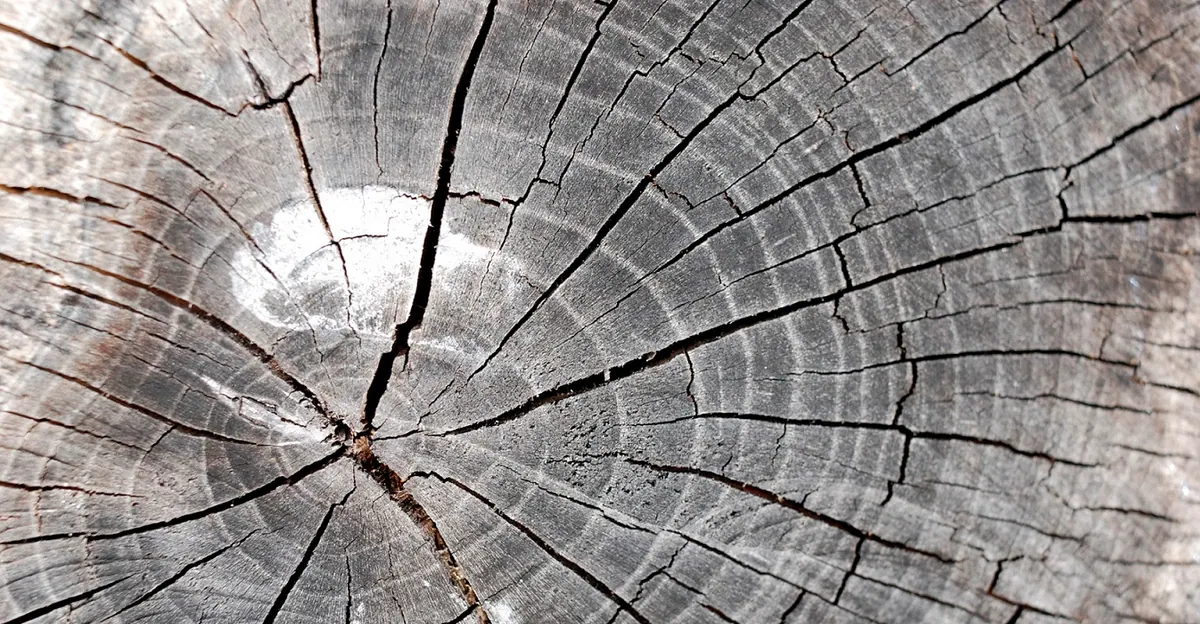
The quality of wood is determined by the presence or absence of defects, which in most cases reduce its strength or impair its external appearance.
Knots
In felled wood, there are sound knots that have grown into the wood, sound knots that have partially grown into it, and knots that have not grown into it — loose, porous knots that fall out easily (Figure 4). Knots are a fundamental defect that determines quality in wood species and wood products because they disturb the uniformity of the wood, make it more difficult to process and reduce its strength.
When there are knots in wood, the reduction in its strength depends on the stage of decay of the knot, its size and the place where it is located. For example, knots located in the tension zone and at the edges of ceiling beams have a strong influence on their load-bearing capacity. Timber trusses must not contain knots with a diameter greater than 10 mm.
In sawn timber, the wood is weakened most at places where there are spike knots and large intergrown knots. Knots that have partially grown in, and especially those that have not grown in at all, impair the integrity of the elements and reduce the quality of the wood even more than sound, intergrown knots.
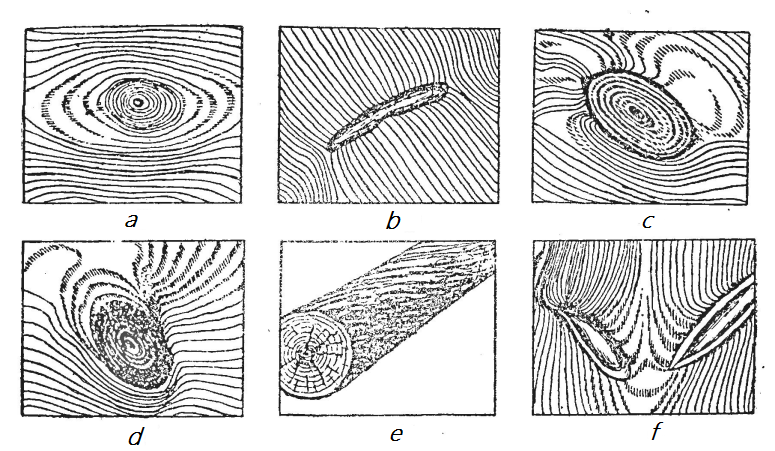
Figure 4: Knots — a) sound, hard, intergrown; b) not intergrown or partially intergrown; c) falling; d) horn knot; e) spiral grain; f) spike knot.
Abnormal colours and rot
Abnormal colours and rot are divided into internal and external types.
Internal colours and rot
Internal colours and rot (Figure 5) occur during the life of the tree in the heartwood of mature wood or in the central part of the trunk. They are generally caused by fungi that destroy the wood. Fungal spores enter the interior of the trunk through broken branches and injuries to the trunk and roots.

Figure 5: Rot in pine.
In felled wood from coniferous and heartwood-forming deciduous species, the activity of the fungus ceases. In the wood of sapwood deciduous species (without heartwood), fungal development can continue even in felled wood.
Internal reddening, spotting and false heartwood do not have a major influence on changes in the strength of the wood. Internal rot, caused by fungi, destroys the wood and makes it unsuitable for use in construction.
External colours and rot
External colours and rot occur in felled wood while it contains sufficiently high moisture. During artificial drying, all fungal spores that cause external colours and rot die.
External colours and rot include yellow rot, brown discoloration, blue-black streaks, black spots, blue stain and mould. They impair the external appearance but reduce the mechanical properties of the wood only slightly. Sapwood rot, pitted rot and peripheral soft rot destroy the wood. Some wood defects are shown in Figure 6.
Wood infected with house fungus loses its mechanical properties and, as a source of infection for sound wood in storage areas and on construction sites, should be burned.
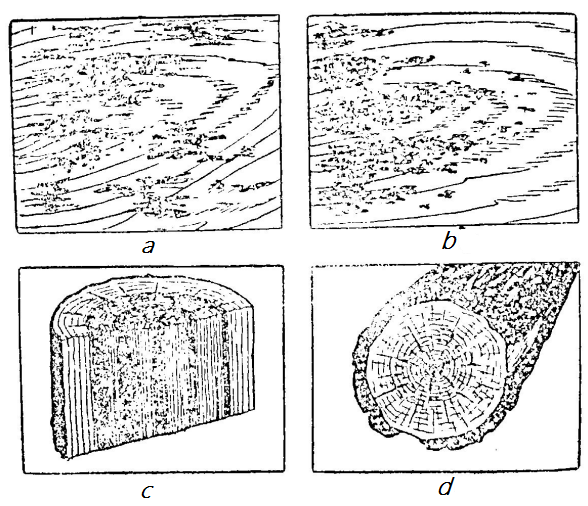
Figure 6: Rot in different types of wood caused by wood-destroying fungi — a) mould; b) blue stain; c) brown discoloration; d) sapwood rot.
Cracks
According to the time at which they appeared and the nature of the damage, cracks are divided into cracks in growing wood, which include fire cracks, ring shakes and frost cracks, and shrinkage cracks caused by the drying of the wood. Cracks impair the integrity of the wood (Figure 7).
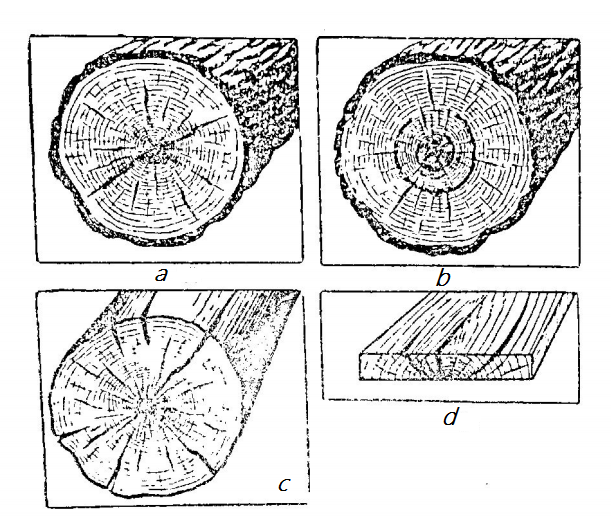
Figure 7: Cracks of mechanical origin — a) fire crack; b) ring shake; c) cracks caused by drying and shrinkage in roundwood; d) shrinkage cracks in boards.
Defects in the shape and structure of the trunk
Defects in trunk shape
Defects in trunk shape consist of curvature, fluting, spiral grain and eccentric pith. This type of defect reduces the percentage yield of timber.
Defects in wood structure
Defects in wood structure — spiral grain, irregular fibre direction, irregular growth-ring lines, internal double sapwood, double pith and false heartwood — are associated with an abnormal structure of the tree trunk.
Spiral grain, irregular fibre direction and irregular growth-ring lines reduce the mechanical properties of the wood.
The density, shrinkage and hardness of spiral-grained wood are greater than those of sound wood. However, because wood with a small proportion of partial spiral grain does not show significant changes in physical and mechanical properties compared with normal wood, it is permitted for use in construction with certain restrictions. Pronounced spiral grain reduces the quality of roundwood assortments. Double sapwood in oak standard timber also reduces quality.
Pith of the wood
The pith of the wood causes sawn timber to split during drying and impairs its quality. In roundwood, the pith zone is not considered a defect. Double pith impairs the quality of roundwood. Eccentric pith often significantly reduces the mechanical properties of wood, which in such cases is classified into lower grades, down to firewood.
Wounds, scars and deformations
Wounds are a group of defects that includes mechanical injuries, scars, partial drying and deformations caused by wounds. Mechanical injuries can reduce the value of wood and contribute to the tree becoming infected with fungi while it is growing, as well as to roundwood becoming infected while being kept in storage.
Scars and partial drying impair quality, disrupt the integrity of the wood and cause the annual layers to curve.
Canker deformations impair the mechanical properties to some extent and reduce the quality of the wood.
Abnormal secretion
Incrustations, resinousness and resin pockets also impair the quality of the wood.
Choosing wood for windows and doors
Proper assessment of timber is one of the subjects related to making wooden windows, wood-aluminium windows and doors. For a specific project and the required dimensions, send a request for quotation.