Machines powered by an electric drill
An electric drill can be fitted with different working heads or used as the drive motor for other types of machine tool. The difference between a drill with a working head and a machine powered by a drill is purely formal. The essential questions are economic viability, the space required and frequency of use. A motor with the same characteristics as a drill occupies little space, but its price is high. Therefore, if both possible drill functions are not required at the same time, it is more economical to have just one motor — the electric-drill motor — and a series of tools and machines without their own corresponding motors.
We can then use either the drill itself or the drill as the drive unit of a machine tool, depending on the need.
Piercing saw or jigsaw
The piercing saw, or jigsaw, is the first device that could be called a “machine tool without a drive motor”, if we consider the general division into hand tools and machine tools. The device transforms the rotary movement of the motor into a reciprocating, straight up-and-down movement of the saw.
The saw blade, 10 to 15 cm long, is fastened in its vertical guides. By placing the drill on a board or wooden panel and pressing down so that the teeth engage the wood, we can cut wood up to 40 millimetres thick and metal up to 2–3 millimetres thick, if a fine-toothed metal-cutting blade is fitted. The machine can also be fitted with metal guides that permit cutting parallel to the edge of a board or panel. Otherwise, the piercing saw is used for cutting circles, provided the radius is not too small, which are later finished more precisely with other tools. It takes up little space, is inexpensive, light and safe to use, although it is somewhat slow, especially when cutting thicker materials or metal.

The piercing saw transforms the drill’s rotary movement into linear movement of the blade.
Circular saw
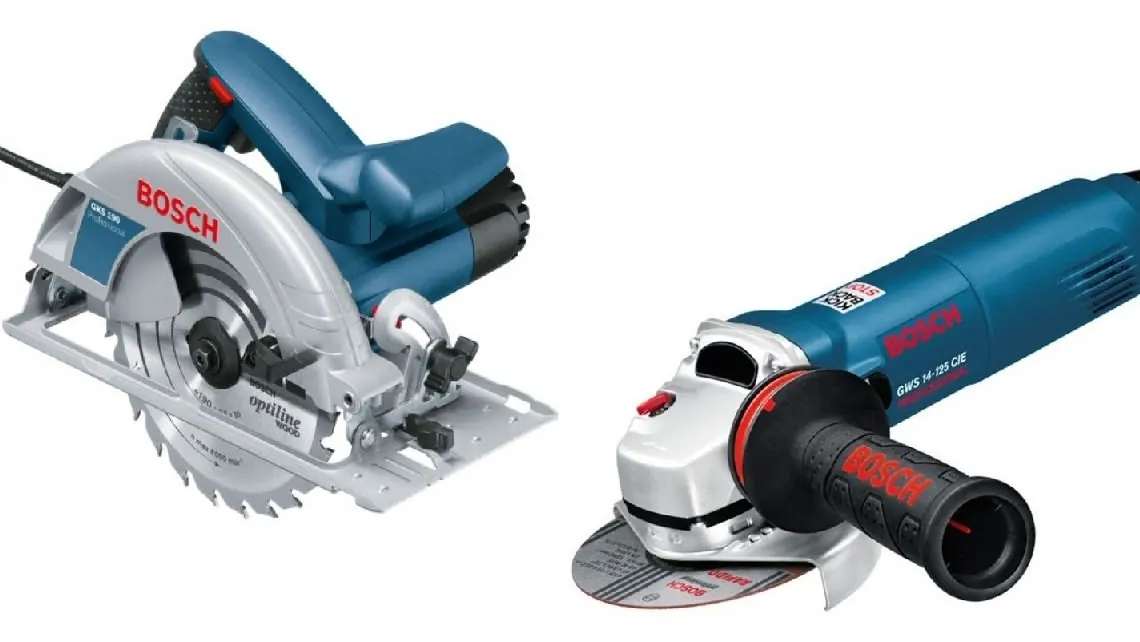
A small circular saw can also be connected to an electric drill. It is suitable for cutting wooden panels and boards, but only in a straight line, as well as plastic sheets, thin non-ferrous metal plates and similar materials. The machine consists of a disc that carries the circular-saw blade, a fixed base with a protective guard, and a parallel guide that allows the entire device to be guided parallel to the edge of a panel or board.
The cutting speed is much higher than that of a reciprocating saw, but the machine must be used very carefully. If handled inexpertly, it may escape from the hand by rebounding from the workpiece and cause serious injury. It can also break and eject fragments of metal, despite the protective guard, which can easily cause injury.
There are also “integral” saws: tools independent of the drill and intended for multiple uses. Thanks to a slide that changes the angle, longitudinal, transverse and even angled cuts can be made. A circular saw can also be installed on a workbench after first being attached to a suitable metal plate adjustable for depth and inclination. The saw is then less dangerous because the workpiece is moved. If no workbench is available, it can be fixed to the metal plate itself using four legs so that it still functions as a true table saw. Owing to its high feed speed, a circular saw provides performance far beyond the needs of household work.
Various saw blades, usually made of special steel, can be fitted according to the material to be cut. Common examples include:
- medium-toothed blades for soft and hard wood;
- fine-toothed blades for hard and soft wood, plywood, panels and plastics, plastic-coated panels, Bakelite, cellulose, Plexiglas, non-ferrous metals and other materials; blades of this type are particularly suitable for cutting across the direction of the wood grain;
- wide-toothed blades reinforced with hard metals for cutting compressed hardwood and hard plastics reinforced with glass fibres;
- discs for cutting brick, fibre-cement board, cast-iron objects, ceramics, stone and similar materials.

Circular saw intended for straight-line cutting of panels and boards.
Band saw
This machine is derived from an industrial machine, especially for carpentry and joinery work. It consists of two or more large-diameter wheels, over half a metre on industrial machines and much smaller on hobby machines, with horizontal shafts mounted in bearings one above the other. One wheel is driven by an electric drill or a built-in motor. A continuous-loop band-saw blade runs over the wheels. A metal table is positioned in the middle of the machine, and the workpiece, most often a board, is pushed across it during cutting. The wheels are protected by covers, while the exposed section of the blade is reduced to the necessary minimum for safety.
These machines, which are rather large for anyone without a workshop, are most often used by people who live in detached houses and frequently work wood, for example when making slatted fences, attic flooring or sheds for garden equipment. The machine has a very high work output and is particularly suited to ripping boards and panels more than two metres long. This work can also be done with a jigsaw, a circular saw fixed to a workbench or even by hand, but it would take much more time. In holiday homes, this type of saw can also be used to cut tree trunks for a fireplace or stove — substantial work that cannot be performed with other saws.
Smaller models with narrow band-saw blades have recently become available. They can also make curved cuts if the radius is not too tight. Machines of this type, weighing a little over ten kilograms, can also cut fairly thick blocks of metal if fitted with a suitable band blade.

Band saw with a continuous blade running over wheels.
Orbital sander
An orbital finishing sander can be supplied either as a complete machine or as an attachment for an electric drill. Its housing contains an eccentric rotating drill connection that transforms rotary motion into vibrations transmitted to the base of the device. Sandpaper of the appropriate size is attached to the sander base.
The orbital sander is used by placing it on a wooden or metal surface and passing over the area section by section with light, even movements. The sanding is first-class and can be coarser or finer depending on the grit of the abrasive paper. The sandpaper must be changed frequently. The machine is light and safe to use and does not require great effort.
Belt sander
Among electric-drill attachments, the belt finishing sander lies somewhere between an orbital sander and a disc grinder. The first of these machines, which works slowly, makes it possible to finish and polish wood or metal working surfaces. A rotating-disc grinder works with more power and can remove various hard deposits, adhesive residue from wood and other material. It is primarily suitable for metal work: removing burrs, levelling welded sections, dulling edges and sharp corners, and preparing surfaces by giving them a certain roughness for better adhesion of filler and paint. A belt sander works with more power than an orbital sander but less than a disc grinder. Held with two hands, it can be used as a portable machine for sanding wood and metal, dulling edges and sharp corners, and levelling irregularities left by earlier metalworking.
It can also be fixed to a workbench when smaller and medium-sized metal or wooden parts are to be finished, sanded or polished. In that case, the machine is not pressed and moved over the workpiece; the workpiece itself is placed on the rotating belt. Such a sander consists of a base that can be fixed to a workbench, handles for holding it when used as a portable machine, and two wide light-alloy rollers mounted on the machine base. One roller has a connection for an electric drill or its own motor. The free roller can be moved closer or farther away by a tensioning device that also permits belt replacement and prevents the belt from slipping off the rollers during operation.

A belt sander can be used as either a portable or benchtop machine.
Benchtop sander with a face disc
This fixed benchtop sander with a face disc can also be obtained either as an attachment for an electric drill or as a separate machine with its own drive. It is always fixed to a workbench with the disc perpendicular to the bench, several centimetres above its surface. Round abrasive paper or cloth with glass grains, in various grades, is attached to the disc by a small, simple, wide screw in the centre. At the height of the disc centre, a movable metal table slides on rails. The workpiece is placed on this table and pressed against the disc, avoiding the danger that it will slip or be positioned incorrectly in relation to the disc.
This machine, which is best powered by a variable-speed motor, can bring previously cut metal or wooden objects to accurate dimensions. It provides high precision and can produce machined surfaces completely perpendicular to the longitudinal axis of the object. In this way, strips, pipes and long, narrow boards made of wood, metal, brass, plastic and even glass are worked, provided that the appropriate abrasive paper is selected for each material.
The face-disc sander can sometimes also be used to finish and polish smaller objects that can be held in the hands. Care must then be taken not to touch the disc by hand, because injury may result.
Grinding disc
The basic part of a grinding-disc machine is a rotating disc with a protective guard to which various coarse-grained abrasive materials are attached. It is a portable machine used mainly for coarse metalworking, such as dulling edges, levelling welded seams, grinding surfaces deeply affected by corrosion, removing old paint and similar tasks. The machine is easy to handle, but care is needed to prevent it from slipping from the hand.
Mitre circular saw
The mitre circular saw is a special version of the circular saw, derived from an industrial machine but much smaller. It can be powered by an electric drill or its own motor. The saw and its motor are hinged to a work table and equipped with a handle that allows the whole machine to be raised and lowered toward the flat table.
The part to be cut is positioned and secured on the work table with wedges and clamps while the saw is in its upper position. After the motor is started, the housing with the saw is lowered using the handle and cutting begins. This type of saw permits strips, pipes, frame profiles and any other objects of suitable dimensions to be cut very precisely and at different angles.
Wood is cut at high rotational speed. For metal, including pipes and other light-alloy and steel profiles, the appropriate saw blade must be used and the motor set to a lower speed. Purchasing the machine is worthwhile only if it is expected to be used systematically for sawing larger quantities of material.

The mitre circular saw permits precise cutting at different angles.
Vibrating saws and small saws
A vibrating saw is a typical machine for model makers and craftspeople engaged in carving and fine joinery, because it makes it possible to cut material with great precision and speed even along curves with a very small radius. The material can be plywood, plastic, sheets of softer metal alloys, copper and sometimes sheet metal made of softer steel. The machine housing is attached to a round or square table that serves as a support, with a thin blade passing through its centre. Inside the machine, a vibration system gives the saw rapid up-and-down movements with a short stroke of 1 cm or less, sufficient to cut the material faster. Faster sawing would be incompatible with the precision required of these tools.
There are also vibrating jigsaws handled like ordinary hand jigsaws, but with a vibrator in a handle as large as that of an electric drill. Because they have low power, they can be powered by either mains electricity or batteries.
Bench grinder
A bench grinder consists of a motor with a base fixed to the workbench and usually two grinding wheels, one at each end of the motor shaft. It generally has two tool rests and two protective guards. The two wheels have different grit sizes: one coarse and the other much finer. The coarse wheel is used to dull sharp edges and level small surfaces. The fine wheel is used for the initial sharpening of tools, such as chisels and plane irons, which is later completed by hand on a special sharpening stone.
We must be very careful with these machines and already have at least some knowledge of their operation. Workpieces must be held firmly and brought slowly toward the wheel because it tends to pull them. The machine is usually fitted with a protective glass shield because of sparking, and this must always be attached. Most eye injuries occur precisely when a grinder is used without this protective part and without special goggles that protect against sparks, swarf and other particles. In terms of its capabilities, the bench grinder is therefore a professional machine, difficult to operate, and it must be firmly fixed to a workbench or wall bracket.
Smaller models without motors are also supplied as electric-drill attachments. These models usually have one round grinding wheel.

Bench grinder with wheels of different grit sizes.
Chain saw
A smaller electrically powered saw was derived from the classic chain saw with an internal-combustion engine used by lumberjacks. It can cut smaller trees and shrubs. It is useful only to those who own a large garden.

Small electric chain saw.
Related topics: woodworking machines and tools, band saws, circular-saw machines, processing services and production of wooden windows and doors.