Important warning: This is a historical archive text, not a current machine specification, risk assessment or turning and milling manual. Models, speeds, dimensions, power ratings, tools, rotating parts, protective devices, electrical supply and procedures must be checked against applicable regulations, the manufacturer’s documentation and safe-working rules.
This text is not an offer of lathes, tools or service documentation from Savo Kusić. The current offer focuses on windows, doors and related solutions.
Lathes and historical features
Woodturning lathes are intended for producing shaped wooden parts with a straight geometric axis. The text divides them into centre lathes, faceplate lathes, frontal lathes and lathes for special turning work.
The basic technical characteristics are the centre height, the maximum distance between centres and the maximum workpiece diameter that can be hollowed. The historical text describes the light-duty TV-200 lathe with the following characteristics:
- Lathe centre height 200 mm
- Distance between centres 1500 mm
- Spindle revolutions per minute 250, 400, 1000 and 2500
- The largest diameter of the element being processed:
- above the base 380 mm
- above the upper part of the support 80 mm
- hollowing 600 mm
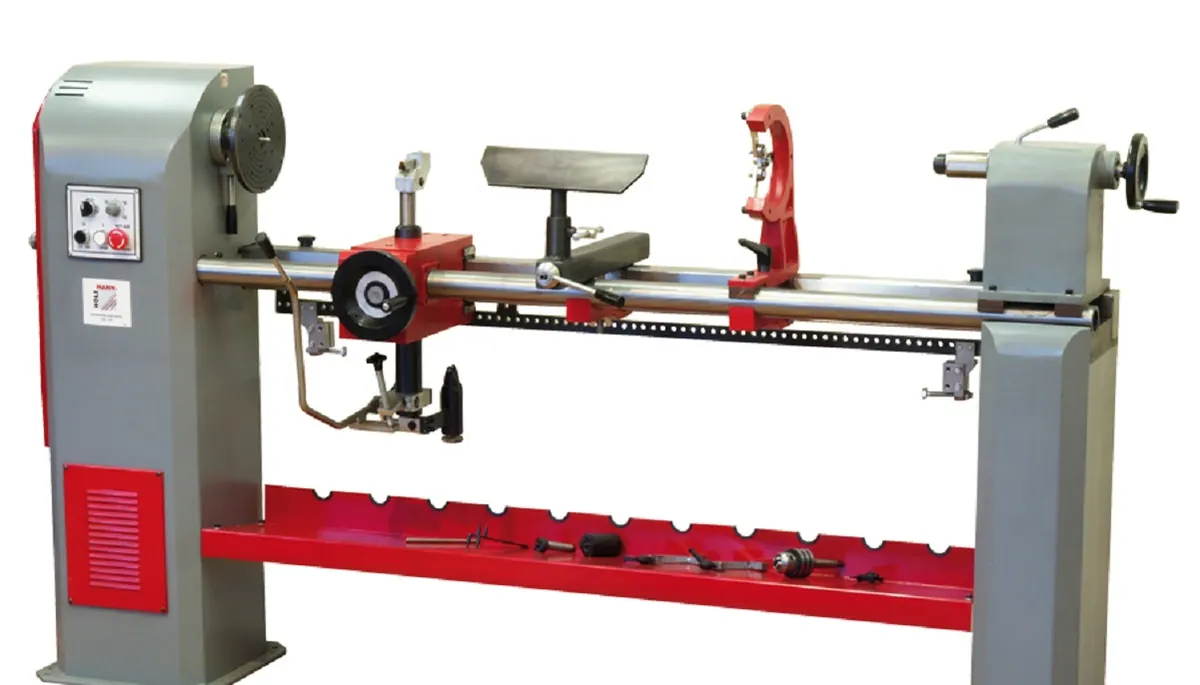
This lathe consists of a bed, headstock, tailstock, electric motor, faceplate and tool rest.
Tools and lathes for round profiles
The listed lathe tools are knives, a turning chisel and a turning gouge. The first tools are used for initial roughing and the others for fine work. During turning, the workpiece rotates while the tool moves in a straight line parallel to its axis; the tool can also move perpendicular to the workpiece axis.
Lathes for the production of round profiles are used for the production of round rods for fastening building elements, for processing elements for bent furniture, etc.
The lathe tool for making round profiles is a rotary head with a set of knives, the blades of which are turned towards the hole through which the element passes during processing. The construction of the rotating head with knives is such that they can be installed and removed easily and quickly.
The KPCA - 2 brand lathe was used for the production of round bars, which can process bars with a diameter of 10 to 50 mm, and a length of up to 500 mm.
- This lathe has four feed rates 15, 20, 30 and 40 m/min
- Number of revolutions of the head with knives per minute up to 4000
- Power of the electric motor that drives the head 4,5 kW
- The power of the electric motor that moves 1,2 and 2,2 kW
This lathe consists of a stand, a head support with knives, on which the head with knives is fixed, a feed mechanism with front and rear spikes and a guide. An electric motor is placed inside the base on the supporting plate, which rotates the main shaft and the head with knives via a triangular belt, and an electric motor for displacement with a two-stage transmission pulley.
Copy lathes
Copying lathes are intended for producing shaped symmetrical and asymmetrical wooden elements. They are divided into cross-copying, longitudinal-copying and face-copying lathes. The shape and dimensions of a part are determined by a copy model kinematically linked to the cutting tool.
Transverse copying lathes are intended for copying shaping of various details.
Technical characteristics of this lathe:
- Diameter of the element to be processed up to 200 mm
- The largest length of the wooden element 600 mm
- Diameter of the knife head 250 mm
- Number of revolutions of the knife head up to 3000 rpm
- The speed of movement of the knife heads towards the element being processed 0,3 m/min
- Duration of the working cycle 10 sec
- The length of time of placing the element between the spikes 5 sec.
- Lathe productivity in one shift of 2500 elements
- The power of the electric motor for the movement of the knife head 1,6 kW
- Power of the electric motor for displacement 1,7 kW
Longitudinal-copying lathes produce shaped asymmetrical elements from a copy model. The cutting tool moves from one end to the other along the model’s outer form while the model rotates in step with the workpiece.
Multi-spindle copy-sculpture lathes are intended for the production of various figures, for the production of carvings, sculptural reliefs, children’s toys and other artistic-copy works.
Copy-milling lathes
For processing flat and relief surfaces, for drilling holes, making ornaments of different shapes, grooves, for milling edges, etc. a copy-milling lathe with an upper spindle brand VFK-I was used, on which holes with a diameter of up to 36 mm can be drilled. The technical characteristics of this lathe are:
- Table dimensions 1170 x 700 mm
- The height of the spike axis from the base 600 mm
- Vertical movement of the table 140 mm
- Vertical spindle displacement 130
- Maximum distance from the face of the spike to the table 472 mm
- Rotation angle of the spindle head ± 360o
- Spindle revolutions per minute 18000
The electric motor receives electricity from the frequency transformer, which increases it to 300 periods per second.
Copy lathes are rarely used in construction industry companies.
Copy-milling lathes with the upper spindle of foreign brands are used as well as ordinary vertical-milling lathes for drilling round holes and grooves, for making ornaments, for making elements with a curvilinear shape according to a template, etc.