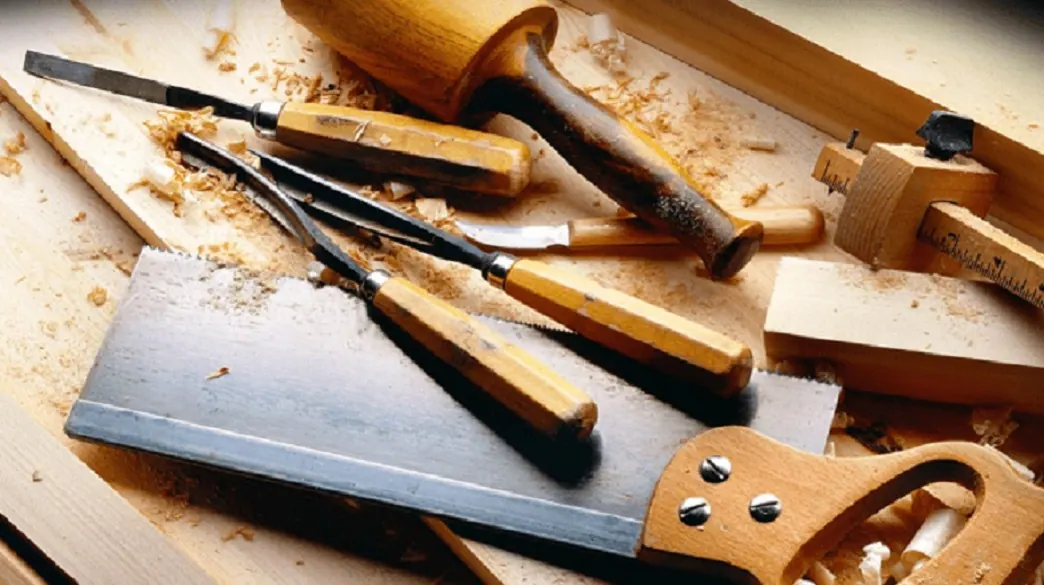
Joinery and construction products and elements must be hygienic, attractive and comfortable in use; they can be divided into frame, panel and frame-and-panel products, with rectilinear and curvilinear forms.
Wood behaviour under changes in temperature and moisture
Under the influence of temperature and moisture, wood can change its dimensions within fairly wide limits. For example, when drying from the hygroscopic (moisture) limit to a completely dry state, depending on the species, wood changes its dimensions along the grain by 0.1 to 0.3%, in the radial direction by 3 to 6%, and in the tangential direction by 6 to 10%.
Thus, over the course of a year, the moisture content of external beech doors changes from 10 to 26%. This means that each board in those doors that is 100 mm wide increases its dimensions by 5.8 mm when it takes up moisture and decreases by the same amount when it dries. In this case, gaps form between the boards.
This can be avoided if joinery products are constructed so that the unavoidable changes in individual parts of the product can take place freely, without impairing shape and strength. For example, when making a panelled door, the panel inserted into the grooves of the vertical frame members should have a clearance of 2 to 3 mm, while still not coming out of the groove when it dries completely (Figure 1).

Figure 1: Cross-section of a panelled door
Joinery products should be made from narrow solid or glued strips (board panels for doors, joinery boards, etc.).
Direction of load and connection of elements
Joinery and construction elements are not subjected to greater static or dynamic stresses during use. Nevertheless, when designing these products, care should be taken that the direction of stress coincides with the direction of the wood grain, or deviates only slightly from it. Otherwise, the strength of the elements can be considerably reduced.
Elements of joinery and construction products are connected to one another in a straight line or at an angle by means of tenons and mortises — slots, glue, screws, metal straps and nails.
Tenon and mortise
Elements are most commonly joined by means of a tenon and mortise. The strength of a tenon-and-mortise connection depends on the moisture content of the material and the accuracy with which the tenon and mortise are made.
Most joinery and construction elements are joined with a single or double tenon that has a flat or round shape. However, round pegs — dowels — are widely used in door construction to connect vertical and horizontal elements, door frames with panels, and so on. These joints do not reduce the strength of the product and provide a 17% saving in wood compared with other methods.
When making doors, built-in household furniture, lift cabins and similar products, the ends of boards and beams are joined with a double tenon, with a tenon and mortise, and with a toothed tenon and mortise. In these cases, boards and strips are joined with flat or round tenons and mortises or inserted wooden pegs (Figures 2, 3 and 4).

Figure 2: Glued door elements faced with veneer

Figure 3: Details of board joints

Figure 4: Connection of vertical and horizontal door parts using inserted round pegs
Dimensional ratios of tenons and elements
For a product to be strong and sufficiently rigid, there must be a defined relationship between the dimensions of the tenon and the elements. The following dimensional ratios are recommended:
- the width of the core must be equal to half the width of the element containing the groove;
- the length of the tenon should be equal to the entire width of the beam or board, less the shoulders of the joint;
- the thickness of a straight tenon is made from 1/3 to 1/7, and the thickness of a double tenon from 1/3 to 2/9 of the thickness of the element;
- the shoulder size is from 1/3 to 2/7 for the first tenon and from 1/5 to 1/6 of the thickness of the element for a double tenon;
- the width of the mortise for a double tenon should be equal to the thickness of the tenon itself.
There are various types of joints. The principal ones are shown in Figure 5.

Figure 5: Different types of joinery joints
Gluing panels, tongue and groove
In practice, panels are most often joined with glue on the contact faces, or with tongue and groove with a spline. When beams are glued together across their width, the joining faces of the beams must be smoothly drilled, quickly assembled into panels and clamped in a wedge clamp. The glued panels should be planed on both sides on a double-sided planer to remove irregularities formed during gluing.
Tongue and groove joints can have a rectangular, triangular, semicircular, oval or dovetail shape. This method is most often used to make door panels, parquet, and vertical and horizontal door elements from offcuts on special joining machines — automatic joining machines — and requires a large amount of wood, so it should therefore be used only in cases of exceptional need.
A joint with a spline is used when making parquet floors. The spline is made from softwood.
Screws, metal connectors and wooden pegs
Screws are used to connect window and door elements, built-in household furniture, lift cabins and similar products. Before they are driven in, the screws should be coated with stearin, graphite dissolved in vegetable oil, grease or something similar.
At the places where screws will be fitted, holes should be drilled whose depth is approximately equal to twice the thread depth. If two thicker elements need to be joined, a hole equal to the diameter of the screw is drilled.
Joints made with iron connectors (Figure 6) are not widely used in practice, but can be used to connect vertical elements with horizontal ones, in door rails and in doors with infill.

Figure 6: Joints using iron connectors
Nailed joints are not used to connect joinery elements. Wooden pegs are used in the manufacture of windows, doors and other joinery and construction products, for supplementary connection of elements at their joints, and to prevent deformation of different frames during use.
Gluing and assembly of structures
A characteristic feature of tenoned joinery connections is that they can only be made with the use of glue. These connections must not be made without gluing. Elements that have been glued must remain tightened in the clamp for at least 6 hours under a pressure of 2 to 12 kg/cm².
Solid elements of joinery products can be assembled by gluing smaller elements of one wood species, as well as by combining valuable species with ordinary wood. Vertical and horizontal elements of windows, doors, boxes and other products can be made from glued coniferous wood faced with oak boards 8–10 mm thick (Figure 7). It is desirable to glue the elements and face them with wood using water-resistant phenol-formaldehyde adhesives.

Figure 7: Glued window and door elements faced with plates of hard deciduous wood
Frame and frame-and-panel structures are assembled using mechanical, hydraulic or pneumatic clamps.
Custom-made windows and doors
To view contemporary solutions, see our wooden windows, wood-aluminium windows and doors, or send a request for quotation.