Glazing work
Knowledge of glazing work is particularly useful when there are children in the family. If a home is insured, damage caused by broken glass is recognised, but it can be difficult to wait—especially in cold weather—for the formalities to be completed and the repair carried out. Glass hardly needs an introduction, because almost everyone has had the “good fortune” to break a window. Window glass is known as flat glass and is produced in thicknesses of 1.3, 1.5, 2, 3, 4, 5 and 7 mm. Dark, opaque and patterned glass is produced from flat glass by sandblasting or etching, in dimensions similar to those of flat glass.
Cast glass is thicker: 5, 6, 7 and 9 mm. Patterned cast glass is 4.5 mm thick, ribbed or cathedral glass is 5 mm, and wired glass is 6 mm.
The triangular glazing point is an important auxiliary material in glazing work. Its thickness ranges from 0.3 to 1.5 mm, and its height from 6 to 18 mm, in proportion to the thickness and dimensions of the glass pane.
Glazing putty is familiar to almost everyone. It consists of 12% linseed oil, 88% chalk and 1% lanolin.
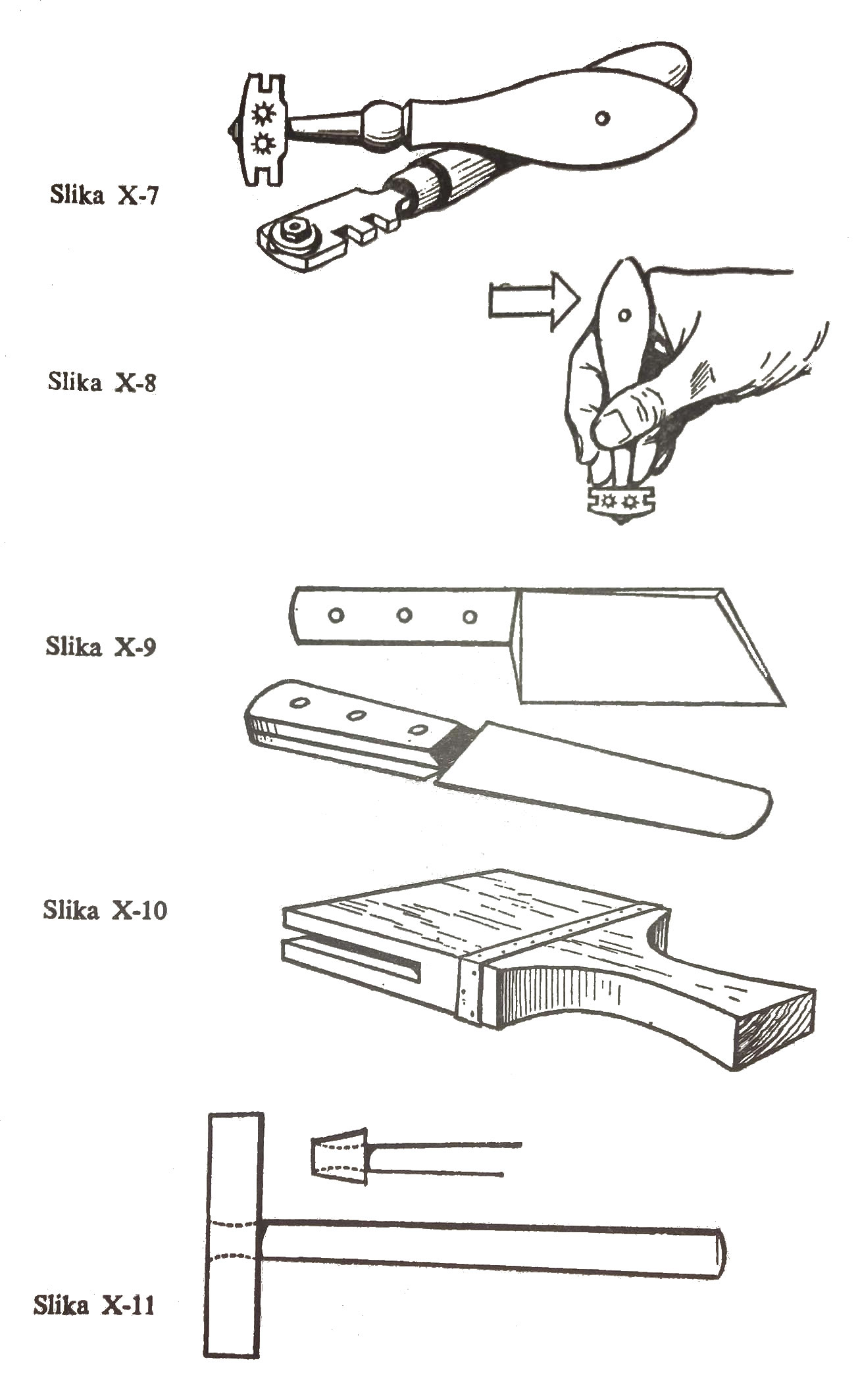
Two types of cutter are used for cutting glass. The first is the diamond knife, usually called simply a diamond, whose most important part is the diamond itself. The second is a cutter with a steel wheel. Only natural, unprocessed cutting points can cut glass well. Worn points do not work well because they produce interrupted, discontinuous cutting surfaces and lines (Fig. X-7).
To hold a diamond glass cutter correctly, place the index and middle fingers of the right hand on the rounded part of the handle, because only this position makes it possible to apply the necessary pressure. The small mark on the handle should always face the person using the cutter (Fig. X-8).
The diamond glass cutter should always be clean and may be dismantled only by a specialist. After cutting, it should be placed in a leather case. Care must be taken to ensure that the same cutter is always used in the same position.
A cutter with a steel wheel is used primarily for cutting thicker cast glass, because irregularities on the surface of this glass would seriously damage a diamond. The cutter consists of a 5 mm diameter cutting wheel made of hard metal, or tungsten carbide, with a 2 mm opening in the centre. The cutting edge is thinned or ground to the appropriate shape. When it is held perpendicular to the plane of the glass, the wheel rotates so that it virtually skips over minor surface irregularities instead of catching on them, leaving a continuous cutting line. This tool requires greater pressure than the diamond cutter. Its cutting wheel also makes a wider line.
There is a hole in the middle of the wheel holder through which it is fastened to the handle by a screw. Numbering makes it easy to replace the wheel with one of the 6 spare wheels in the tool. A felt pad should be placed under the tightening screw. Soaked in kerosene, this pad protects the wheels from overheating by lubricating them continuously during cutting.
Glazing knives
The groove-cleaning knife is the glazing tool used most often. Its blade is about twice as wide as the handle, which is cylindrical for a better grip. The blade is rounded or cut off, and its tip is sharpened so that putty can be removed from grooves. Hard putty is removed by striking the end of the knife handle with a hammer (Fig. X-9).
The breaking tool is made of steamed beech with flat surfaces, without knots or cracks, and is essential for cutting wired glass (Fig. X-10).
Other necessary tools include a hammer, pliers, gloves and a knife (Fig. X-11).
Cutting
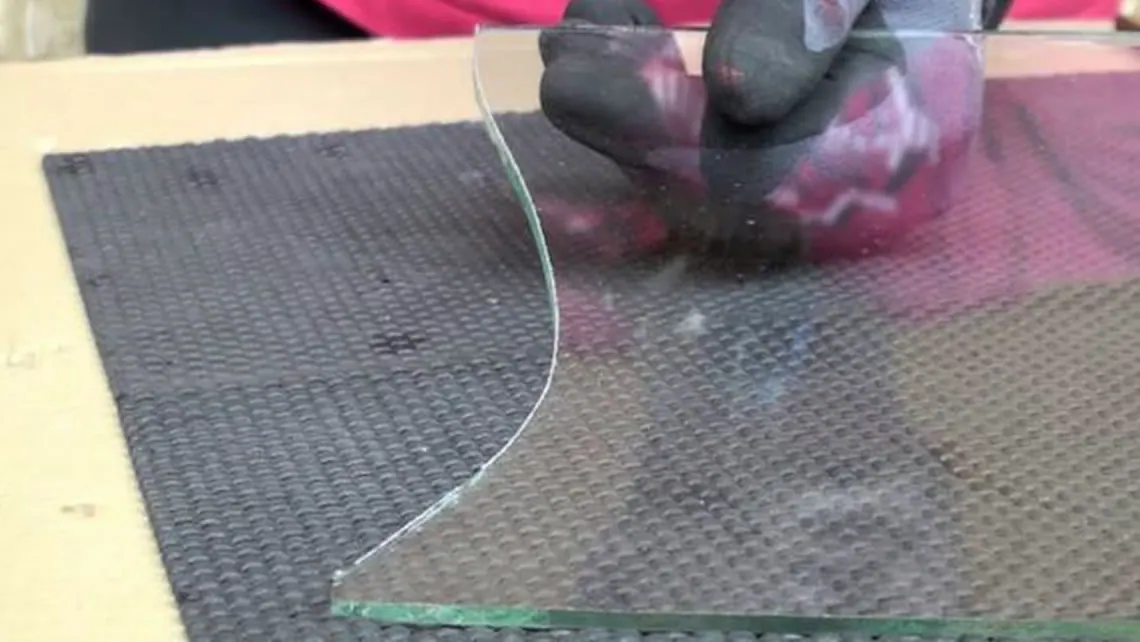
Place the sheet of glass on a level table covered with a soft material. Take hold of the edge nearest to you, pull the pane towards you and, holding the middle of its edges, place it on the table or lift it off. While it is being worked, the pane should rest on its entire surface. When stored, it should stand upright, supported on one edge.
Measure accurately before cutting. Take into account that the distance between the diamond tip and the ruler is about 4 mm. It is better to measure twice than to cut a piece to the wrong dimensions. The squareness of the sides must also be checked. Wipe the cutting area beforehand and, especially when cutting thicker glass, coat it with kerosene to dissolve and remove dirt and make the cut smooth and even. During cutting, press the cutter only lightly against the glass and move it evenly without stopping. The angle between the diamond cutting point and the glass should remain 5–6° throughout the cut. Never cut the same line twice, as this will ruin the diamond. Hold the cutter so that the little finger rests on the glass; this helps maintain the correct angle and an even movement. A good diamond cutter makes a quiet sound—the diamond “sings”. If it merely scratches instead of cutting, the sound is unpleasant.
Breaking
After cutting, the pane remains in one piece and must be broken. Break it immediately, because once the cutting line cools, the glass becomes jagged and difficult to break.
For a lengthwise cut, draw the pane to the edge of the table until the cutting line is aligned with the edge, then break it with a light but quick downward pressure. Another good method is to place a ruler or similar support beneath the cutting line and break the glass with a sudden pressure. Very narrow strips, 2–3 cm wide, can be broken with the breaker on the cutter: place it over the strip and make the break. Remaining fragments and irregular edges can also be removed with the breaker. A strip 4–5 cm wide can be broken by pressing the cutter handle beneath the part to be removed and applying gentle pressure. Thicker and cast glass can be helped to break by tapping the underside along the cutting line with the cutter handle and then using a ruler as a support. After cutting and breaking, remove sharp edges on both sides with a wet carborundum sharpening stone.
Cutting profiles
In addition to straight cuts, glass in the home often needs to be cut to a particular profile. Circular or other curved shapes are frequently required for picture frames, windows or experiments. A simple circular-cutting tool and a template can be used to cut regular circles of any dimension.
Circular cutting
First clean dust from the glass plate with a soft cloth and apply kerosene or turpentine along the cutting line. Then place the foot of the circular cutter, a rubber suction cup, at the centre of the circle to be cut (Fig. 1).
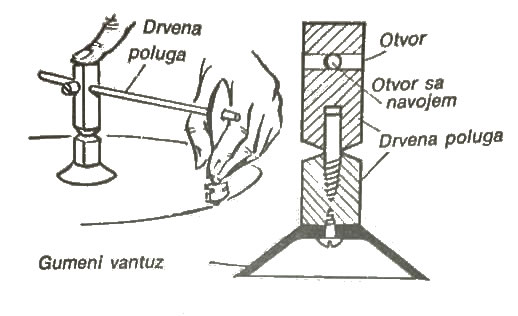
FIGURE 1
Adjust the arm holding the diamond to the required dimension and lock it with the screw. Cutting is carried out as follows: with one hand, press the circular cutter lightly; with the other, hold the end of the diamond-carrying arm and move it around the circle while applying gentle pressure.
When the cut is complete, place the glass plate on the table and press the waste part with one hand and the circular part with the other. If the circle does not separate, make an auxiliary cut between the edge of the sheet and the circular cutting line. After the auxiliary cut, hold the plate with both hands and flex it slightly until the circular piece “drops out”.
A circular cutter can also be made at home. Cut two square pieces of hardwood measuring 1.5 × 1.5 × 6 cm. Shape adjacent sides of the pieces into a taper. Fasten a rubber suction cup to the flat end of one piece with a wood screw, and fit another wood screw into the tapered end, later cutting off its head. Drill the second piece crosswise near its flat end, then drill a threaded hole perpendicular to that opening. Drill another hole in the second tapered end to receive the screw whose head was removed. Sand the contact surfaces of the two pieces smooth and lubricate them so the tool turns easily.
Insert the diamond-holder arm into the horizontal opening in the upper wooden piece. Once the required dimension is set, secure the arm through the threaded hole with a wing-head screw.
For curved cutting, use a template diamond cutter whose tapping or breaking head is slightly narrower so that it follows curves more easily. Cutting can be done in two ways.
For template cutting, use the original pattern or make a template from cardboard or a wooden board. Place it on the glass and run the diamond along its edge.
Alternatively, draw the required shape on a sheet of paper, place the paper beneath the glass and cut along the drawn line. Removing the waste after a curved cut is much more difficult. Tap along the cutting line from below, beneath the part that is to remain, until the glass cracks, then separate it with gentle pressure.
Curves with large radii should be cut in sections. First remove the larger waste pieces, then work on the remainder in small pieces with the breaker. Auxiliary cuts can also be used where necessary. Sand the edges of the glass after cutting.
Glazing windows
Cutting the glass is an intermediate operation in window glazing. To glaze a broken window, begin by removing the remaining pieces of glass. Remove old, dried putty from the grooves with a putty knife or an old broken knife. Remove the triangular glazing points as well, taking care not to damage the wood of the frame. Collect and dispose of the glass fragments immediately. Once the points and putty have been removed, draw the knife along the grooves several times to correct any irregularities in the frame.
Measure the length and width of the frame at 2–3 points. This is necessary because a frame is often wider at the top than at the bottom. The glass should be 2–3 mm smaller than these measurements. When sizing the glass, cover the table with newspaper or a soft cloth. Place the glass on this surface and use a ruler and diamond cutter at the marked points. Draw the cut pane to the edge of the table, tap it from below with the cutter and break it.
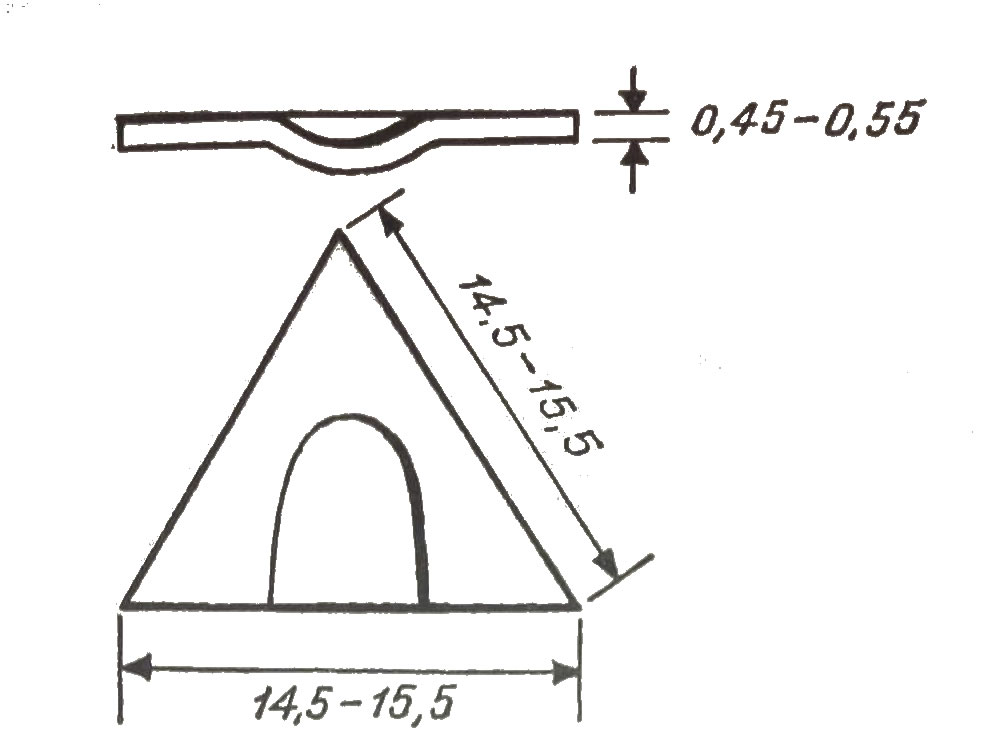
FIGURE 2
First place thin strips of putty in the frame beneath the glass. Insert the cut pane and secure it with triangular glazing points. The points shown in Figure 2 are driven with a sharp-edged hammer. Finally, press fresh strips of putty around the edges of the glass and level them with a putty knife. Wired cathedral glass can be cut only with a wheel cutter. After scoring, draw the glass to the edge of the table and break it with stronger pressure, then cut the wires with shears or a chisel. Cutting any type of glass is easier when it is coated with kerosene or turpentine, as already described.
If the repair has prompted you to consider new joinery, view our wooden windows, made-to-measure doors or send us an enquiry for a recommendation on the system and glass.