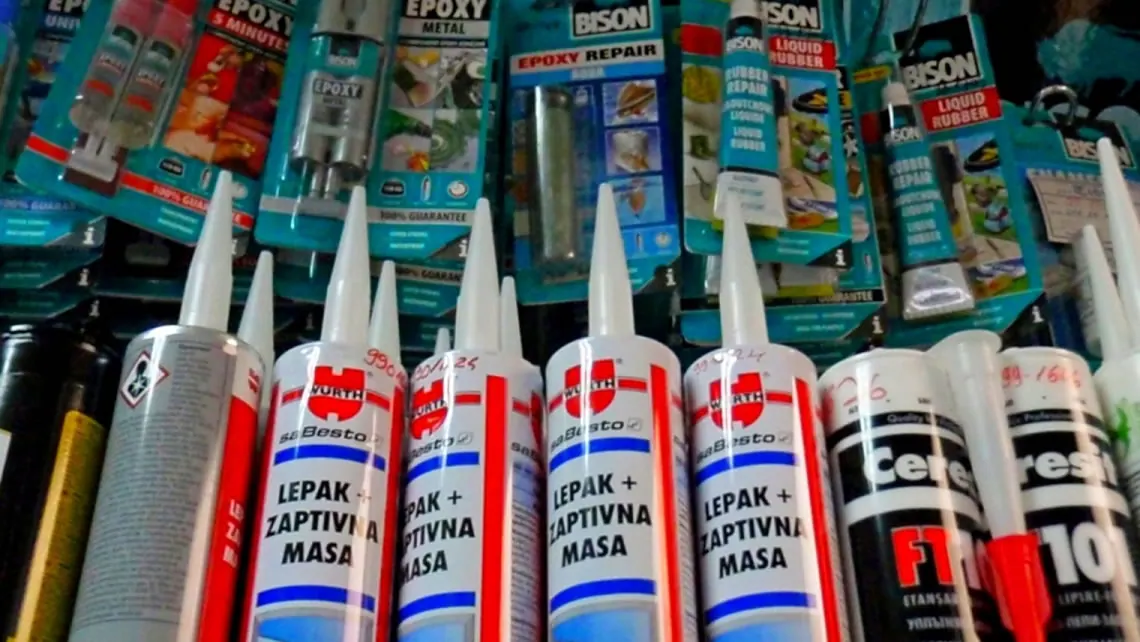
Important Health, Fire and Safety Note: This is archived text from 2018. year, and not a modern instruction for the selection, mixing, storage or use of adhesives, sealants, solvents and lubricants. The products described may contain flammable, toxic, corrosive, irritating or reactive ingredients and may release hazardous fumes. Do not store or use gasoline, trichlorethylene, ammonia, turpentine, acetone, formaldehyde systems, or other chemicals according to the historical advice on this page. For each specific product, its current label, safety data sheet, manufacturer’s instructions, compatibility with the substrate, ventilation and extraction, protection of the skin, eyes and respiratory organs, fire prevention measures and proper disposal of residues are relevant. Adhesives and sealants for load-bearing structures, vehicles, electrical and gas appliances, pipes and pressure systems, drinking water, food contact, aquariums or other safety-critical applications require a specially approved system and professional evaluation.
Adhesives, sealants, solvents and lubricants are not part of the new public offer of Savo Kusić. Current focus is wood windows, wood-aluminum windows, custom windows and doors. For a specific window or door project, you can send request for quote.
Adhesives
Adhesives are used for firmly and permanently joining objects made of the same or different materials. In order for the joining to take place, it is necessary that the glue adheres well to both surfaces, that the glue does not harden too early during joining, and that after drying it maintains a firm bond with the objects, be they rigid or flexible. It can therefore be inferred that an adhesive that is effective for one type of material may not be effective for another. The problem is even more complex when you need to bond materials with very different physical properties, such as metal and rubber or rubber and glass. In addition, the conditions in which the blinded objects will be located are also important. If it is outdoors, the adhesive must be weatherproof. If the items will be exposed to heat, the glue must be heat resistant, and so on.
At first, glues were obtained exclusively by boiling the skin and bones of animals, or from the juice of some plants. Adhesives of this type are used mainly for gluing porous materials, such as paper, cardboard, wood and others. In recent decades, under the influence of research related to space projects, new, synthetic adhesives have been perfected, which are slowly replacing traditional adhesives due to their greater practicality. Some types of adhesives have such good adhesion and resistance characteristics that they can easily join hard and compact materials such as metal, so they are sometimes used as an alternative to welding. Manufacturers give these adhesives various names that indicate their specific uses. In case of doubt, when choosing, it is best to ask the seller and to explain exactly which items we want to glue. We should keep several different types of glues in the house and possibly expand the range later based on experience. It is better to know the application of five-six adhesives well than to buy one adhesive after another based on some general instructions. A more precise analysis of commercially available adhesives would go beyond the scope of this text. That’s why we’ll stick to a brief overview of the criteria for selection, recognition, and above all, the use and application of adhesives.
Weak adhesives
The first group includes weak adhesives, almost always of vegetable origin, which are suitable for some absorbent materials, but which are too weak for solid connections. For gluing paper and cardboard, the usual white glues that we can get in any bookstore are quite good. The same applies to liquid adhesives such as gum and others. Fish glue, already prepared in tubes, which we call fish sprouts, is also suitable for gluing paper, cardboard, leather, fabric and wood, so whenever a special strong connection is not required. It hardens relatively slowly and is easily removed with water.
This group of adhesives should also include those commonly referred to as universal adhesives. They are produced from cellulose-based synthetic resins, dissolved in solvents that evaporate faster. They can be recognized by a specific smell similar to that of nail polish. They harden quickly, are resistant to water, most chemicals and ageing. However, they have a weak mechanical resistance, which excludes gluing furniture or equipment and devices that are used on a daily basis. The best hold is achieved by applying a double layer, on both surfaces. Also, glue for wallpaper is made on the basis of cellulose. It is a powdered substance that we dissolve in cold water immediately before use. The mixture is more or less grainy, which depends on the type of wallpaper. With the addition of gypsum powder, the same means are used to make wall putty.

Example of universal glue from the time of publication of the article
Carpentry adhesives
Three types of glues are mainly used in carpentry: glue based on casein (a protein in milk), “strong glue” - putty - and polyvinyl glues. Casein glue has the advantage of being cheap and of forming a strong bond, although it is not water resistant. It is usually sold as a powder that is stored in well-stoppered containers, so that moisture or water does not penetrate. We prepare it by putting the contents in a plastic bucket, and adding a little water, we mix the mixture »one and a half liters per kilogram of glue«. After we let the mixture rest for about fifteen minutes, add the same amount of water. If the amount of water used is smaller, casein-based glue can be used for gluing leather, linoleum, marble, and metal plates to wood. Once prepared, the mixture must be used within a few hours because it hardens quite quickly. A strong glue, tutkalo is obtained from animal remains and is sold in yellowish tiles or beads that dissolve more easily. Before synthetic glues, there was classic carpenter’s glue. Nowadays, it is used less frequently due to the unpleasant smell and long preparation, usually only during special works such as the restoration of old furniture. We prepare it by letting the tiles or beads swell in lukewarm water (one kilogram of glue in two to three kilograms of water) for one day and then leave it to dissolve further by heating it in a container immersed in warm water. During all this time, we stir the mixture with a piece of wood, removing the foam that forms from the surface. If the mixture is too thick, we will add more hot water. When cooled, this glue hardens but can be reused by heating or adding water.
Polyvinyl adhesives have the advantage that they can remain ready for use for months in the packages in which they are supplied. These are dispersive substances whose basic ingredients are small brushes of polyvinyl acids dissolved in water and with the addition of different types of resins. The glue begins to set when, due to the evaporation of water, the particles stick together to form a single film. Complete drying requires about 24 hours. Adhesives of this type are sold under various commercial names and are suitable for gluing wood to wood, plastic boards, felt, and rubber to wood. With them, the presence of polyvinyl resins is usually indicated on the packaging, while the other ingredients are omitted, as a factory secret.
The carpentry glues we have mentioned so far are only suitable indoors because atmospheric influences and the sun weaken the hold of these glues. For gluing objects that will be standing outdoors, in a damp area or in water, we must use glues where the sticking is the result of a chemical reaction and which are resistant to water, hydrocarbons and other solvents. Adhesives based on urea-formaldehyde (two-component adhesives supplied in pastes or powder) or phenol-formaldehyde harden by heating and are practically used only in factory production. Adhesives based on resorcinol-formaldehyde harden even when cold, with the addition of a catalyst, and have good mechanical resistance even when gluing objects of considerable thickness. First of all, they are recommended for gluing objects made of plastic and rubber.
Historical descriptions of formaldehyde and other reactive systems are not a sufficient basis for the selection or preparation of the adhesive. Do not mix, heat or apply such products without current manufacturer’s documentation, appropriate industrial exposure controls and expert assessment of intended use.
Dissolving synthetic adhesives
Among the multi-purpose synthetic solvent adhesives, the most famous are the so-called contact or “instant” adhesives. They are so called because they grip firmly immediately after joining two objects, and subsequent corrections in the position of the glued objects are impossible. Therefore, it is about products with strong adhesive abilities for a large number of materials, including some synthetic materials and metals. We apply the glue with a spatula to both surfaces, which we then join and press well on each other, but only after allowing a certain amount of solvent to evaporate for a short time. They are suitable for gluing to wood or plaster covering of larger surfaces. They are also effective on moderately wet surfaces, but they are less effective at low temperatures. Therefore, we should glue them in moderate temperatures (minimum 15°C). Once the curing process is completed, the bonded material is able to withstand temperatures higher than 100 and 150°C.
The temperatures, curing times and resistances listed in the archive text are not the specifications of today’s products. Use only the values from the current label and data sheet of the selected product and ensure ventilation, protection against vapors and distance from ignition sources.
Epoxy adhesives
The strongest joints are obtained with two-component epoxy glues. In stores, we can find them under various names, which, as a rule, resemble the chemical composition “epoxy”, “epoxy”. They are usually packaged in two tubes, one with resin and one with hardener, and are sold in several versions: clear, white, steel-colored, and so on. Before using the two components, we have to mix them and apply the resulting mixture in a thin layer over both surfaces (if possible a little rough) and let the glue rest a little before joining. The first hardening is completed within two to six hours, and the second already according to the type of glue. For the final, final hardening, 8 to 24 hours are required. During this time, we keep the surfaces firmly connected, but not too much. The chemical process that causes hardening cannot begin at temperatures below 15°C, but it can be accelerated by gentle heating. Once hardened, the glue becomes resistant to long-term moisture, solvents, acids and very high temperatures. Epoxy glues are effective not only on wood, but also on a large number of materials, even very hard, such as stone, marble, ceramics, glass, metals and heat-resistant plastics and others.
These adhesives acquire special characteristics when various other synthetic resins are added to them. Thus, the epoxy-phenol glue becomes resistant to temperatures up to 250°C; epoxy-silicone adhesives have lower mechanical resistance, but withstand temperatures of 300 or 350 degrees Celsius. Epoxy - polyamide adhesives provide the strongest bond but less resistant when joining hard materials than when joining flexible materials.
If the surfaces to be bonded are properly prepared, amazing results are obtained: in many cases, this glue can replace welding. Do not forget that in aeronautical structures, three-quarters of the parts, even if they are part of the supporting structures, are joined by adhesives, most of which are epoxy adhesives.
The previous historical statements about the replacement of welding and supporting structures are not a design recommendation. Structural bonding requires precisely defined materials, surface preparation, controlled curing, calculation, testing and an approved procedure for a specific application.
Cyano-acrylic adhesives
Cyano-acrylic adhesives are certainly the most suitable for precise work, for small repairs on all metals, on glass, on rubber and on almost all types of plastic (except polyethylene and certain acrylic resins). When it comes to gluing materials of this type, cyano-acrylic glue has exceptional adhesiveness and is effective in minimal amounts: one drop is sufficient for an area of 6 square centimeters. That is why it is sold in small packages, but the price is relatively high. Otherwise, if stored at room temperature the glue lasts for almost a year. If we leave it in the fresh air, the durability has practically no limits. Due to its properties, cyano-acrylic adhesives are used for gluing valuables in jewelry, with outstanding results. The perfect transparency and index of refraction, which is equal to glass, make it an irreplaceable glue for restoring broken crystal objects to their original state. Another advantage it has, when it comes to interventions on small surfaces, consists in the speed of gluing, which is almost instantaneous: with this glue, several gluings can be done immediately, one after the other, on the same object.
Quick-setting adhesives can instantly fuse skin and seriously endanger the eyes and respiratory system. Do not bring them close to your face, do not use them without current instructions and keep them out of the reach of children; in case of exposure, follow the label and seek appropriate professional help immediately.
Special adhesives
Finally, there is a whole series of special products that are intended to solve special problems of adhesion. Among these we recall solutions of rubber in organic solvents, simple solutions or with additions of synthetic resins, which are used for gluing parts made of rubber, plastic or flexible plastic (polyethylene, nylon, Teflon and others). In the version of compact adhesives, they harden quickly and are used to repair inner tubes as they are resistant to bending and water. Adhesives of this type are also suitable for gluing acrylic materials (plexiglass), as an alternative to acrylic resin solutions.
Another product allows us to perform repairs on felt, woolen fabrics, hemp and cotton. Thus, it is possible to join the hems without sewing, or to stick others to the worn areas of the fabric as reinforcement. Such repairs are even resistant to washing and ironing. Even for fixing polystyrene on wood, cardboard, metal foils or ceramics, there is a special glue. There is also an adhesive for gluing sheets of PVC (polyvinyl chloride). Silicone glue is used to join the glasses, which is quite elastic and able to withstand considerable pressure: it is used, for example, in aquarium constructions. When we want to realize a temporary layer, we can also use rubber-based glue, which is characterized by a drying time that is quite long. Because it allows parts to be separated multiple times to fine-tune their relative position, it is used quite often in publishing and newspaper technical newsrooms. The so-called “glue in tape” can also be used to fasten light-weight objects to vertical walls. It is an adhesive tape of a certain thickness, whose appearance resembles tar, which can be stuck to different substrates. The object that we want to fix is strongly pressed over the tape and remains firmly stuck there. In specialized stores, you can also find a special liquid product for better adhesion of rubber or leather transmission belts. It can be used in cars or some household electrical appliances.
Adhesive listed as “special” is therefore not safe for aquarium, vehicle, electrical appliance, polystyrene or other sensitive use. Specific compatibility and approval of the manufacturer is required for the specific material, load, temperature, moisture and contact with living organisms.
Whales
Putties are adhesive substances of different densities, which we use to fill and align holes or cracks and which firmly bind to the material on which they are applied. In some cases, they can also be used to fill joints between different materials and thus contribute to better holding of the joint.
In general, it can be said that the most common putties are obtained from real adhesives when appropriate inert substances and some other additives are added to them. Sometimes, however, the adhesive itself can work as a putty, if we use it in thicker layers. Therefore, the main considerations that we have made in relation to adhesives apply to and apply to whales as well.
Traditional putties, which were made by hand using linseed oil and strong carpenter’s glue as a binder, and kaolin powder as an inert substance, are practically no longer used. If we want to decorate holes, cracks and scratches on wood, we can use a special paste for wood made of the finest sawdust dispersed in an acrylic binder. We apply it directly from the tube and it is a great replacement for traditional products due to its better adhesion and absolute permanence (unchanging). Once hardened, it acquires physical properties similar to wood and can be processed in the same way as wood. Sometimes, in the packages of this paste, we can also find wax pencils with which we improve the repair aesthetically, imitating stripes, wood fibers.
Cracks in metal can also be patched, “welded” cold, using appropriate products. Putty based on acrylic resins and steel and aluminum powder are good for repairing cracks and holes in household electrical appliances, radiators, pipes and gutters. When special strength and greater heat resistance are required, it is better to use liquid or paste products based on epoxy resins. When the putty hardens, we can sand, drill, thread, etc. In addition, the prepared place is also impermeable to water, resistant to rust and the most common chemical agents.
Do not repair electrical or gas appliances, radiators, pipes, tanks or pressure parts based on this historical description alone. Such systems require a cause-of-failure investigation, material and process approved for the correct temperature, pressure and medium, as well as qualified performance and testing.
For sealing marble, cement, ceramics or heat-resistant plastics, two-component epoxy putties are best. In these cases, the putty achieves such impact resistance that it even exceeds the resistance of the material coated with the adhesive mass. So, for example, two cracked plates, joined with an epoxy product, can later, if necessary, be broken at any point other than along the previous fracture.
Glazed surfaces of sanitary ceramics, ceramic tiles or household electrical appliances that are scratched or cracked by some chance can be easily coated with “white enamel” - a liquid white coating - in minimal quantities. It is a product that, thanks to its chemical properties, adheres perfectly to smooth and hard surfaces, remains unaffected by water and heat, and does not yellow.
For the repair of rubber objects and surfaces, there are synthetic rubbers in tubes, black color and in paste form. They are applied to cleaned and degreased surfaces, which are previously roughened with sandpaper. After hardening, the paste retains its flexibility. Because it adheres to the surfaces of objects of any shape, it is also sometimes used to insulate handles and handles of tools and utensils.
For applications where a certain elasticity is required, as, for example, when filling cracks between built-in objects in the wall and the wall itself, or pipe joints, we should resort to the use of silicone putties. These are products in the form of a paste that, due to the action of air, quickly acquires and permanently retains the density of rubber. Packaging for household use allows the product to be easily applied in a continuous line of the desired thickness.
Solvents
By the term solvent we mean substances that can dissolve others. The chemical industry has devoted a great deal of attention to this field of research. Theoretically, it can be said that every substance or chemical composition has its own solvent, which can be, starting from one extreme to the other, water or the most complicated mixture of natural or synthetic products. It is important for us to know how to choose the right solvents for the substances we use the most: thinners for all types of paints, varnish removers, softeners for all types of adhesives, etc.
For the most common uses, such as degreasing and cleaning, we should keep several multi-purpose solvents in the house that do not have a limited duration. Highly flammable and poisonous ethyl alcohol, which we can get pure (colorless) or denatured (reddish color) dissolves fats, a large number of natural and synthetic glues and some varnishes.
Gasoline, a colorless and poisonous solvent, will be used with caution and kept in a ventilated place, away from any heat source, because not only the liquid is flammable, but also its vapors. Gasoline is an excellent solvent for paint, tar, oil stains. It also dissolves all rubber-based adhesives.
Trielin is the trade name for trichloroethylene, a toxic chemical we use to dissolve grease and oil and which can replace gasoline in spot cleaning. Like all chloride solvents, it is active on rubber and its derivatives.
Ammonia is a poisonous and corrosive liquid with a strong smell. It is sold more or less concentrated: the strongest concentrations dissolve varnishes. It is an excellent cleaning agent, because it turns fats into soapy water and excellently degreases a wide variety of materials.
Turpentine is also a highly flammable liquid that we must keep in a well-stoppered bottle or tin box, and in a ventilated room. We use it primarily for thinning varnishes and substances based on wax or rubber and for removing stains from these substances.
Acetone, a flammable and volatile liquid, is active on nitrocellulose-based varnishes and on all cellulosic products, including adhesives. Dissolves almost all thermoplastic synthetic adhesives.
Historical advice to keep solvents indoors should not be followed. Do not use gasoline, trichlorethylene, ammonia, turpentine, acetone and similar substances for cleaning or degreasing without checking current restrictions, safety data sheet, proper ventilation and protection; do not pour them into unmarked or food packaging and keep them away from flames, sparks, heat and unauthorized persons.

Examples of thinner packaging from the time the article was published
Lubricants
Some lube will always come in handy. One bottle or can of rare oil lubrication can be useful for many occasions: to lubricate a sewing machine, squeaky hinges, porous bronze “self-lubricating” bearings in some electrical household appliances, and the like. If we mix water with oil (with about 15% oil), we get the best coolant for metal drilling.
Vaseline is indispensable for lubrication after cleaning the taps of gas consumers, and we can apply it in the house to hinges, fasteners, locks and bolts.
Do not clean, lubricate or disassemble taps or other parts of gas consumers according to this archive statement. Service of gas appliances, selection of compatible lubricant, leak check and re-commissioning belong to a qualified service.
We will need one box of special grease for ball bearings to lubricate these bearings in electric motors of vacuum cleaners, sump pumps, etc.
Some regular grease can be useful for fine, manual sharpening of chisels and planer knives on a whetstone. With the mixture of this grease and oil, we will be able to move the sliding bars on the door without effort and without squeaking. With the grease itself, we will also lubricate the large hinges on the blinds (shukura) that open to the outside, the external gates of the yard, garage, etc.