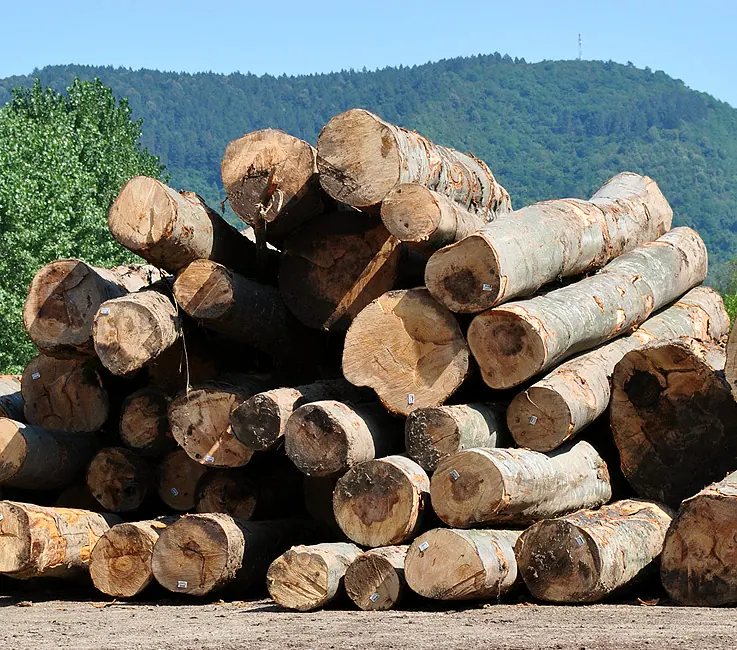
Timber and products made from it are used widely in industrial and civil construction. Construction-industry manufacturers use wood to make prefabricated buildings, civil-engineering structures, glued structures, products and elements, joinery products, parquet, floorboards, organic thermal-insulation materials, glued and sawn plywood, blockboard, roof shingles, wooden paving blocks and other products.
Round timber from coniferous species
Uses, wood species and quality classes
Coniferous round timber used without longitudinal sawing and intended for industrial, civil and railway construction, bridge building, piles, the building and repair of wooden ships, telephone and telegraph poles, block-system poles, electrical lines and contact networks on electrified railway lines is made from pine, spruce, larch, cedar and fir.
According to wood quality, timber is divided into three classes: I, II and III.
For construction work, including bridge building, roundwood of all three classes is used, usually more than 12 cm thick and 4 to 9 m long.
For piles, roundwood 18 cm or more thick and 6.5 to 8.5 m long is used. Piles for railway bridges must be made from class I roundwood, 22 to 24 cm thick, in lengths of 6.5 and 8.5 m and from 10 to 16 m in increments of 1 m. Roundwood must have a length allowance of 5 to 10 cm. The bark must be removed from roundwood for railway bridges.
The quality of round timber supplied for construction purposes should be determined according to the applicable conditions.
Dimensions of coniferous roundwood by use
| Use | Class | Thickness | Length | Additional requirement |
|---|---|---|---|---|
| Construction work and bridges | I, II and III | More than 12 cm | 4 to 9 m | — |
| Piles for railway bridges | I | 22 to 24 cm | 6.5 m, 8.5 m and 10 to 16 m, in increments of 1 m | Length allowance of 5 to 10 cm; bark removed |
Construction round timber from broadleaved species
Construction round timber from broadleaved wood species is made from aspen, poplar, linden, alder, birch and beech.
Division by dimensions
| Type | Thickness at the upper end | Increment |
|---|---|---|
| Construction roundwood | 12 cm and more | 1 cm |
| Second thickness class | 8–11 cm | 1 cm |
| Stakes | 3–7 cm | 1 cm |
According to wood quality, roundwood is divided into two classes: I and II. Class II timber is used mainly for temporary and auxiliary buildings. Timber length is specified as 3 m and more, in increments of 0.25 m. Timber should have a length allowance of 3–7 cm.
Round timber from broadleaved species supplied to companies and construction sites between 1 May and 1 October must have its bark removed. It must also be cleaned of branch remnants and made flush with the surface of the trunk, while its ends must be cut at a right angle to the longitudinal axis, with a permitted deviation of up to 0.1 of the diameter of the cut end.
Roundwood for sawn coniferous timber
Sawmill logs of pine, spruce, larch, cedar and fir are used to produce coniferous sawn timber for industry and construction. Logs used to produce sawn timber for industry and construction are 3.0 to 7.5 m long, in increments of 0.25 m. Logs for special sawn timber are 3.7 to 8.5 m long, in increments of 0.3 m. Every log must have a length allowance of 5 to 10 cm. The diameter at the upper end is specified as 14 cm and more, in increments of 2 cm.
According to wood quality, roundwood is divided into three classes: I, II and III.
Logs must be cleaned of branch remnants flush with the surface, and their ends cut at a right angle to the longitudinal axis, with a maximum permitted deviation from the right angle of 0.1 of the end diameter. The spronc formed during the processing of trunks in the forest must be cut off.
Roundwood is delivered to the sawmill with the bark on.
Dimensions of logs for sawn timber
| Use | Length | Increment | Diameter at the upper end | Length allowance |
|---|---|---|---|---|
| Sawn timber for industry and construction | 3.0 to 7.5 m | 0.25 m | 14 cm and more, in increments of 2 cm | 5 to 10 cm |
| Special sawn timber | 3.7 to 8.5 m | 0.3 m | 14 cm and more, in increments of 2 cm | 5 to 10 cm |
Logs from hard broadleaved species
Logs from hard broadleaved species are used for making beams, boards and battens that are used at full length, as well as cut pieces for individual parts of every kind of industrial product, except special-purpose sawn timber and sawn timber for the aircraft industry, for which separate standards exist.
Logs are made from oak, ash, beech, birch, maple, hornbeam and elm trunks. Their specified lengths range from 1 to 6.5 m in increments of 0.1 m. Every log must have a length allowance of 3 to 7 cm.
Log thickness is specified as 14 cm and more at the upper end, in increments of 1 cm.
| Property | Value |
|---|---|
| Log length | 1 to 6.5 m |
| Length increment | 0.1 m |
| Length allowance | 3 to 7 cm |
| Thickness at the upper end | 14 cm and more |
| Thickness increment | 1 cm |
According to wood quality, logs are divided into three classes: I, II and III. Logs are made with the bark on. They must be cleaned of branch remnants flush with the trunk surface, and their ends cut at a right angle to the longitudinal axis. The permitted bevel of the cut from the right angle must not exceed 0.1 of the diameter of the cut end.