Important warning: This is a historical archive text, not a current specification, risk assessment or operating manual for electric machines. Models, electrical connection, earthing, protective devices, diameters, depths, speeds, operating procedures and maintenance must be checked against applicable regulations, the manufacturer’s documentation and safe-working rules.
This text is not an offer of electric tools, machines or service documentation from Savo Kusić. The current offer focuses on windows, doors and related solutions.
Purpose of hand-held electric machines
In factory production of joinery products and in joinery and carpentry work on construction sites, handheld electric tools and machines are widely used: electric circular saws, electric planers, electric drills, handheld chain mortisers, electric screwdrivers, electric wrenches and mobile machines for planing and sanding parquet floors.
In terms of the working principle of their cutting tools, handheld electric machines do not differ from corresponding stationary machines. The text describes their advantages as portability, low weight and the ability to perform various operations (sawing, planing, drilling, mortising and sanding) in different conditions. It lists their use in assembly shops for assembling and fitting doors and windows into their frames, installing windows and doors in buildings, producing arches, lattices, hangers and formwork on construction sites, and planing and sanding parquet floors. However, machining with electric machines does not completely eliminate the need for hand tools because sawing and planing with rotary cutters leave waves, scratches and other irregularities that can be removed with a hand scraper or abrasive paper.
Historical comparisons of productivity
The productivity of manual electric machines is several times higher than the productivity of manual carpentry tools. For example, the productivity of a circular saw is higher than the productivity of a hand saw 4 to 10 times
Circular and band electric saws
Electric circular saws are used for ripping and cross-cutting boards, beams and other elements and for cutting tenons and other types of joints. The circular-saw blade can be positioned on the right or left, which makes the saw universal. Figure 1 shows the I-78 circular saw.

Figure 1: I-78 universal electric saw
The text states that the electric band saw, used for cutting smaller straight and curved elements and for forming tongues and grooves, did not become widely used.
Electric planers
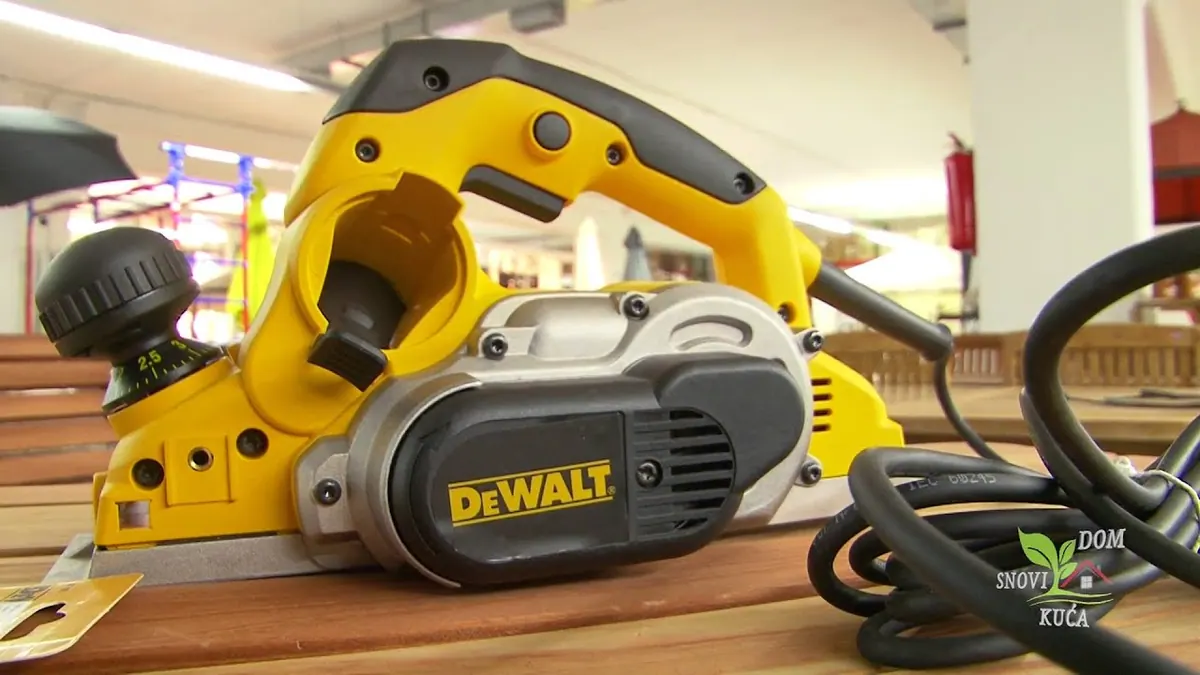
Electric planers are used for planing boards, floors and other sawn timber. The text states that the output of an electric planer is 5 - 10 times that of a hand plane. Its working part is a rotating cutterhead driven by an electric motor. The I-24 and I-25 electric planers are described as using an external-rotor electric motor that also serves as the rotating cutterhead carrying four knives. The I-24 planer has a planing width of 100 mm, while the I-25 planer has a width of 60 mm.
The I-24 electric planer (Fig. 2) consists of a rigid frame carrying a motor whose rotor is fitted with an aluminium drum and four knives. The thickness of the removed chip is adjusted by lowering the front table with an adjustment screw. The rotating cutterhead is enclosed by a protective cover.
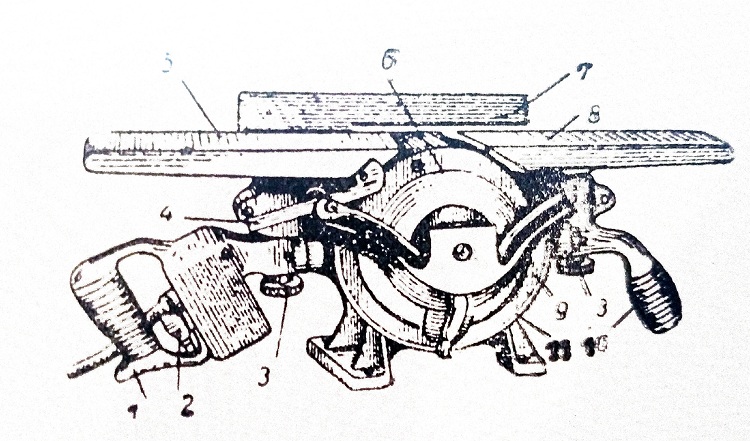
Image 2: Electric planer
This planer can also be used as a bench planer; the text describes 4 feet on the protective cover that allow it to be fixed to a base. The existing guide is used for planing elements at an angle. The electric planer has a hand-operated brake.
Drills, chain mortisers and electric screwdrivers
The type 1-27 electric drill, powered by an asynchronous three-phase motor, is described as drilling holes up to 26 mm in diameter and up to 1000 mm deep. For holes up to 52 mm in diameter, the text describes the heavier SA-27 electric drill with an adjustment device for drilling at an angle of 45o. The handheld mortising machine is used to form rectangular mortises and tenons on construction sites. Its cutting tool is an endless mortising chain comprising individual links joined by rivets. The output of the handheld electric mortiser is stated as up to 10 times that of manual work without a machine. The type I -1 electric mortiser is also mentioned. Electric wrenches and electric screwdrivers are used for tightening and loosening coach screws, screws, nuts and similar fasteners. Figure 3 shows the TKO electric wrench.

Picture 3: Electric screwdriver type TKO
Parquet processing machines
The parquet planing machine 0 - 1 (fig. 4) is used for planing the surfaces of parquet floors.

Image 4: Parquet planing machine 0 - 1
The rotating cutterhead of the parquet-planing machine is formed by the drum-shaped rotor of a squirrel-cage motor carrying three planing knives. Because of its high torque, the machine is described as removing a chip up to 3 mm thick, giving it an advantage over other parquet planers with a separate electric motor and special cutterhead that can remove a chip no thicker than 1,5 mm. At a cutting angle of 90o, the machine can perform fine planing. It travels on two front and two rear rollers.
For sanding parquet floors, a parquet sanding machine 0 - 8 (fig. 5) is used.

Image 5: Parquet sanding machine 0 - 8
Historical notes on operation and maintenance
Before putting the machine into operation, the safety of fixing the rotating parts, the direction of rotation of the sanding cylinder, the fastening of the sanding cloth, and the grounding of the machine must be checked. The machine should be put into operation with the sanding cylinder raised.
The historical text calls for sanding in parallel passes with adjacent passes overlapping by 30 to 35 mm so that no marks remain at the overlaps. It states that the moving machine can be turned with the sanding drum lowered. During the first pass, an additional load is placed on the machine so that the sanding drum bears closely against the surface.
At the end of the work, the cylinder should be lifted; turn off the electric motor; disconnect it from the power supply and collect the electric conductor in the compartment designated for that purpose, carefully clean the machine from dust and carry out a preventive inspection of the machine.
When using hand-held electrified machines, labor protection regulations and sanitary regulations for manufacturing companies should be strictly followed.