Important safety warning: This is a historical archival text, not a modern work instruction. Heating, hardening, melting and casting metals carries a serious risk of fire, explosion, burns and toxic fumes. In particular, the described home procedures involving lead, open flames, stoves or electric hotplates must not be followed. Such work requires compliance with current regulations, appropriate equipment, ventilation and professional training.
This text is not part of the current offer of Savo Kusić, which is focused on windows, doors and associated solutions.
Heat treatment of metals
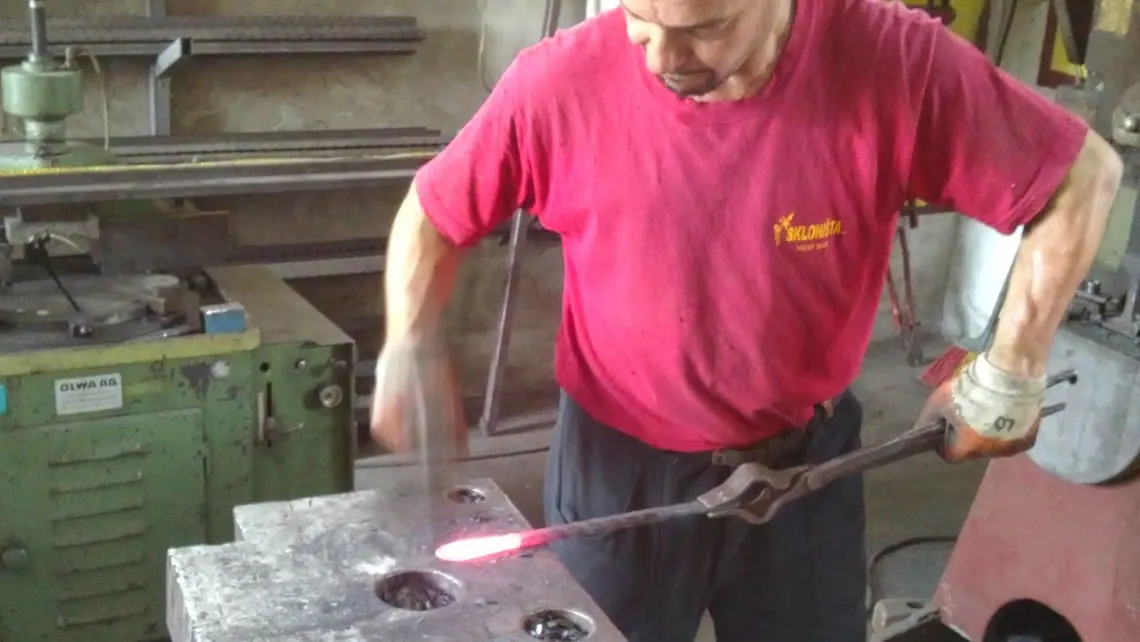
The essence of this treatment is that red-hot steel which is rapidly cooled in water becomes harder. This process is called hardening. In contrast, steel that is heated and cooled very slowly loses hardness and becomes soft. This process is called annealing. Tempering means softening the metal only to a lesser degree, so that metal which had become too hard and brittle can be worked again.
It goes without saying that it is not easy to measure how much metal has been heated or processed during technical processing. Useful information about the temperature of the steel during heating is given by the color that changes at various temperatures.
It is very important that tempering is performed at the appropriate temperature. Here are several examples:
…………………………………………………………………………………………………………………………………..
Temperature Tempering colour Objects
C for heat treatment
225 light yellow needle, drill bit, plate with
indentation
250 brown-yellow marking tool
265-275 red brown woodworking tools
285-295 purple red
purple-dark blue screwdriver, cutter, spring
Heating should cover the entire material, and cooling is most simply done by immersing the object in water. During tempering, it is enough to heat only the surface of the object being tempered and then leave it to cool in the air (on a gas flame, only the cutting edge of a chisel can be tempered).
During softening, the entire object should be slowly and gradually heated, and the cooling air should be at room temperature.
Apart from steel, some other metals can also be heat-treated. Hard brass is softened by heating to 500°C and cooling it in water. If this process is very slow, the brass becomes hard again. Brass is also hardened by hammer blows and forging. Aluminium, if it is harder than required, can be softened at a temperature of 450-500°C with slow cooling. Be careful with aluminium, because it melts at a temperature of 650°C.
About casting
For domestic purposes, lead was mainly cast. Where possible, lead cleaned of grease and paint was placed in a wrought-iron vessel. It casts well above 300°C. Care was needed when casting in a plaster mould because moisture trapped in the plaster turns into steam under heat and can destroy the mould. Lead could be melted in a thicker tin can prepared as a casting vessel. The historical text describes heating it on a stove, or as a last resort on a gas stove or electric hotplate (Figure 1). It warns of the dangers of lead casting, particularly inhaling its fumes. The casting mould was filled gradually and slowly with molten lead.

FIGURE 1
Current regulations, technical documentation of materials, risk assessment and instructions of qualified experts are authoritative for modern application. Historical temperatures, procedures and recommendations from this text should not be used as a working procedure.