Archive note: This text preserves historical claims and figures from the source article. They have not been independently reverified and do not constitute a current project, structural calculation, fire-safety specification, environmental declaration or cost estimate. A specific application requires the current regulations, the manufacturer’s documentation and the appropriate authorized professionals.
CLT panels and CLT building design are not presented as part of Savo Kusić’s current public offering. The current focus is on custom-made windows and doors.
In the previous article, “New construction technology - CLT,” we introduced the fundamentals of CLT construction. This article lists six basic advantages attributed to CLT engineering.
At the outset, the source article states that every advantage merits attention and that further study of this field reveals additional benefits. For now, it highlights the 6 most obvious ones.
The source article describes multi-layer glued timber panels as the most modern technology of its time and as something that will be highly valued in the future. It then considers whether CLT is affordable only for people with larger budgets.
Advantage 1 - Sustainability
The durability of wood is already well known, but the source article reiterates it. Trees act like a sponge that absorbs carbon dioxide from the air. While absorbing carbon dioxide, a tree simultaneously releases oxygen into the air. Once wood has “absorbed” carbon, the article says that it is later released only if the wood dries naturally or is burned. When wood is processed mechanically, carbon dioxide remains stored in the shaped material.
The article says that using solid wood products in building construction will reduce carbon dioxide:
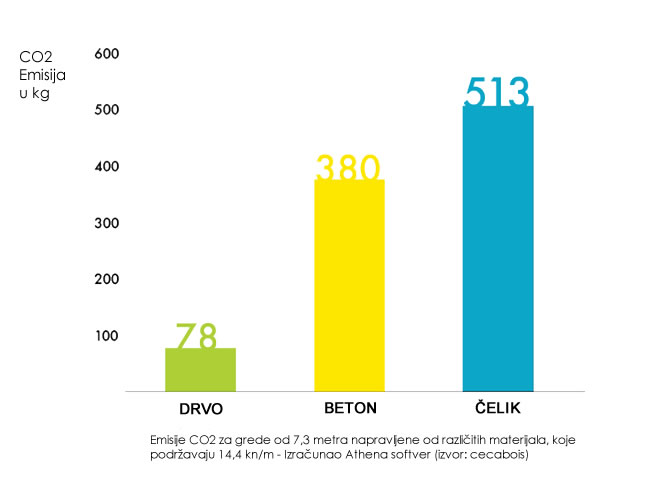
- 1m3 of CLT panels will remove 0.8 tons of carbon dioxide from the atmosphere, so 1m3 of CLT panels will contain an average of 240 to 250kg of carbon dioxide
- Cement production results in emissions of 870kg of carbon dioxide per ton of cement (“The cement industry plays an important role in climate change,” Dr. Robert McCaffrey for “Cement and Lime” magazine)
- Cement production creates about 1.75 tons of carbon dioxide emissions per ton of steel production (The Carbon Trust)
- Granular slag (standard mix of 40-50%) can reduce carbon dioxide emissions, but only about 100-130kg per ton (Ecocem)
CLT timber panels can be produced using low-pollution technology, relatively little energy, minimal fresh water and zero percent waste in factory processes.
Advantage 2 - Structural durability
Multi-layer adhesive structural panels can be used for building elements (walls, floors, roofs) or as part of hybrid constructions, and thanks to the “decorative lamination” production process, it is possible to produce dimensionally stable panels of various visually appealing shapes. The high stiffness of the panels provides significant robustness and wall elements that can be extended as cantilevers. The structural capabilities of decorative laminated wood panels are similar to those of concrete and can be used for similar applications.
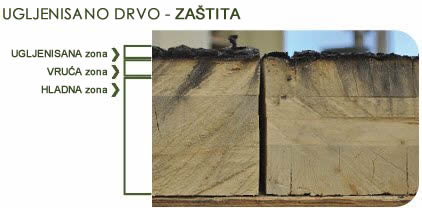
One of the biggest concerns for end users with solid wood products and cross laminated timber construction is fire. The fear is that a building made of wood will burn completely if there is a fire, but of course, it is wood; just as glass will melt, just as concrete will crack. An important question is actually the predictability of the material in the fire and how long it can burn without losing its properties. Wood is actually very predictable in fire - the outer layer of a cross-laminated timber panel will catch fire first, then build up a layer of insulation that provides 30,60 or more minutes of fire resistance, depending on the number and size of the panel.
Advantage 3- Easy construction methods
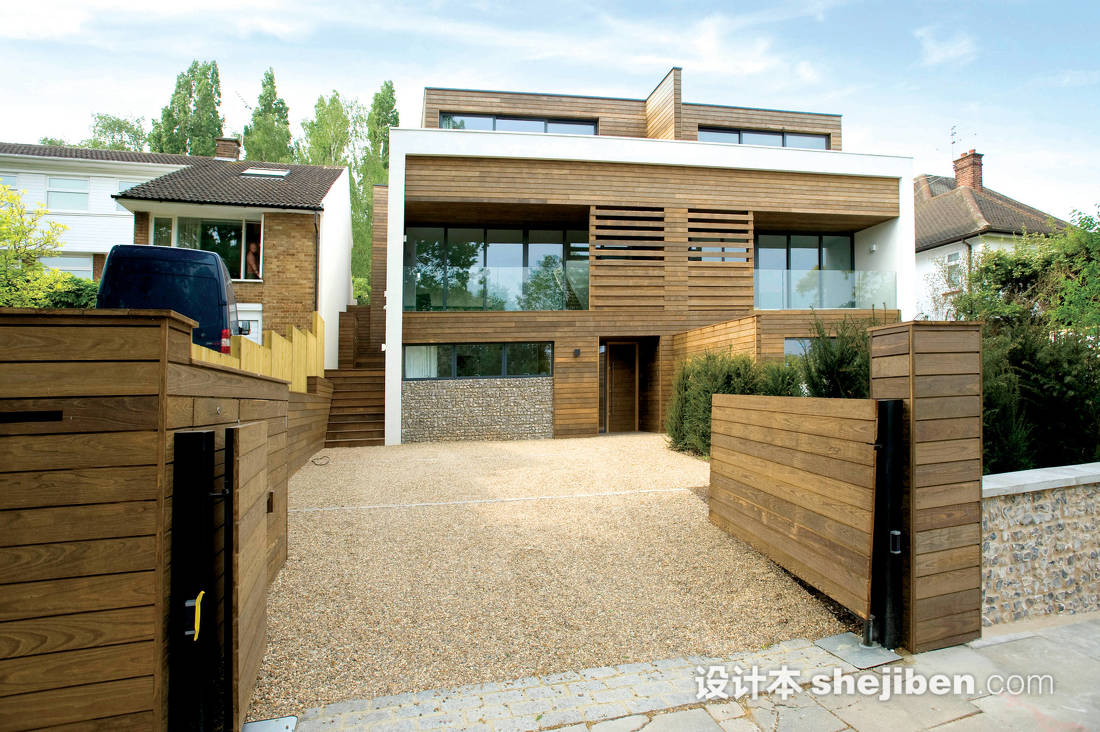
CLT systems are classified as MMC technology because of the simple and fast construction process. The panels are mainly fitted with self-tapping wood screws and steel supports, which significantly accelerates the process compared with traditional building materials. The video at http://youtu.be/bURy80-ZE7Y shows the construction of a private residence in Highgate, United Kingdom, developed by “BLISS” using CLT panels supplied by “KLH UK”. Because of the relatively favorable tolerances of factory-made panels, sealing—that is, airtightness between joints—can be achieved with pre-compressed foam and/or special tape applied over the external joints. Because they are cross-laminated, the panels quickly provide a dry, weather-resistant material without temporary supports. This creates an external protective shell that can become watertight very quickly. CLT panels can be supplied in different finishes, allowing the buyer to choose between the natural appearance of wood and a wall clad with another material. Because the panels are made to measure in a factory, waste at the assembly site is minimal, while the construction process is quiet and clean and requires less equipment and fewer tools than traditional methods. The source article states that use of the CLT system supports contractor accreditation.
Advantage 4 - Cost savings
The costs of building a building using CLT panel technology should be viewed in a broader context and over a longer period of time. What is given by the current calculation of the construction, during the exploitation of the building, becomes a calculation that is amortized very favorably for the user. Cost savings with this construction are obtained throughout the entire life of the built project. The speed of construction reduces the overall construction program, which results in a reduction in the contractor’s preliminary work, reduces the contractor’s costs and lowers the construction costs for the end client. Reduction of total project construction costs is based on:
- Less weight in the overall structure results in a more economical design of the substructure/foundation (less concrete)
- Planning can be accelerated; for example windows can be pre-ordered as there is a high degree of accuracy provided by precision CNC cutting
Advantage 5 - Saving time
As already described, the efficient speed of construction with these wood panels can ensure significant time savings on the project. As materials that are made in factories, it does not require other materials during construction, therefore fewer people are involved in construction, and CLT panels arrive on site ready for assembly. The following savings are achieved:
- Construction services - about 30-50% faster
- Installation of windows and doors - 20-30% faster
- Installation - 20-30% faster
Advantage 6 - Design flexibility
The ways in which CLT panels can be cut and routed allow for enormous design flexibility and architectural freedom.
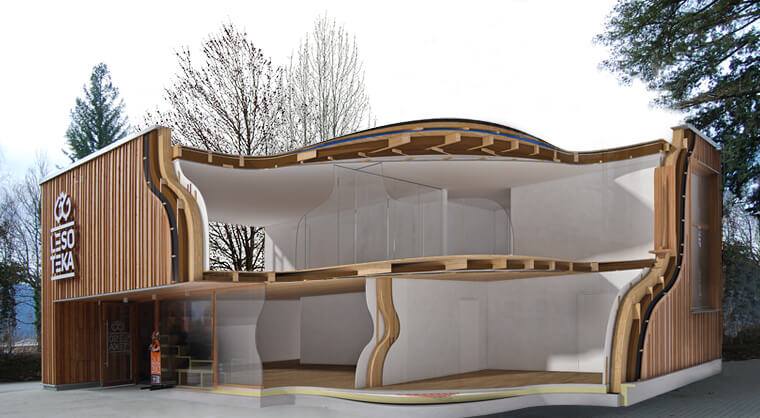
To use the full potential of CLT, it is important to have a clear design approved in advance by the client and the entire design team, because the clarity and precision of the project plan itself—the preparation—are as important as the construction.
Wood is easy to process, and modern CNC machines make it possible to machine matching elements and curves identically, as envisioned by designers and architects.
The source article states that more than 280 such houses had been built in the United Kingdom by that time. As awareness of these ideas grew, many companies developed to manufacture this type of material. Architect Alex de Rijke is quoted as saying: “If the 19th century was the century of steel and the 20th the century of concrete, then the 21st century belongs to building with timber.”