Important warning: This is a historical archive text, not a current standard or specification for parquet production and installation. Types of wood, humidity, dimensions, tolerances, adhesives, coatings and installation method must be checked according to valid regulations, manufacturer’s documentation and the conditions of the specific object.
This text is not part of the current offer of Savo Kusić, which is focused on windows, doors and associated solutions.
Historical dimensions and types of wood
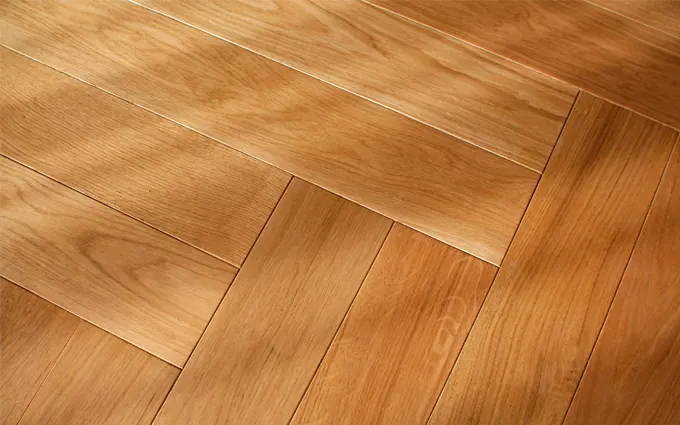
Parquet consists of wooden planks for floor covering, which are properly trimmed on the fronts and coated on four sides, with narrow sides of a special profile.
Parquet is made from boards (friezes) that are cut from normal boards. The dimensions of these boards (in mm) are as follows:
- For length 170 ……………………………. 40 - 80
- For length 220 ……………………………. 40 - 85
- For length 270 ……………………………. 40 - 95
- For length 320 ……………………………. 40 - 95
- For length 370 ……………………………. 40 - 95
- For length 420 ……………………………. 50 - 95
- For length 470 ……………………………. 50 - 95
- For length 520 ……………………………. 60 - 95
The width of beech and birch planks should not exceed 75 mm. The thickness of these planks for parquet with a slanted edge made of oak, ash, hornbeam, beech, elm and hornbeam is prescribed 16 mm; for parquet with a beveled edge of larch, birch and pine - 22 mm; for tongue and groove parquet made of oak, ash and hornbeam - 22 mm; for tongue and groove parquet made of larch, birch and pine - 25 mm.
The dimensions of parquet boards for thickness and width are adopted for wood with a moisture content of 15 %. In the case when the wood has a higher humidity, the boards must have an excess due to drying. Deviations from the prescribed dimensions are allowed for length ± 5 mm, and for width and thickness ± 1 mm Parquet boards are made of oak, ash, maple, beech, elm, hornbeam, larch, birch and pine. Pine boards must be radially cut; the angle of inclination of the lines to the surface of the boards must not be less than 450. The humidity of beech and birch planks, which are delivered between 1 May and 1 October, must not exceed 25 %. Parquet boards are made of I and II class. Parquet has different edge profiles:
Parquet profiles

Sl. 9. Parquet with a sloping edge for laying over mastic: a - from oak, ash, chub, beech, elm and hornbeam;
b - from larch, pine and birch
a) parquet with a slanted edge, when the boards have straight slanted edges. When installing parquet, these planks are laid over mastic coating or fixed with thin nails, they are made of oak, ash, hornbeam, beech, elm and hornbeam (fig. 9, a) as well as larch pine and birch (fig. 9,b);
b) parquet with grooves, when the planks on the edges have grooves, into which connecting slats are inserted for mutual connection when laying the parquet (fig. 10);

Sl. 10. Parquet with grooves:
a - from oak, chub, ash, beech, elm and hornbeam; b - from larch, pine and birch

Sl. 11. Parquet with rebate:
a - from oak, chub, ash, beech, elm and hornbeam; b - from larch, pine and birch
c) parquet with a rebate, when the planks have an oblique rebate on the edge, which serves to connect them to the asphalt over which the parquet is laid (fig. 11).
d) tongue and groove parquet, when the planks have tongue and groove (fig. 12), can only be made of oak, ash, hornbeam, beech, elm and hornbeam.

Sl. 12. Parquet with tongue and groove
a - from oak, ash, chub, beech, elm and hornbeam; b - connecting strip for joining parquet
Dimensions and requirements for the final product
| length | width with increments of 5 mm |
|---|---|
| 150 | 35 – 75 |
| 200 | 35 – 80 |
| 250 | |
| 300 | 35 – 90 |
| 350 | |
| 400 | 55 – 90 |
| 450 | |
| 500 | 55 – 90 |
The width of beech and birch parquet should not exceed 70 mm. When using waste from production, it is allowed to make parquet with grooves, as well as tongue and groove 22 mm thick. In this case, the thickness of the wearing part of the parquet must be increased to 12 - 13 mm. The dimensions of the connecting strips are 30 x 14 x 4 mm.
Deviations from the prescribed dimensions in length, width and thickness of parquet are allowed ± 0,3 mm, in width of slat ± 2 mm, in thickness of slat ± 0,1 mm: in length of slat ± 0,5 mm, in its width ± 2 mm, in its thickness ± 0,1 mm. Parquet is made of oak, ash, maple, beech, elm, hornbeam, larch, pine and birch. Pine parquet is made only in a radial cut with an inclination angle of the grain lines to the board surface greater than 450. Connecting slats are made of soft types of wood. The humidity of wood for parquet and slats should be 8 % with a permissible deviation of ± 2 %. Parquet has two classes: I and II.
The wood of the perimeter slat should be healthy, without rot and cracks, and the wood of the connecting slat, in addition to this, must not have any knots. Boards must have parallel straight wide and lateral sides (edges). The fronts of the boards must be cut perpendicular to the longitudinal axis of the board. When checking the straightness of the face, a maximum deviation of 0,25 mm is allowed. The tongue and groove must be the same size along the entire length and must be equidistant from the back of the boards. Deviations are allowed at most ± 0,25 mm. The length of the wave during planing on the edges must not be more than 3 mm, and on the surface of the face — no more than 5 mm. Unfinished part and indentations are allowed on the reverse side at most 0,3 mm. Cuts and broken parts are allowed on the surface of the face up to a depth of 0,3 mm, and on the surface of the back and the lower half of the edges up to a depth of 2 mm.
Current standards, declared properties of the parquet, condition of the substrate, humidity and temperature regime and instructions of the manufacturer of the installation system are valid for the modern floor. The historical dimensions and tolerances in this text are not performance specifications.