Important Warning: This is a historical archive text, not a current machine specification, risk assessment or operating manual. Speeds, connections, tools, protective measures and described procedures must be checked according to valid regulations, manufacturer’s documentation and actual working conditions. Working with rotary cutting tools, wall milling machines, electrical installations, sheet metal and pumps requires appropriate expertise and protection.
This text is not an offer of machines or tools of Savo Kusić. The current offer is focused on windows, doors and custom carpentry production.
Motor planer
As an attachment for a hand-held electric drill head and alternatively, as a self-propelled machine, there is also a motorized planer. The working part of the machine is a single roller with two or more blades parallel to the axis of rotation and which engage the wood, as they are placed on the roller casing. The housing of the planer attachment carries a cover and a parallel rest that is placed on the surface to be machined and pulled and worked on as with a regular planer.
The planed surface is several centimeters wide and several tenths of a millimeter deep. We can fasten the connection to the work table. And in that case, we get a stable machine where the object is the one we pulled over the planer. Such a machine can save us a lot of effort and give good results, but under one condition: that we already know manual planing.
Rotary rasp
With the help of an inexpensive attachment, any electric drill can be transformed into a rotary rasp for woodworking. It consists of a toothed roller, 6-8 millimeters in diameter and several centimeters long. At one end, the roller is clamped in the rotating head of the drill, and at the other end, it is fed into the shank with a ball bearing. Thus, we hold the handle with the left hand, and with the right drill and the working part - the roller - we process the surface of the object, which must be fixed using a stage, if the surface is not part of a heavier object. If we get two or three of these rasps, different lengths and grits, we can do almost all the wood filing work that we would normally do with a hand rasp. These are, first of all, rounding of edges, processing of billets, slabs, slats, shaping of wood of medium thickness (from one to two to three centimeters), widening of holes on boards of medium thickness, and so on.
Milling machine
A small milling machine can also be of great use, also with a lil without its own motor. Whether it is fixed or mobile. Supplied with a large selection of router bits for a wide range of jobs. With the help of a milling machine, we can shape the slats for furniture, the outer sides of the furniture giving them the desired shape, we can double-cut notches on parts of the furniture (for example slots for drawers), we can make slots in the shape of Iastina’s tail and other shapes; from square Ill rectangular slats we can extract profiles for frames and more. Otherwise, the machine must be handled carefully, in order for the work to be aesthetically acceptable, on the one hand, and on the other hand, due to the high speed at which the milling machine works (around 2000 revolutions per minute and more), it is important not to put your hand close to the milling machine. There are many routers that can be connected, and each one is used for certain shapes of grooves and recesses. it is easy to have small dimensions, the milling machine offers quite a lot of possibilities - much bigger than the needs of the house And that explains its increasing use among professional craftsmen. On the other hand, while we can make grooves and notches, grooves and recesses with chisels and saws, it is impossible, at least too difficult, to make certain profiles on slats, boards, III pieces of furniture without this machine. Finally, the rule also applies to the milling machine that it is better to first gain some practice with hand tools, and then move on to machine processing.
Milling machine for walls
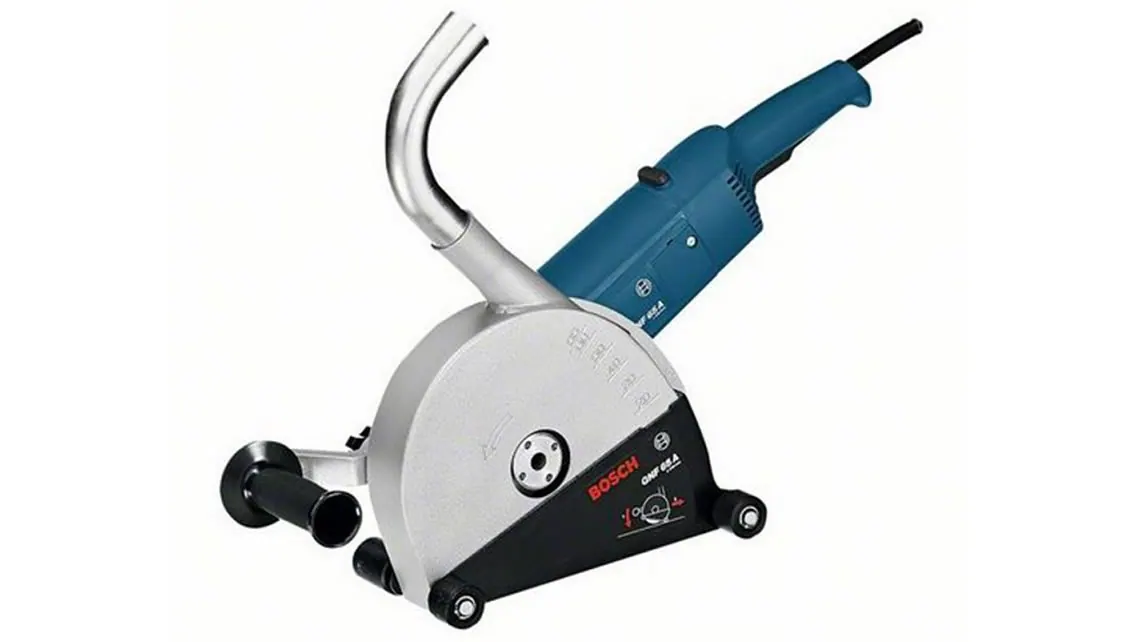
The main parts of a wall router, which can also be found as an accessory for an electric drill, are a circular rotating blade in a housing that rests on rubber wheels. It is used by dragging it several times over the wall in the same desired path, thus obtaining two cuts in the wall, and later, removing the plaster, we obtain a depression of several centimeters. The recess is long and of a regular shape so that the pipes of an installation can be inserted into it without difficulty. We must, of course, plaster the wall again after installing the pipes.
This little-known accessory for an electric drill can serve us well if we want to expand the electrical installation. This work, however, is best combined with eventual painting of the walls or installation of new wallpaper.
Gardening shears
Gardening shears are a typical accessory to an electric drill for gardening. Their form and use do not require special explanations. Since their operation requires little power, battery-powered models or with built-in accumulators are also produced.
Sheet metal shears
Sheet metal scissors consist of two short blades, which, with the help of an electric drill motor, perform the same movements as ordinary scissors. There are several models: some scissors are intended for straight movement, others, with short cutting surfaces and a special shape, for cutting along curved lines.
Acquiring this attachment is profitable only if we work intensively with sheet metal, either for making furniture or other parts (garden tables, metal pots, etc.). Cutting sheet metal, even if it is of small thickness and of softer materials, such as aluminum sheets, if performed with manual scissors, is always laborious, and curvilinear cutting is difficult and requires work in several stages. However, we can do all this more easily with sheet metal shears, and they are also necessary for sheet metal work on the house (changing and repairing gutters, for example). Since sheet metal work on the house later requires welding, either electric arc or soldering, these shears are classified as a professional Iimara tool.

Speed reducer and hedge shears
A speed reducer can be added to an electric drill, an extremely useful device, as many of the machines and accessories require a low operating speed. Hedge shears consist of double, serrated blades whose movement is alternating: back and forth. They move in reverse order, so they act as one set of scissors. The device has, however, a very specific use - it is only for cutting hedges.
Carpentry (lathe) lathe
Another typical use of an electric drill as a drive motor is on a carpentry lathe, which is small in size and can hold pieces of wood thirty or more centimeters long. In this type of lathe (as well as other lathes), the motor drives a single head with a fixture. The object we are working on is usually oblong in shape, it is fixed at the other end by means of a suitable stud.
With such a small lathe, we can process fence posts, furniture legs, and other parts of smaller dimensions from square or round slats. Metal discs with sliding clamps (about 20 centimeters in diameter) can be attached to certain models of lathes. With the help of those three or four sliding clamps (which slide in the corresponding grooves) we can fasten pieces of wood 4-5 centimeters thick to the disc. This way we can make plates, bowls, lids and so on. On the lathe, we can also make beautiful toys from hard wood, then various handles, wooden rings, wheels, cones and thousands of other objects, of course with the dimensions that the lathe at our disposal allows us.
However, working on a lathe requires considerable skill, which can hardly be acquired by reading a book. By watching one of the few wood turners while he works and constructs the bark of antique furniture, or reconstructs pieces of furniture cracked by time, we will learn a lot more. A carpenter’s lathe offers almost countless possibilities for woodworking, and if we acquire enough skill and take this type of craftsmanship to heart, we will be able to make high-quality objects that could be classified as products of artisan artists.
Rotary pump
The rotary pump is not very well known as a power drill attachment, but it is very useful. The models on sale, which are few and far between, are very compact (about the size of a meat can, let’s face it), and the suction hose and discharge hose are a finger thick. The capabilities of this pump are similar to those of dishwashers.
The use of such pumps is manifold. We can, for example, use it to add water, regular or distilled, to pour wine, avoiding spills or stains at the same time. Once the car radiator is emptied and cleaned with the appropriate means, we will quickly fill it with water and another liquid using a pump. We can easily pour wine from the demijohn into bottles. Accumulated water from the old cistern in the garden can be quickly emptied and possibly used for watering with a sprinkler.
In an emergency, we will use a pump to quickly drain water from a tank whose normal draining device does not work: from a ruby washer, bathtub, toilet bowl, from a cistern. After use, we should let the pump run for a few minutes using tap water to clean the mechanism and the hoses from the smell and the remains of the liquid we pumped. If we want to use the pump for pumping some drinking liquid (water, wine, vinegar), we should let the pump run for a few minutes using tap water and check that the water coming out is odorless and tasteless. If the test is negative, you should continue to draw plain water until the smell and taste are completely gone.
The purchase of this pump is recommended even if we will rarely use it, precisely because we cannot foresee unpleasant situations in which it could be of great use to us. It does not cost much and since it is small, although we will find a place for it in the house. And the ability to use it immediately in emergency situations and to do some work more easily are its great advantages.
Portable milling machine
Some manufacturers have launched portable wood routers for non-professional use. Such machines allow a wide range of work to be carried out: milling straight grooves, or dovetail grooves, milling the edges of plates and slats, straightening edges, making blind or through holes, cavities and so on.
Such machines, vertical axes, move in relation to the workpiece, which must therefore be fixed with clamps. A variety of tools can be attached to them depending on the job to be done. Otherwise, they work at high speeds (over 10 000 revolutions per minute) which corresponds to woodworking. That’s why their work effect is much higher than that of a wood router connected to a manual electric drill with a maximum of 3000 revolutions per minute. The choice of routers for these machines is large, so a variety of profiles can be made on boards, beams and laths.
However, the same should be said for these machines as for the others: given the high performance, the device will benefit anyone who intends to use it systematically. Otherwise, their advantage is that they do not take up a lot of space in the house.

Combined machines
These machines are by far the most complex and, of course, the most expensive. Sometimes it’s hard to tell the difference between them and professional machines. We mention them here only because they can be seen more and more often at numerous specialized fairs. They are called combined because they allow all basic carpentry and carpentry work to be done with high efficiency. A planer, circular and band saw, vertical axis routers, belt sander and face disc sanders are housed in a single block. In some models, a grinder for sharpening tools and a turning head are also installed. Some of these machines are always in the same position and subsequently have parts added to them for certain types of work, while others can change their position depending on the type of work they need to do. Of course, there are also combined machines on sale that are much simpler and much smaller in size, with a reduced number of operations.
However, their price is high, they take up more space, but their performance is great. Combined machines are usually bought by people who live in family houses built mainly of wood and on which they want to do most of the carpentry and carpentry work (modification of stairs, roof construction, wooden walls and partitions, sometimes also modification and extension of terraces, construction of huts, sheds). Apart from the fact that it takes practice to work with such complex machines, it takes just as much knowledge to make the elements and install them.

Related topics: planing and milling machines — part one, parquet machines and cutting tools — part two and window and door manufacturing.