Important health and safety note: This is an archived educational text from 2017. year, and not the project of a well, water installation, pressure system, electrical installation or water preparation device. The original measurements, distances, pressures, forces, materials, procedures and claims were transferred without expert verification or adaptation to today’s regulations. Water from wells, springs, streams or the described filter must not be considered safe for drinking without proper sampling, laboratory analysis and certification by the relevant health authorities. Activated carbon in itself is not proof of the microbiological or chemical integrity of the water. Digging or entering a well carries the risk of collapse, suffocation, drowning and other fatal accidents; the works must be planned and carried out by authorized experts with the necessary permits. Pumps, hydrophores, pressure vessels and electrical installations require expert selection, protection and installation according to current regulations.
The described wells and domestic water stations are not part of the new public offer of Savo Kusić. The current production focus consists of wooden windows, wood-aluminium windows and custom-made doors. For a specific window or door project, you can send a request for quotation.
Before choosing a home water station
In places that are far from towns and villages, water cannot be provided from the public communal water supply. If there is no possibility for several families, or possibly an entire neighborhood, to join together and build their own mini central water station, the problem remains to be solved with their own home water station. Of course, attention should be paid to this problem already when buying land or when determining the location of a building. It should be checked whether there is a usable source of water in the vicinity of the desired construction site, in which layers the underground water is located and what its quality is. If there is a well nearby, a water sample should be taken in a well-boiled bottle and sent for analysis to the competent Institute of Hygiene. Water from the stream can only be used directly from the source, because only there is it clean, without pollution. For taking away and using spring water, it is also necessary to obtain a permit from the competent authority.
The groundwater level significantly affects the solution of the domestic water station, if the groundwater level is not below 7 meters, ordinary and cheap suction wells can be used, and if the level is lower, wells with wheels or much more expensive ones that work on the principle of pressure are needed. In plains, next to rivers and lakes, the groundwater level is usually 4-5 meters, and in hilly places it depends on local conditions
A dug well
The simplest well is the one made by digging. Well digging can only be done by an expert with the appropriate equipment, because in addition to the finer digging of wells requiring certain expertise and experience, this work is also very dangerous.
Ready-made concrete rings with a diameter of 80, or 100 cm, height 80 cm, with grooved flanges for connection. For the first ring, a hole is dug with the correct dimensions to fit the ring. Then it continues digging so that the ring slides lower and lower. When the first ring is completely sunk in, the second is placed and so on. The excavated soil is first simply thrown out and later scooped out with a bucket.

The easiest, and at the same time the most dangerous, is to dig a well in the sand. Namely, in loose soil, the rings move easily and sudden penetration of sand can occur. In the last phase of digging the well, the last rings are inserted already into the wet ground, possibly even into the water. During work, the well digger is constantly exposed to the danger of sand and water penetration, therefore the ladder in the well must always be at hand, and the digger must be tied with a rope and must not be left unattended for a single moment. If the well is finished, the construction of the mechanism for raising water can be started.
Suction wells
Water lifting devices generally work on one of three principles: mechanical devices usually only lift water up to the top of the well; in wells with a wheel, water is raised by buckets mounted on a continuous chain (fig. 1, upper part), wells that work on the principle of pressure with a compressor cause overpressure in a closed well, which forces water through a single pipe.
The advantage of these wells is that the water can also rise above the well, e.g. into a tank placed on the roof or floor. The water lifting limit of mechanical wells based on the principle of pressure is theoretically not limited, which means that they can also lift water from greater depths. Suction wells, in contrast, suck in air above the water in the well. The weight of air is equal to a water column of 10 m. Therefore, suction wells are theoretically limited to 10 m, but in practice they can be used up to 7 m deep.

Image 1
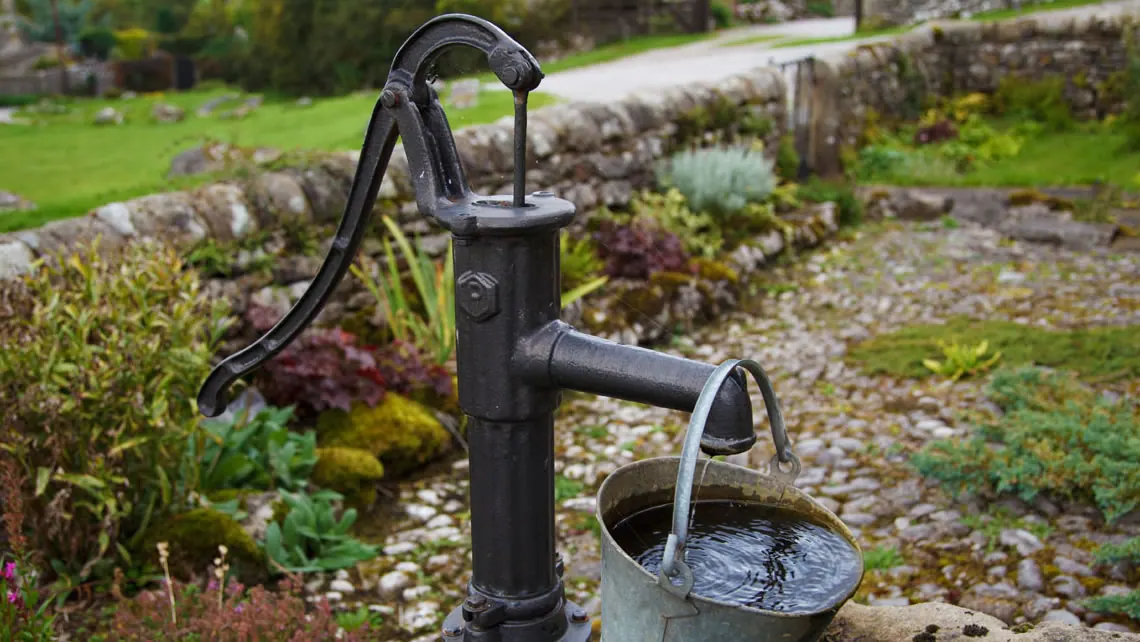
Water supply to family buildings and weekend houses can be solved in the simplest and cheapest way with suction wells (if the water is not deeper than 7 m). In the plains and next to running and still waters, the underground water level is usually higher than this. The simplest and cheapest suction well is the so-called A Norton hand-operated pump-and-lever and rammed-tube well (Fig. 1, bottom). Galvanized steel pipes of 1 1/4“, usually 2 m long, are driven into the ground all the way to the water. A hole head with a conical tip is placed on the first pipe, and if the terrain is sandy, the filtering effect is increased by welding a dense bronze wire mesh. For the first piece of already filled pipe, the following pipes are connected with couplings. Another 4 piece of 2 m pipe is connected to the well head made of a pipe 1,5 m long. The back piece of pipe is rammed so that it sticks out of the ground about half a meter. A cast iron pump is connected to the upper end of this pipe, which is equipped with a thread, or its flange. It is important that the pump valves close well, that the pump piston moves easily and that the entire well and pump are hermetically sealed. When putting the pump into operation, it should first be filled with water several times from the top and pump all the way, until clean water is obtained. If there is a risk of freezing, the pump and well should be drained.
The Norton well can also be installed in dug wells (Fig. 1, lower part). The capacity of this well at one push of the handle is 0,3 - 0,8 liters from the hygienic side, it is satisfactory because water and precipitation cannot get into it. Maintenance consists only in the fact that the leather piston and the lower valve should be changed once a year. It can also happen that the steel seat of the lifting valve wears out, that the valve gets stuck, or that sand gets under the foot valve, as well as that due to poor assembly or poor sealing, the elements of the well do not close hermetically. Norton’s well is ideal for cottages (if the water table is not too deep).
Suction-pressure wells
The good features of suction-pressure wells are combined with suction-pressure devices. The two main types of these wells are very widespread. In twin piston devices one lever moves the suction part similar to that of suction wells. However, here the sucked water does not go out into the free space, but enters another closed cylinder whose piston also moves due to the same lever up and down. The valve of this cylinder works in reverse to the suction part, so that the piston does not suck, but pushes the water further. Suction-thrust devices can be used e.g. to water the garden, as well as to fill a tank placed a few meters above the well. They can also be installed on tube wells just like the Norton well. This well (device) gives water only if the lever is moved, therefore, for continuous water supply to the family building, it can only be used in combination with a special tank (placed at a certain height). In essence, a suction-push pump with vanes is similar to these wells. Here, too, suction and discharge of water is provided by an alternately moving vane pump equipped with a double valve system. The disadvantage is that, similar to the device with a double piston, it can only be used up to a depth of 7m (picture 2, left side)

Image 2
With a suction-push device, we can already ensure a continuous supply of water to the family building, it is only necessary to place one tank of 200-500 liters on the roof of the building, in the attic space, or on a high stand. The water from the well, therefore, should be transferred to a tank that is closed, but not hermetically sealed. If the tank is lined with thermal insulation material (eg glass wool) the water in it will always be pleasant. An overflow connection should be placed near the upper edge of the tank, and the overflow pipe should be led to the sewer (fig. 2, right side).
Between the suction-discharge pump and the tank, we can include a closure in the filling line. At the same time, another branch should be made, bypassing the tank, so that the device can be used in winter. From the lower part of the tank, we lead the water to the places of consumption (wall taps, toilet, shower, etc.). The pressure will of course be lower, so it is best to use larger diameter pipes and taps. The tank should also be equipped with a clearly visible level indicator (fig. 3).

Image 3
Motor well and hydrophore
Where there is electricity and where the expected water consumption justifies it, it is economical to build a motorized water house station, which also works on a pressure system. The essence of such a station is to hermetically close the space above the well (possibly a larger dug tube well) and create overpressure in this space with a compressor. An overpressure of 1 atm can push water up to a height of 10 m. Therefore, if the compressor produces an overpressure of 3 atm, we can push the water to a height of 30 m, or to a height of 10 m so that the water pressure at the exit from the tap is 2 atm.

There is also such a system, where just opening the faucet turns on the pump motor and starts the water transport, but this kind of system overloads the electric motor and the pump due to constant switching on. Therefore, systems with a hydrophore are the most used. In this system, a 1,5 horsepower motor drives a compressor, which presses water into a vessel. Water enters this tank only so far, until the air pressure above the water level in the tank equals the pressure in the well. If the pressure rises to a certain value, a switch connected to a pressure gauge in the tank stops the compressor motor. Water can be released from the tank without any problems, until the pressure drops to a certain minimum. When this minimum is reached, the manometer or switch, turns the compressor back on. By reducing the number of switching on, the lifetime of the device is significantly increased (fig. 4)

Image 4
Where there is electricity and where the groundwater level is high, this device can also be connected to the pump. The combined device with electric drive is, in fact, on the suction-push principle. The suction part continuously lifts water from the well, and the pressure part pushes it into the hydrophore, i.e. into the domestic water supply network, and keeps it there at the required pressure.
Safety tips from the source text
Finally, some important tips for home water station builders:
1. The well should be 10 and even 20m from the nearest toilet, garbage dump and settling tank. The location of the well should be such that the flow of groundwater does not bring dirty water into the well under any circumstances.
2. The well should be protected from precipitation, dust, dirt, waste water and care should be taken to ensure that the extracted water does not return to the well.
3. Before the start of construction, the level and process of underground water flow should be examined and that in dry weather. We can carry out testing possibly on nearby wells.
4. A common shortcoming of suction or pressure wells is generally unsatisfactory sealing. We can check the tightness by listening (putting the ear) to determine if and where there is air or water penetration.
5. We can only carry out assembly work on electrical installations if we have previously turned off the electricity. Let’s pay attention to the fact that stray currents (fook currents) can cause a fatal shock even at very long distances in the water supply network!
6. If we remove water from the system or protect the system from freezing before the winter period, we will prevent serious consequences.
Archive description of activated carbon filters
To filter today’s increasingly polluted and chemically cleaned water, a very efficient filter can be made. It consists of a tank with a volume of ca. 1 liter to be filled with activated carbon. The charcoal binds the secondary substances and pollution and the water coming out of the filter will be of such a quality that it can be used as a drink.
The tank can be made from a large diameter plastic pipe, e.g. the size of a thermos or a soda-water bottle and attach it to the wall in a vertical position. A rubber hose connection should be placed in the middle of the upper and lower tank covers. The lower connection and the hose are attached by gluing. The caps are attached to the tank with a thread, but should be sealed with a rubber ring (fig. 5). A copper or brass sieve with as small holes as possible should be placed on the lower part of the tank, and above that in the entire space of the tank, activated carbon the size of a pea. A sieve should also be placed on the upper side above the filling. The water is introduced into the filter from the bottom, and the cleaned water is removed from the top so that the water flows from the bottom to the top and thus cannot carry with it the otherwise completely harmless pieces of carbon.

Image 5
One filter cartridge is enough to filter the necessary drinking water for a family of four for half a year. Of course it is unnecessary to filter water for washing, washing and bathing. That’s why it’s good to put a branch on the faucet so that we release the water that is really needed.