Important professional note: This is an archival educational text, not a current specification, test standard, conservation project or guide for stone selection, installation and protection. The type of stone, water, salt, frost, substrate, mortar, processing method and protective coating must be evaluated for a specific structure according to applicable regulations, manufacturer documentation and the advice of appropriate experts.
Natural stone, coatings and conservation works are not part of the current public offer of Savo Kusić. Today’s production focus consists of wooden windows, wood-aluminum windows and custom doors.
General concepts
It is the responsibility of engineers and architects to select the most suitable stone for the intended purpose; when choosing stone for especially important structures, it must not be forgotten that material testing, in cooperation with geologists and mineralogists, provides valuable assistance.
Geologists divide rocks into the following groups: igneous rocks, with subgroups of intrusive and extrusive igneous rocks (e.g. granite, diorite, gabbro, porphyry, diabase, basalt), then sedimentary or layered rocks (e.g. sandstone, Jurassic limestone, conglomerates), and finally metamorphic or transformed rocks (e.g. gneiss, schist). A mineralogist examines the structure of rocks (type and shape of crystallites, their size and alteration, freshness, type of binder, etc.). The engineer evaluates colour, colour distribution, structure, extraction method, workability, resistance to weathering and strength.
Structure and chemical composition of stone
The structure and composition of the stone should be taken into account if the material is to be weather-resistant or if the stone is chosen for special purposes, such as in the chemical industry. Densely interlocked and well-bonded crystallites of moderate size are, among other things, a characteristic of good granite; on the other hand, granite with a large amount of flaky mica and partially decomposed feldspar is not suitable for more important structures. Sandstones made of uniformly sized quartz grains, with voids containing only a small amount of binder, are more permeable to water than rock with a compact structure (that is, a structure with few or no voids) or rock whose structure is consolidated by a binder. The composition of the binder in sandstone is highly important to its resistance to the chemical influences expected where the stone will be installed.

Stone strength
In construction terminology and testing, there are several types of strength: compressive strength, tensile strength, shear strength, flexural strength, etc. Stone-strength testing uses compressive loading (for building stone), less frequently tensile loading, bending loading, impact loading (for paving stone), and finally abrasion testing (again for paving stone, footpath slabs and stairs).
1. Compressive strength
For the compressive strength of stone - determined on cubes with an edge length of at least 4 cm - at the Research Institute for Civil Engineering at the Technical University of Stuttgart, the following values were obtained for building stone samples:

The table below shows indicative values for the selection and assessment of natural-stone properties. The standards require minimum values for various construction applications in relation to the reference values; for example, paving stone for state roads was previously required to have a compressive strength in at least the upper half of the reference values and of at least 2000 kg/cm2. In building construction, as a rule, there is no need to limit the strength of the stone. The compressive strength of stone decreases significantly when the stone is left in water.

2. Flexural strength
It is tested on stone prisms cut with a saw (testing at the same Institute as for compressive strength); the flexural strength was determined to be:

It is recommended that only stone with a flexural strength of at least 100 kg/cm2 be used for concrete that must achieve high flexural strength. For the rest, see the guide value table for the selection and assessment of natural stone (above).
3. Impact strength
The test is performed on cubes with edge length 4 cm. The work required to destroy one stone cube under certain conditions is measured. In Stuttgart, among other things, the following values are established:

4. Abrasion resistance
It is tested by abrasion; the following values were established in Stuttgart:

It should be pointed out here that compressive strength and abrasion resistance do not stand in any regular relationship; it cannot simply be assumed that stone with good compressive strength will also show good abrasion resistance. According to the instructions for constructing concrete road pavements, stone for concrete roads was required to show wear of no more than 0,2 cm (10 cm3) per 50 cm2. In addition, the wear of water-wetted stone used for pavements and concrete roads must also be determined, because greater differences in wear occur under these conditions. Experience has shown that this gives a better assessment for practical applications than the usual tests of dry stone.
The stone’s resistance to weathering
For stone that will be exposed to the weather, its frost resistance should be tested, i.e. whether it remains without visible damage after being frozen and thawed 25 times in a water-saturated state. If stone containing natural moisture is installed, care is required; in that case, the stone must be tested at its natural moisture content rather than in a water-saturated state. In addition, stone for external walls, monuments, etc. is required to show sufficient resistance to weathering, i.e. to withstand for a long time the additional stresses caused by exposure to sunlight, cycles of wetting and drying, atmospheric deposits and airborne weathering agents. Experienced experts should be consulted when selecting stone.

When shaping building stone, attention must be paid to allowing rainwater and splash water to drain as quickly as possible so that it has as little opportunity as possible to penetrate the stone and masonry joints. Stone with projections, as well as rough-hewn stone, can retain soot, snow, water, etc., which intensifies the harmful effects much more than on smooth surfaces. Polished surfaces are least exposed to the retention of dust and soot and to colonisation by plant organisms. The processing method therefore affects the durability of stone exposed to the weather.

Layered stone must be processed according to the layers, i.e. the layers must be stacked horizontally, otherwise water, and aggressive substances with it, will penetrate into weak and fissile layers; damage can be expected sooner than if the stone were handled professionally.
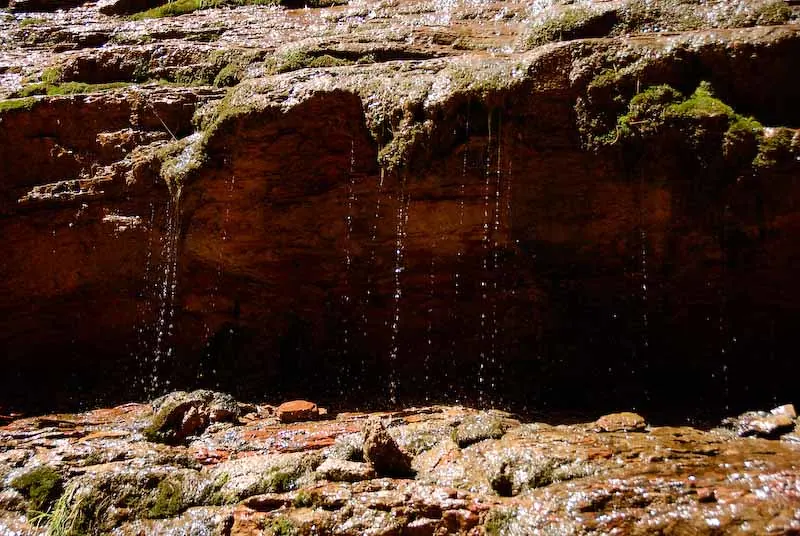
Groundwater can rise through capillary action and diffusion. Certain salts can then attack stone and mortar. In the evaporation zone of the rising water, the salts crystallise and create internal pressures that lead to deterioration. Here too, water must be prevented from penetrating the stone, in this case by providing waterproofing towards the ground.
Regarding the durability of walls, there is much discussion about the choice of mortar for building natural-stone walls. If the wall will not be exposed to the weather and remains dry, the mortar can be selected solely according to its workability, strength and appearance. For external walls, account is taken of the fact that rainwater entering the wall dissolves constituents of the mortar and, as the wall dries, carries them to the surface and deposits them there. For example, if a porous sandstone wall is divided by impermeable joints, water accumulates salts above the joints, leading to increased stress in the stone.
Stone, like all other materials, undergoes larger or smaller volume changes due to changes in temperature, which are, for example, in limestone, much less than in quartzite stone. Under normal conditions, these volume changes are of secondary importance if they are taken into account when using stone. Problems can arise on cornices under roofs, on facing slabs of masonry bridges, etc. For building elements that are exposed to extremely high temperatures, it is recommended to choose a stone that shows small and gradual expansion at a temperature of 500-1000oC, such as e.g. lumpy slag or sintered clay.
Prevention of stone damage
Today, there are various protective materials (varnishes, coatings) that protect stone, both polished and rough, from weather and other influences. Coatings are based on silicone, wax or other types of materials that create a barrier between the stone and the environment. Regular cleaning of the stone prevents the accumulation of dust and dirt over time, which can also adversely affect the stone itself. Placing stone surfaces in the covered area reduces the possibility of water reaching it. Basically, the most important thing is to consult with experts and choose the right stone in order to prevent any damage as effectively as possible.

Application note: Historical values, test procedures and coating recommendations are not a substitute for current standards, laboratory testing, a trial area, a material-compatibility check and a maintenance plan for the specific structure.