In soil mechanics, three main types of soil are distinguished: non-cohesive, cohesive and soils of organic origin. In addition, there are also rocks, but they are not studied in soil mechanics, but in the scientific discipline of rock mechanics.
Non-cohesive soils
Loose or noncohesive soils are those whose components are not bound by any binding agent. In the dry state, when they are not affected by moisture, the solid components of loose soil are completely free within the earth mass and there is only friction between them, called internal friction. Loose soils include:
- Blocks, grain size 200 – 2000 mm
- -碎石, grain size 60 – 200 mm
- Gravel, grain size 2 – 60 mm
- Sand, grain size 0,02 – 2 mm
- Dust, grain size 0,002 – 0,02 mm.
It should be noted that the dust fraction is sometimes called silt (Eng. silt, Ger. Schluff). However, since silt here means a certain type of soil of organic origin, this name for the stated fraction could cause confusion.

Fig. 1 - Sandy soil
Bound soils
Bound or coherent soils are those whose solid particles are bound together by cohesion. Cohesive soils can have very unstable physical properties, which easily change under the action of water. Bound soils include those containing solid particles smaller than 0,002 mm. Soil containing predominantly particles of size 0,002 – 0,0002 mm is called clay, and if these particles are of size 0,0002 – 0,00002 mm, then it is called colloidal clay.
In nature, pure clay is rarely found; it is most often mixed with other constituents, such as sand and dust, which is called loam; clay with limestone is called marly clay (marl), and clay with magnesium is uma. It is generally accepted that soil containing more than 50% clay constituents is called fat clay or simply clay, while soil with less than 50% clay constituents is called clayey soil. Soil containing less than 5% clay constituents is considered to have the properties of non-coherent soil.
The fastest and simplest way to assess which group a soil belongs to is to dry the sample and try to crumble it between your fingers. Non-cohesive soils fall apart immediately. Clayey soils crumble into smaller pieces between the fingers, and clay becomes hard almost like stone.

Fig. 2 - Clay soil
Soils of organic origin
These soils consist largely of organic or plant materials, with clayey and other components. Because of the content of organic constituents, these soils are very unstable and absorb water strongly, and for that reason they are unstable and cannot serve either as load-bearing soil or as material for the construction of earthworks. These soils include humus, silt, and peat.
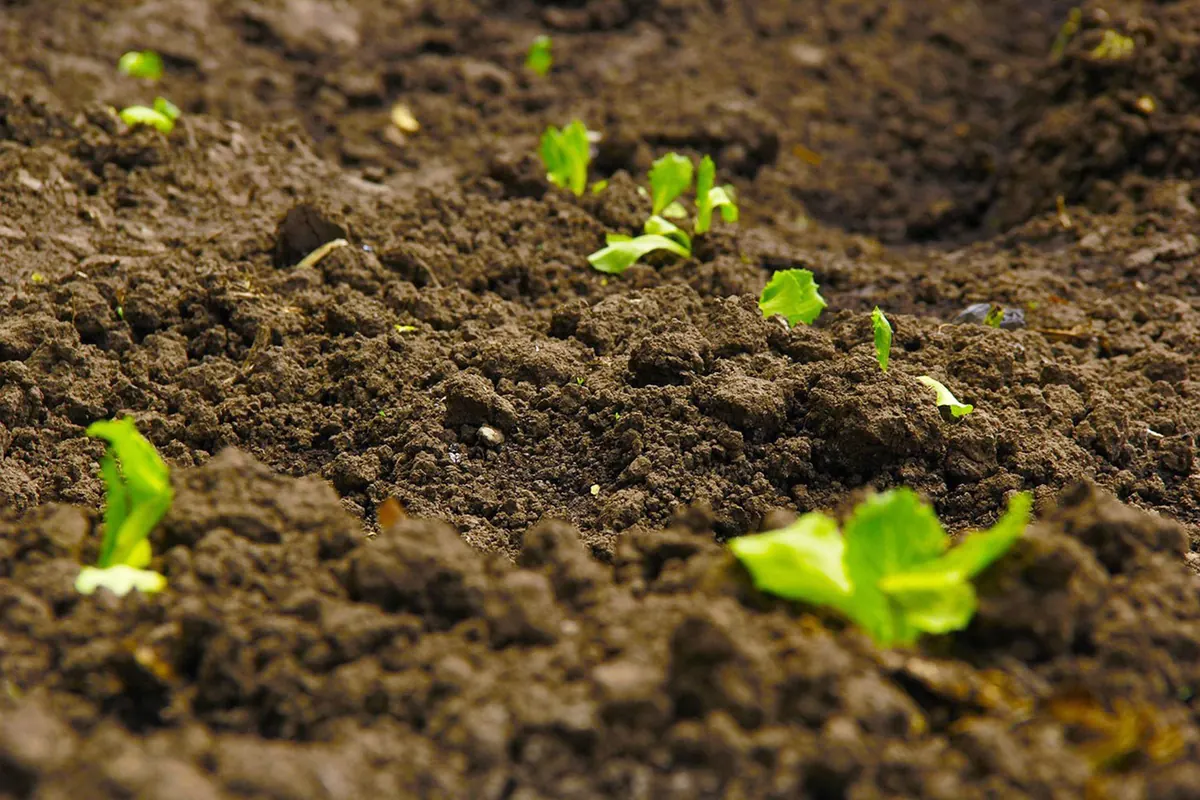
Humus is fertile soil found in the surface layer of the earth’s crust, usually several decimeters thick. It consists of a mixture of organic and mineral substances with many bacteria. When constructing earth embankments, road pavements and similar works on soil, as well as when excavating borrow pits for the production of earth structures, the entire humus layer should be excavated and removed, as it can be used only for protecting earth slopes against water erosion.

Fig. 3 - Humus
Silt consists of a mixture of organic matter in the form of very fine particles with mineral materials such as clay, dust and sand. It is found at the bottom of former rivers and lakes.
Peat consists of a large quantity of plant and organic matter in the form of fibers, with a lower mineral content.
Origin of soil
If we were to make a cross-section through the earth’s crust, we would find that it usually consists of surface soil – humus of a small layer thickness, then subsurface soil consisting of one or more layers of different composition and varying thicknesses, and finally solid rock. Surface soil was formed mainly by the decomposition of plant and organic matter, while subsurface soil was formed by the decomposition of solid rock.
The disintegration of solid rock occurs due to atmospheric influences or due to volcanic action. Atmospheric influences may be mechanical or chemical. If the process of disintegration of solid rock is the combination of minerals with oxygen, then it is disintegration by oxidation, and if it is the combination with water, then it is disintegration by hydration. Volcanic action is chemical. Due to high heat, solid rock is transformed into volcanic ash.
The process of disintegration of solid rock and its transformation into soil can occur in place, “in situ,” or with transport. The transport of disintegrated particles is carried out by water, in which case alluvial soils are formed, by wind, when they become aeolian soils, or by ice, when glacial soils are formed. During the transport of disintegrated fragments and particles of solid rock, they are further comminuted by impact, friction, and washing, to which they are exposed during transport. As a result of this action, the edges of broken fragments become rounded, new particles are crushed, their edges become rounded again, and so on until transport ends. The size and shape of the solid constituents depend on the strength of the rock, the length of transport, the type of transport, etc. Therefore the shape of solid particles in soil is very diverse: round, oval, with sharp or rounded edges, triangular, etc. Solid constituents of size 0,02 – 0,002 mm, which fraction in soil mechanics is called dust, are mostly round or oval in shape. Such constituents smaller than 0,002 mm, which fraction is called clay, are flaky in shape. Coarser particles of sand, gravel, and pebbles may have various shapes: cubical, rounded, flat, etc. Cubical particles are more difficult to change in shape, flat ones more easily. For this reason, soils consisting predominantly of flat particles can easily change their composition.
It should be noted that some soils, whose formation has been completely finished, are sometimes later covered by new deposits, so that the previously formed soil remains in depth, while a second soil forms on the new deposit, which need have no connection whatever with the earlier one. Such a previously formed soil later covered by a new deposit is called buried soil. These are most often cultivated soils that had been worked and were then covered by deposits of wind-blown loess dust, but the deposits may also be fluvial. Buried soil is recognized by its dark color, and there may be several such layers if this process has been repeated several times.
Alluvial soils
Alluvial soils are formed by the deposition of solid particles during transport by water. Deposition depends on a number of factors, the most important of which are the speed of the water flow, the coarseness of the transported material, and the content of other constituents such as salts, lime, etc. At high flow velocities, only coarse particles are deposited, while fine particles are not deposited but are carried further downstream. For this reason, coarser solid particles are deposited in the upper part of the watercourse, closer to the source, where the water velocity is high. As the flow velocity decreases, progressively finer particles are deposited. In still water, without flow, the finest solid particles are deposited as a rule. Wherever the water flow slows down, major deposits occur, as is the case in flooded areas when water overflows from the riverbed, at river mouths, in front of dams, etc.
The settling of very fine colloidal clay particles can last for an unlimited period of time due to the electrochemical effect that arises between fine particles smaller than 0,0002 mm when they are immersed in water. In this case, the solid particles carry an electric charge of the same sign (negative), which causes them to repel each other and move in the liquid mass at speeds that are greater the smaller they are. These are Brownian motions. Because of these motions, the settling of solid particles in water is significantly slowed and can last for an unlimited period of time.

Fig. 4 - Alluvial soil
Aeolian soils
Aeolian soils are formed by wind deposition of solid particles. Two types of aeolian soil are distinguished: loess and dunes. Loess consists of solid particles about 0,05 mm in size or slightly smaller, bonded together by calcium carbonate. For this reason, when dry, loess has great strength. Cuts in loess can stand with vertical sides at very great heights. However, if loess becomes heavily soaked, it loses its strength and can easily move. Well-known are the loess deposits of Bežanijska Kosa near Belgrade, which can stand with vertical sides at heights over 20m. However, in parts where settlements have been built near the edges, as is the case in Čunarska Street in Zemun, where constant wetting occurs right next to the slope of the loess plateau due to the spilling of wastewater, the loess slopes collapse and the stability of the loess soil near the edge is threatened.
Dunes are moving hills of loose sand deposited by the wind. Under the action of wind these hills are quickly blown away and re-formed, which makes them a danger of burying and destroying houses and vehicles.

Fig. 5 - Aeolian soil
Glacial soils
Glacial soils are formed by the transport of solid soil particles by ice. Glacial soils have a different composition than alluvial soils, because they consist of solid particles of approximately similar grain size, namely pebbles, gravel (moraines), or sand left behind after the ice melts. In the deposits of former glacial lakes there is glacial loam.

Fig. 6 - Glacial soil