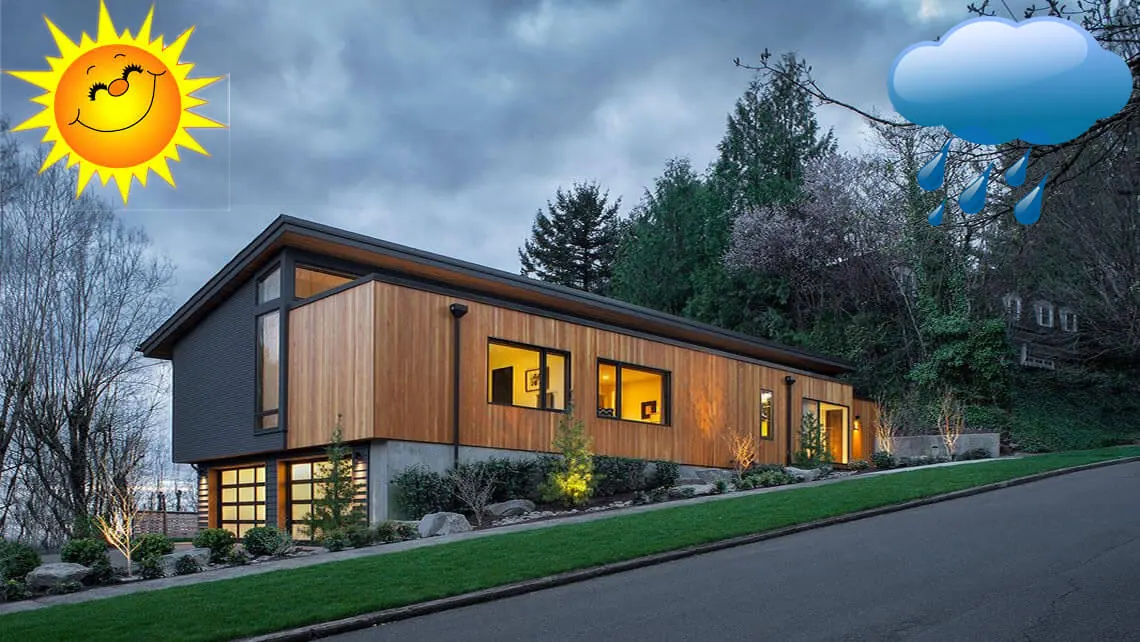
The greatest enemy of windows and exterior wooden joinery is not water, but the sun.
Even PVC joinery has to battle the sun. If PVC profiles are poor, the joinery may turn yellow, warp over time — which is why reinforcement is placed inside PVC joinery — and become more brittle.
On the other hand, wood bonded from several layers, namely laminated profiles, does not have problems with warping, but the exterior varnish must be of very high quality and applied correctly.
What is used to coat exterior joinery?
Water-based varnish for exterior use consists of a first coat, or primer, which contains an isolating agent for protection from water and sun and an impregnating agent that protects against insects and fungi. When applied, they penetrate deeply and protect the wood. The next two or three coats are topcoats that contain the most UV inhibitors, whose main task is to protect the wood from UV rays.
Water-based varnish is diluted with water during application, so people often wonder whether rain can wash it off the wood. This is not true. As soon as it dries on the wood surface, the varnish becomes waterproof and water can no longer penetrate to the wood.

Why is the sun a greater problem than water?
The answer is in the first sentence of this article. Nothing is resistant to the sun. Plastic becomes brittle and cracks, rubber does too, colours fade — think of a beach umbrella — fabrics tear and façades fade.
Like everything else, wooden joinery must be adequately protected from the sun. This technology is complex because it must protect the wood as much as possible while allowing it to breathe and, like every material, expand in summer and contract in winter.
When wood is treated with varnishes, the topcoats must contain UV inhibitors that battle the sun. The sun consumes them over time, so the topcoats should be applied as thickly as possible so that there are more inhibitors and the exterior surfaces resist solar radiation for longer.
Technologies differ among manufacturers. Some apply the impregnating and isolating agents separately, followed by the colour and topcoat, but the protection principle remains the same. Technologists still debate which technology is better, but that is not the subject here.
How do UV inhibitors protect the topcoat?
Most UV protection is in the topcoat, with less in the primer. Varnishers know that the topcoat has an apricot colour — this is the colour of the inhibitors that protect the primer and colour from deterioration. When the coat dries, it becomes completely transparent.
The technology used at Savo Kusić uses coatings made with pigments of inorganic origin. They are much more resistant to UV radiation than pigments of organic origin used for staining interior furniture.
Can wood colours be mixed?
If a colour or stain intended for interior use were added to an exterior topcoat varnish, it would work for some time, until the UV inhibitors were exhausted. The sun’s rays would then act on the pigment of organic origin and break down the colour. Double bonds in the organic pigment are broken by the action of sunlight; for example, mahogany becomes brittle after a certain time.
Most inhibitors are found in the topcoats because they are the first to be struck by the sun, but they are also present in the primer, or first coat. The impregnating agent must therefore also be intended for exterior use. It must contain pigments of inorganic origin because UV radiation affects them much less and cannot break them down.
One type of inorganic pigment is iron oxide, or rust. Through particular technological processes and at particular temperatures, manufacturers process the rust and obtain black, ochre, various shades of red and similar variations. A characteristic of pigments obtained through this process is that they maintain colour consistency over time.
One of these variants is the so-called Bayer ferroxides. This is a special group of compounds used for finer tinting, concrete, and the construction and wood industries.
When a client requests a colour that is not in the standard RAL system but must match existing furniture or a façade, the shade has to be mixed by hand. Varnishers particularly dislike this task because it requires a large number of shades on water, oil and nitro bases. Colours intended for exterior use must always be mixed into an exterior varnish because only they contain the mentioned UV inhibitors.

Universal stains exist, but those intended for interior use are by no means suitable for exterior use. If they are used outside, the colour will fade after only one year.
When windows are treated with water-based varnishes, UV inhibitors are present in the primer but are most abundant in the topcoats because these provide the first protection from the sun. The topcoat therefore has a “creamy” colour that disappears as it dries and becomes transparent, allowing the colour in the first coat to show through.
How does the position of a window affect coating durability?
The loss of inhibitors becomes visible sooner on windows on the side of a house that is more exposed to sunlight. On north-facing windows that the sun does not reach, or on recessed entrance doors that the rays do not strike, this effect will not appear in the same way.
When should wooden windows be repainted?
If windows are on the south side, where there is more sunlight, after how many years should they be repainted? There is no single rule. It depends on the side on which the window is located and how much UV radiation reaches it.
If the varnish is of good quality and the procedure is followed, manufacturers generally give a five-year warranty on the varnish. Some manufacturers give a warranty of up to ten years, but on condition that the customer manually applies a new coat of varnish to the window once or twice a year.
Why are window construction and varnish application important?
The degree of damage to a window over the years also depends greatly on its construction. It is important for window surfaces to be sloped so that water does not remain on them.
If the varnish topcoats are poorly applied or the varnishes contain few UV inhibitors, the inhibitors will be quickly exhausted under UV exposure and cracks will appear in the varnish. If the bottom window rail does not have a sufficient angle, while all the water running down the window passes over it, this is where peeling varnish will first be noticed.
Summary
The sun acts on the varnish, UV inhibitors are consumed and the varnish cracks when its surface weakens. If the window construction is poor, water remains, penetrates through the cracks and leaves the wood practically unprotected.
It is therefore most important to apply the topcoats several times and make every coat as thick as possible. Only well-trained varnishers can do this because varnish is liquid and runs or slides off the surface. The varnisher therefore applies it on the fine line between a sufficiently thick coat and sagging.
Every step must be followed, but even with every point in the process covered, the human factor remains. It determines not only whether the points have been completed, but also how well they have been completed.
If durable protection of exterior joinery is important to you, view our wooden windows and entrance doors, or contact us for a quotation and advice.