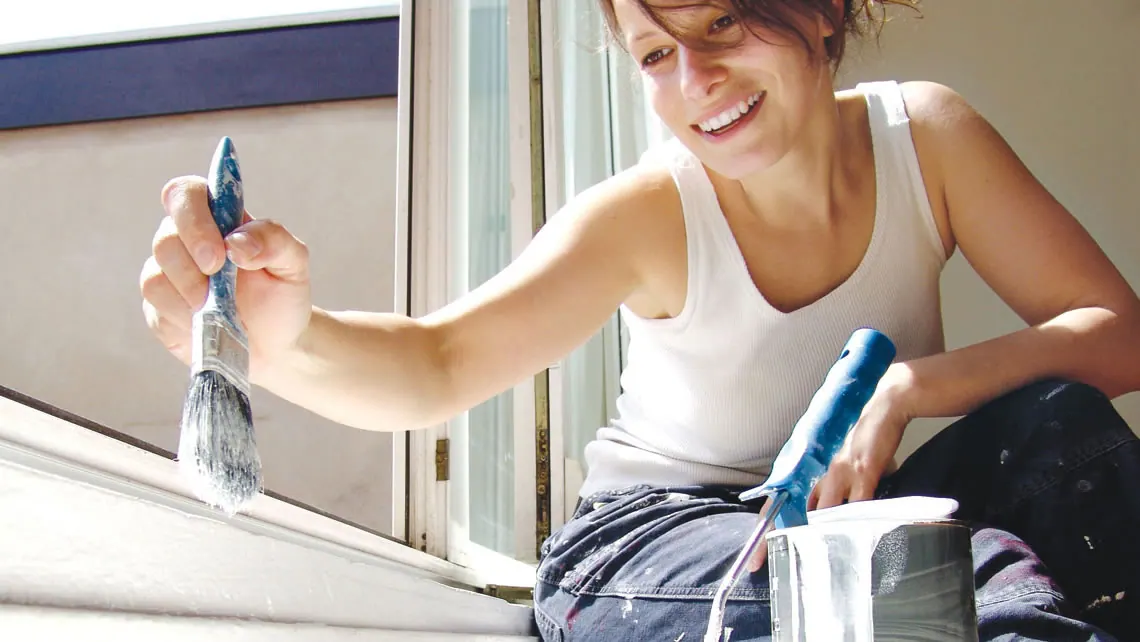
Painting the walls
Walls in the bathroom, kitchen, etc. which are exposed to the influence of water and are not covered with tiles, it is advisable to paint. Before painting, the walls should be leveled and primed. These substrates are mixed with water in a ratio of 7:1 and applied with a brush or roller. After complete drying (if 36 hours), smoothing follows. First and foremost is to use corner moldings. They give direction and strengthen the corners, and are installed before smoothing. The grout itself is mixed with a mixer that goes on a drill, and about 30% of water goes into a full bucket of grout. The mass should be thick, not runny. The grout is applied to the wall with a planer. The treated wall should be completely smooth. The putty must not be applied in layers thicker than 1 mm. Larger unevenness can and should only be leveled in several layers, so always wait for the individual layers to dry completely.
The procedure for applying the glaze (in these steps):
1. The first layer is applied from above, up to the middle of the wall. It is applied in a width of one meter and then we go back with the planer to pick up the excess material. A trowel is used to apply to the corners, for easier access.
2. The second layer is applied from 30 cm from the bottom, then towards the top layer, so they are joined (direction from bottom to top).
3. The third layer is applied from the floor, towards the middle layer.
After troweling and complete drying of the trowel (15 to 20 hours), the trowel is sanded. Large flat surfaces are sanded by machine, and parts around the edges, corners towards the ceiling, around doors and sockets are sanded by hand with sandpaper fineness 580.
Now the walls are completely flat and everything is ready for painting or wallpapering
If we follow these rules, we will avoid later inconveniences.

Wood painting
Preparation of the wood surface
If the surface of the wood is still raw (unpainted), it should first be sanded and stitched, i.e. reduce, or completely eliminate, the power of wood absorption. Oil paint thinner is used for this. The thinner is applied to the surface with a brush and after 2-3 hours, its excess is wiped off with a dry cloth. You should always wipe in the direction of the wood grain. A wooden surface saturated in this way dries for 24 hours. Of course, the wet surface must not be coated or puttyed. If the surface of the wood is uneven, then it is puttyed with wood putty or special putty. The putty is applied in a thin layer to the surface of the wood with a spatula (maximum layer thickness 0.5 mm) and carefully leveled. The direction of movement of the spatula should deviate slightly from the direction of the fibers (about 20-30°). Excess putty must be removed immediately. After this, putty is applied in several layers, and between each layer you should wait for drying time (about 24 hours) and sand the dried layer with sandpaper. The sanded surface should be cleaned of dust and painting can begin. If a special putty is used, the duration of the operation is reduced to 2-3 hours.
From surfaces that have already been painted, the old paint should be removed by scraping (spatula, scraper knife), lighting with a gasoline lamp or some means for etching the paint (fig. 1). The etchant is applied thickly to the surface with a cloth or brush, wait for the paint to swell (similar to boiling milk) and then removed with a spatula. When the old layer of paint is removed, the surface should be sanded with sandpaper (placed on a piece of wood) and cleaned of dust with a cloth or brush. If a paint etching agent is used, the surface should be washed several times with water and detergent.

Picture 1.
Priming
If the prepared surface has not yet been painted, the surface is first sanded. If the surfaces are flat, the fastest sanding can be done on calibrating machines (sanding machines), because only they can sand uniformly large surfaces, without throwing out hard parts of the stone. After that, it is good to coat the grain with thinned paint, on the basis of which there will be layers of sand, or simply moisten the surface with plain water, so that all the “hairs” will rise. If possible, priming should be carried out in the same tone as the final paint. The substrate applied in this way should be dried for 24 hours, after which it should be lightly sanded and cleaned of dust.
If it is a wooden surface that has already been painted, we can omit the priming operation.
This is followed by a top coat. As the operations of surface preparation and priming for painting (for top coating) are the same for all wooden objects, we will describe in detail only the operation of applying top coating for individual objects of use.
Painting doors and windows
First, as in the previous case, good preparation and grinding is required. If possible, sanding should be done on specialized machines for sanding flat surfaces - calibrators. These machines feature multiple belts with different grits of sandpaper and bring the surface to perfection. Prepared and primed doors and windows can be painted in different colors. If it is not necessary for the surface to be beautiful and shiny, oil paints are used, possibly diluted with a little solvent. For interior painting, oiling paint with a vegetable oil base or newer technologies such as polyurethane paints are suitable. For surfaces that are ex
married
due to weathering, linseed oil-based paints or the latest technologies such as water-based paints should be used. If a decorative coating with enamel luster is desired (the most common case), internal enamel or synthetic enamel should be used. The first one is used inside the apartment, and the second one is used for objects that are exposed to atmospheric influences (e.g. the outer parts of windows). In both cases, at least two coats should be applied, but it is better if three coats are applied using a brush (at home) or a spray gun. Objects can only be used after drying (about 24 hours). Doors or windows are best removed and painted in a horizontal position, due to leaks.
Click here to read how to properly paint exterior woodwork.
Painting of kitchen furniture
The surfaces of the kitchen furniture should be especially carefully prepared. (Preparation should be carried out in the previously described manner). Internal enamel or synthetic enamel can be used for the top coat. The latter provides a more durable coating and is more water resistant.
Painting of wooden pathos
Fresh pathos must not be painted due to humidity. It is recommended to wait until the wood is completely dry before painting. Before painting, the pathos should be scrubbed well and after complete drying, the surface should be prepared according to the previously described instructions. For priming, you should use oil-based brown paint diluted with 10% white spirit or turpentine. After complete drying (24 hours), the base coat must be lightly sanded with emery paper and cleaned of dust. The surface obtained in this way (lighter or darker) should be coated twice with pathos enamel. Between two coats, drying takes 24 hours. The first coat should be lightly sanded after drying.
Parquet varnishing
Varnishing parquet floors is very useful. The reasons are simple: labor saving, varnishing fills the openings of the parquet and it is the easiest to keep clean. The painting operation is very simple. First, the parquet should be thoroughly scrubbed with water and detergent so that the scrubbing paste is completely removed. With new parquet, where the paste has not yet been used, this arrangement may be omitted. After the parquet has completely dried, we can start varnishing it with parquet varnish. Parquet varnish is sold together with contact and thinner (as a set). Before use, the varnish and the contact should be mixed well. For better application, the mixture can be thinned with a thinner if necessary. With 1 kg of varnish, 12 m2 of surface can be coated in one layer. At least three coats of varnish are required to achieve good quality. The drying time between individual layers is 24 hours. The dried layer should be sanded with sandpaper before applying the next layer.

The mixed varnish is usable within 5 hours, after that it thickens and even hardens. A contact that is chemically acidic attacks iron objects. Similarly, varnish that has been in contact with an iron object becomes unusable. Varnish and contact can only be mixed in a glass or undamaged enamel container. When applying with a brush, the metal part of the brush must not come into contact with the varnish, and therefore it is best to use a round brush with a holder made of synthetic material. After use, the brush should be immediately washed in thinner.
Varnishing the parquet must not be done when the temperature is lower than +10°S or in a room with a strong draft, because the coating will turn white. Due to the evaporation of the thinner, it is recommended to work with open windows. Smoking, the use of open flames, the use of electrical switches is prohibited due to the risk of fire and explosion when working with varnish.
Painting iron surfaces
When painting iron surfaces, surface preparation is very important, because if the paint is applied to a rusty, uneven surface, it will quickly peel off. To remove rust, the simplest means are a wire brush, sandpaper and a scraping knife. This work is very tiring, but the time and effort should not be regretted, because the durability of the coating depends on good cleaning.
After removing the rust, the iron surface should be coated with a brush and rubbed with light gasoline or turpentine (degreasing) and then cleaned of dust after drying.
Oil paint with iron minium is suitable for priming, and synthetic minium for more difficult conditions. The base coat should be applied in one, possibly two layers. Oil paint dries in 24 hours, but it takes at least a week to dry completely. Therefore, no top coat should be applied before this time. The drying time of the synthetic minium is 4 hours for each layer, and after 24 hours the top coat can be applied. Attention! These materials are toxic and should be handled with great care.
Roughnesses and cracks on iron surfaces, similar to wooden surfaces, are removed by puttying. The only difference is that a dark oil putty is used for iron surfaces. Interior enamels can be used for the top coating inside the apartment, and synthetic enamel or protective oil paint against rust can be used for objects that are exposed to atmospheric influences (eg fences, iron posts, etc.). To repair minor damage to the coating on motorcycles or car bodies, nitro-enamel is used, which can be applied with a brush. This enamel dries very quickly (4 hours). Primol is used for priming under nitro-enamel, and nitro-putty for filling. Heat-resistant silver paint is used for painting the stove chunks, which is applied without priming after removing rust and degreasing. When painting these pipes, you should pay attention to the fact that during use, the temperature increases very slowly so that the coating does not swell. Silver enamel for stoves cannot be used in places that are exposed to atmospheric influences.
Painting garden furniture
The durability and aesthetic appearance of the useful items in our home and our surroundings are equally important to everyone. If we paint these objects with modern coatings, both requirements are satisfied. Below we will describe those coatings that can be used for garden furniture, decorative flower stands, balcony fences and other fences.
The quality of the coating is determined by how professionally and carefully the painting was done. Before starting the painting work, the paint in the box should be mixed well and the consistency of the paint should be adjusted with the thinner - with constant mixing. The dilution of the paint depends on whether it is applied with a brush or by spraying. Namely, when applying with a brush, a lower dilution is needed, and when spraying, a higher dilution (for applying with a brush, you need about 5-10%, and for spraying, 15-50% of synthetic thinner).
Painting work is recommended to be done in a dry, dust-free room. If painting is done in several layers, then the drying time between individual layers is about 16-24 hours.
The colors, which we will describe below, can be applied with a brush or by spraying. The exception is synthetic minium, which can only be applied with a brush (for health reasons).
When painting metal objects, the basic element of the coating is a protective base coat (against rust). Protective coatings contain highly effective inhibitory pigments and prevent the spread and formation of rust. For painting iron and steel surfaces synthetic minium is predominantly used as a base coat, and for light metals (e.g. aluminum) a base coat for light metals is used.
As a thinner, for synthetic minium, and also for the base coating for light metals, light gasoline is used. If it is a matter of repainting surfaces that have already been painted, the protective coating may be omitted and should only be used to repair minor surface defects. Enamel for garden furniture is sold in boxes of 0.35 and 0.70 liters in all colors and has a covering power of 8 -12 m2/kg.
It is known that a good top coat can only be made if a base coat is applied under the enamel. This type of base coat is a synthetic universal base coat that dries very quickly, is hard, withstands impacts, but provides an elastic membrane. One kg of universal base paint is enough to cover 6-8 m2 of surface. The advantage of the universal primer is that, in addition to ensuring the appropriate overall thickness of the coating, it also removes minor defects and unevenness of the surface. A coat of this base color can be sanded well, gives an eggshell tone and all top enamels adhere well to it.
For a universal base coat, it is recommended to use a synthetic thinner in a maximum amount of 20%. This coating is available in all shades in 1/2, 1 and 5 kg boxes. The special enamel varnish for garden furniture is extremely suitable for high-gloss, fast-drying coatings for both wooden and metal objects.
Enamel varnish can be applied directly to sanded and properly prepared surfaces, which have already been painted, and to completely new surfaces in combination with a universal base coat.
A synthetic thinner should be used to dilute the special enamel varnish, because this varnish does not tolerate other thinners (petrol, turpentine, nitro-thinner).
Freshly applied coating dries very quickly which prevents airborne dust from sticking to the painted surface. In any case, it is advisable to wait a drying time of about 24 hours before using the item.
Radiator painting
After the end of the heating season, the radiators can also be repainted. During one heating season, coatings on radiators are exposed to various influences, which can be seen in the partial or complete deterioration of the protective coating. Such radiators in the apartment, with damaged paint, create a very bad impression from an aesthetic point of view, so restoring the paint is also justified from this aspect.

Radiator lacquers (there are two types: based on natural resins and synthetic) protect radiators from rust and at the same time give them a beautiful appearance. Radiator varnishes are sold in packages of 1 and 5 kg. Before starting painting, minor damage should be repaired with sandpaper (80, 100 or 120 grit). It is recommended to place sawdust or some larger paper under the radiator during painting to protect the parquet from paint drops. If, despite this protection, a drop gets on the parquet, it should be wiped immediately with a cloth soaked in radiator varnish thinner.
Radiator-varnish can be applied with a brush (for thinner, radiator-thinner or nitro-thinner should be used). The radiator-lacquer coating dries very quickly, in about half an hour it reaches the degree of surface dryness, and in 8-10 hours it dries completely. During painting, a suitable draft should be created in the room. One kg of radiator varnish is enough to paint 8-10 m2 of surface. The surface, painted with radiator-lacquer, is very shiny and decorative, white in color and retains this color even after a more permanent thermal effect, i.e. it does not turn a yellowish color due to heat.
When painting with this paint, as well as the other described paints, the use of open flames should be avoided, because the paints contain flammable solvents.
Varnishing of metal surfaces
Colorless varnish can be used to paint smaller objects made of brass, bronze, aluminum or chromed metal objects. This polish can be applied with a brush in very thin layers e.g. on chandeliers, doorknobs, chromed surfaces, etc. It protects the surface of the lacquered object so that it does not lose its shine and color even without cleaning. The drying time of this varnish is 4 hours.
Maintenance of varnished and painted surfaces
Lacquer and paint coatings become dirty, lose their shine and turn dark over time. Scratches form on the top layer and the paint becomes dull. Conventional methods cannot be used to clean painted surfaces, as cleaning agents attack the coating materials. Therefore, for the cleaning and maintenance of lacquered and painted surfaces, special agents are needed that will extend the life of the coating and preserve their decorative properties. Such agents are: polish polishers.
These agents are very suitable for cleaning varnished and painted surfaces. Their use does not damage the coating, what’s more, it protects and polishes it.
They are used in such a way that a small amount is poured onto cotton wool or a cloth and the surface to be cleaned is gently rubbed in circular motions. Then a dry cloth or cotton wool is taken and rubbed over the coating so that it becomes shiny. This agent is one of the very important props for daily cleaning and maintenance of varnished and painted surfaces.
Car polish polisher
It is used to clean, maintain and polish lacquered and painted surfaces of motorcycles and cars. It contains a special resin additive so that with systematic use, the surface repels water, i.e. the rain reflects off the surface of the car.
Before use, the car, or the motorcycle should be thoroughly washed and wiped with a dry sponge. The technique of working with this agent is the same as with the cleaning agent for varnished and painted surfaces.
Superpolit
It is used for fine sanding of varnished and painted coatings. It also contains solid materials for sanding. Minor scratches, wear and dull coating color can be removed with this tool.
Superpolit should first be shaken and a small amount should be poured onto a cotton ball or cloth and with this, first lightly, then more strongly, rub the surface. To remove scratches, it is necessary to rub the surface a little longer and, if necessary, repeat the polishing. Porous and pitted surfaces cannot be polished with this agent, because it gets into the pores and is almost impossible to remove later.
Polishing is recommended to be repeated twice a year.
If you are renovating or choosing new joinery, take a look at our timber windows, front doors or send us an inquiry through the contact page.