Important safety note: This is an archival professional text, not a current laboratory or field manual. The procedures described include mercury, open flames, heating, paraffin, and other equipment and materials that may be hazardous or unacceptable today. Do not apply them without valid standards, risk assessment, safety data sheets, appropriate laboratory and professional supervision. The text is not part of the current offer of products and services of Savo Kusić.
Determining the bulk density of soil
There are several methods for determining the bulk density of soil. The most commonly used methods described here are the cylinder method, immersion of a sample in water, immersion of a sample in mercury and the sand method.
Procedure with a cylinder
This procedure is the most widely used and is performed in the field and in the laboratory. It is applied to cohesive and non-cohesive soil.
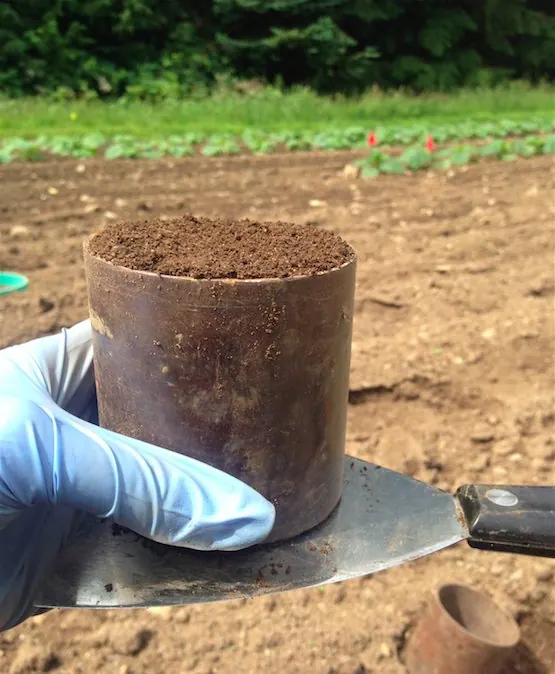
A metal cylinder of known volume, with a sharpened lower edge, is pressed into the soil or into an undisturbed or artificially compacted sample, so that it is completely filled with soil mass. After that, the surface of the sample is leveled with a knife with the upper and lower edges of the cylinder and immediately closed with metal covers and weighed on a scale.
If W is the weight of the sample with cylinder and caps, W0 is the weight of the cylinder itself with caps, V is the volume of the cylinder
the bulk density of the soil, γ, is:
γ = (W - WP)/V
Immersion of the sample in water
This procedure is based on the physical property that the volume of a body immersed in water is equal to the volume of displaced water. It is used only for cohesive soil when a sample of regular geometric shape cannot be obtained.
A piece of any shape is taken from undisturbed soil or from a larger sample, and its natural-state weight W is measured on a scale. The sample is then coated with molten paraffin, which must not be overheated but only warmed enough to melt. A paraffin layer 1-2 mm thick should completely cover the sample. The paraffin-coated sample is then weighed to obtain W’. The weight of the paraffin is W’ – W.
The volume of paraffin VP is obtained from the formula: VP * γP = W’ – W,
where γP is the volumetric weight of paraffin, which is known and amounts to γP = 0,892 p/cm3.
From the above equation we have: VP = (W’ – W)/0,892 [cm3].

Sl. 1. Determining the volumetric weight of the soil by submerging the sample in water
Then, the paraffin-wrapped sample is hung on a scale with a thin silk thread (fig. 1), the scale is brought to balance, and immediately a vessel with distilled water is drawn under the sample, so that the entire sample is submerged in water. Since due to the apparent loss of the weight of the sample in the water, the balance on the scale is disturbed, it is re-established by removing the weights, so that the weight of the sample with paraffin immersed in the water W is obtained. The difference in the weight of the sample with paraffin in the unsubmerged and submerged state gives the weight of the displaced water, i.e. if the volumetric weight of water YW = 1,00, the volume of displaced water Vw

From the volume Vw, we subtract the volume of paraffin VP, and get the volume of the sample.
The volumetric weight of the soil is: γ = W/(Vw – VP)*m
where m is the correction coefficient due to the difference in water temperature, since Y = 1,0 for water temperature at 4 °C: m = γw,T / γw,4oC.
Immersion of the sample in mercury
This procedure is applied to cohesive soils when a sample of regular geometric shape cannot be taken, as may be the case when determining soil shrinkage limits.

Sl. 2. Determining the volumetric weight of the soil by immersing the sample in mercury
The sample is immersed in a vessel completely filled with mercury (fig. 2) and pressed with a glass plate fitted with thin metal pins so that it is fully submerged. The displaced mercury overflows into a larger vessel, from which it is collected and weighed. If W is the weight of the sample, Wz is the weight of the displaced mercury, γz is the volumetric weight of mercury, and Vz=V is the volume of displaced mercury, which equals the volume of the sample;
Vz * γz = Wz * Vz = Wz/ γz
then the bulk density of the soil is:
γ =W*γz /Wz.
Sand method
This test is performed in the field and is most often applied to unbound soils, gravel, gravel sand, moraine material and in other cases, when the extraction of undisturbed samples with cylinders is not possible. The principle of this procedure consists in digging a hole in the ground and then filling it with normal sand of known volumetric weight, based on which the volume of the hole is determined. The volumetric weight of the soil is determined from the weight of the excavated mass and the volume of the hole.
The surface of the soil whose volumetric weight needs to be determined is leveled so that it is horizontal, then a tin plate measuring about 40 x 40 cm (fig. 3) is placed on it, with a template cut out in the middle of the diameter Ø = 20 cm, 5 mm thick, for digging a hole in the ground. The tin plate is laid flat on the ground and fixed with pegs. A hole with a diameter of 20 cm and a depth of about 20 cm is dug with a hand tool (knife, spatula, spoon, chisel) through the opening of the template, preferably with vertical walls, but not outside the template and cleaned well. All the excavated material is placed on the slab, then immediately after digging, while it still has its natural humidity, weigh it on a scale and determine its weight W. In order to later determine the natural humidity, the sample is placed in a tin box with lids, to be taken to the drying room after the field work is completed. Immediately afterwards, dry normal sand is poured into the excavated hole, the volume weight of which is γd determined by sanding, i.e. from the previously performed laboratory test, by pouring sand through the same funnel and from the same height, h falls as in the field test.

Sl. 3. Determining the volumetric weight of the soil using the sand test
Before starting the test, measure the weight of normal sand in the beaker, then after filling the hole in the ground with that sand up to the top surface of the tin plate, which is leveled with a steel ruler 40 cm long, measure the rest of the sand in the beaker, so that the exact weight Wd of dry normal sand in the hole up to the top surface of the tin plate is obtained. The volume Vd of the excavated hole to the upper surface of the tin plate is determined based on the formula Vd = Wd/γd.
The volume V of the hole in the ground is obtained by subtracting the volume v of the opening of the tin template:

The volumetric weight of soil γ is: γ = W/V, where W is the weight of excavated soil from the hole measured immediately after excavation. It is noted that plaster, oil or cold asphalt is used instead of sand, which are less sensitive in wet weather. In addition, there are also special devices for easier and faster work on the test with sand.
Approximate values of soil volume weights are given in table 1, with a note that in geomechanical analyzes in each case the soil volume weight should be determined by experiment in the laboratory or in the field.

Determination of soil moisture
Soil moisture can be determined in several ways: by a laboratory method using an electric drying oven, by field methods involving drying over an open fire, by using carbide, by measurement under water and by using an air pycnometer. Only the first two methods, historically the most commonly used locally, are described here.
Laboratory method using an electric drying oven
This method is the most reliable and most widely used for all types of soil. A piece of soil from an undisturbed sample is placed between two concave watch glasses, secured with a metal clamp and weighed together on an analytical balance. It is then placed in an electric drying oven and dried at 105°C to constant weight (fig. 4). The temperature variation during drying should not exceed ±2°C: at a lower temperature drying may be incomplete, while at a higher temperature organic constituents in the sample may burn. The approximate drying time for the sample enclosed by watch glasses is about 6 hours for sand and about 12 hours for clay. After drying, the clamped sample is placed in a desiccator to cool to room temperature and is then weighed again.

Fig. 4. Drying a sample between watch glasses secured with a clamp
If W is the weight of the sample at natural moisture content together with the watch glasses and clamp, Ws is the weight of the dry sample with the watch glasses and clamp, and Wt is the weight of the watch glasses and clamp, soil moisture w according to Atterberg’s definition is the weight of water divided by the dry weight of the soil, that is: w = W-Ws / Ws-Wt * 100 [%].
Determination of soil porosity and porosity coefficient
The test is performed on an undisturbed sample, provided that its volume can be determined in an undisturbed state.
We press a metal cylinder of known volume into the undisturbed soil or into a sample of larger dimensions, level the upper surface of the sample with the edges of the cylinder and let it dry at 105°C until the weight is constant, then let it cool down at room temperature, and weigh it again on the scale together with the cylinder.
If V is the internal volume of the cylinder, Vm the volume of non-porous soil solids, Wd the dry weight of the sample, γs the volume weight of the solid particles, the soil porosity n is

The volume Vm is determined based on the dry weight of the sample Wd:

that is, in percentages of the total soil volume

Since γd = Wd/V, i.e. dry volumetric weight of the soil, it can be put
n = 100* (1 – γd/ γs) [%].
The porosity coefficient is obtained from the form e = n/(1-n).
For design, quality control or execution of works, use current regulations, standardized test methods and an authorized laboratory. This text is preserved as a historical educational resource.