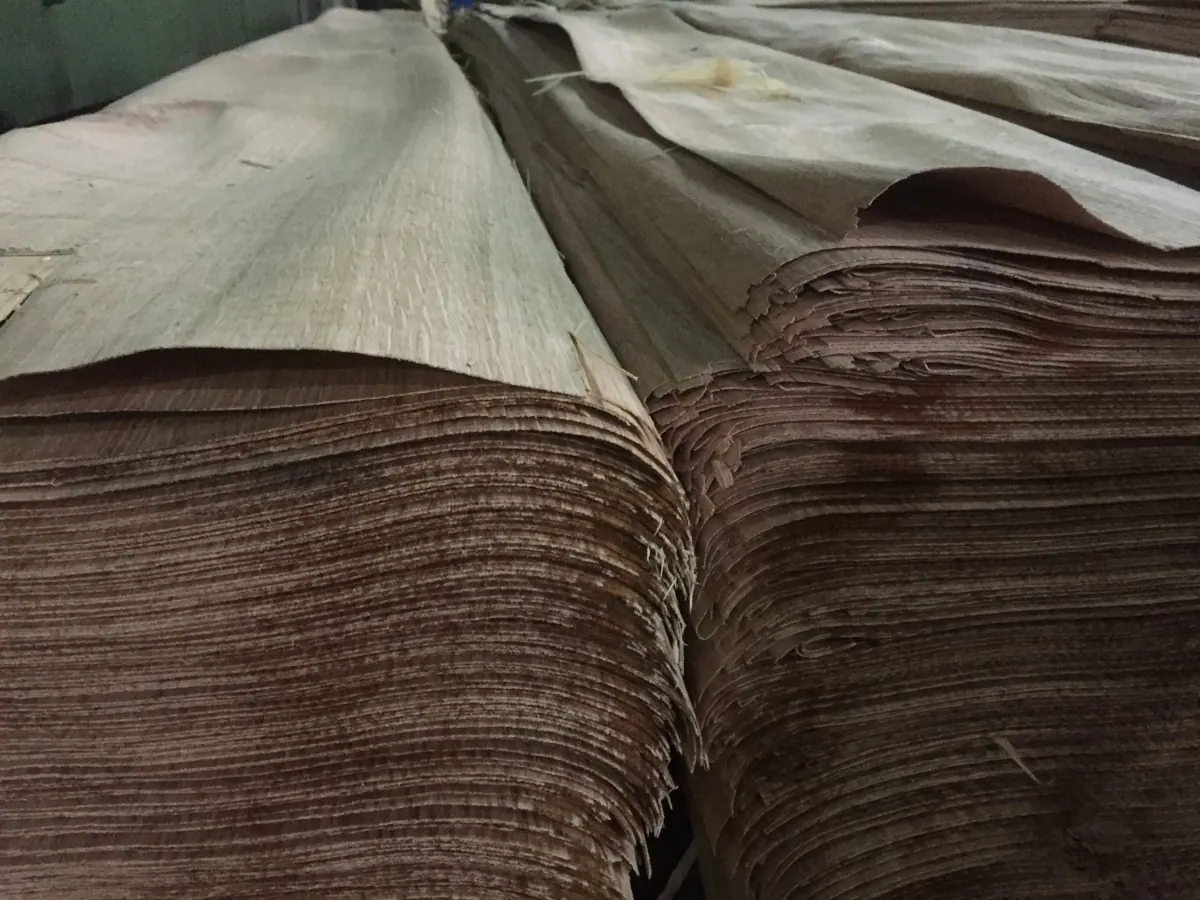
Veneer is produced from long and short birch, beech, alder and oak logs. Appropriate grades, dimensions and technical conditions exist for each wood species, and suppliers of raw materials are strictly required to meet them.
Birch logs for plywood production
Long and short birch logs for plywood production are 1.3, 1.6, 1.9, 2.2, 2.3, 2.6 and 3.2 m long. Their thickness at the smaller end is 20 cm or more, increasing in 1 cm increments.
Each short log should have a length oversize of 2 to 3 cm, and each long log 3 cm for every short log cut from it. The dimensions of long logs should be evenly divisible by the length of short logs.
According to wood quality, long and short logs are divided into three grades: I, II and III. Each grade must have a veneer zone of at least 4 cm. The peripheral part of a long or short log is considered the veneer zone. Its thickness is determined by its width along the minimum radius of the end face, from the inner surface of the bark towards the centre. Long and short logs of the first grade are used to produce higher-grade veneer.
Beech logs
Long and short beech logs for veneer production must have the following lengths:
- short logs: 1.2, 1.3, 1.4, 1.5, 1.6, 1.8, 1.9, 2.3 and 2.6 m;
- long logs: dimensions evenly divisible by the length of short logs.
Each short log should have a mandatory length oversize of 2 to 3 cm, and each long log 2 to 3 cm for every short log that will be cut from it. The thickness of long and short logs at the smaller end is usually 20 cm.
According to wood quality, long and short beech logs are divided into three grades: I, II and III. They must have a peripheral zone with the following minimum width:
| Log thickness | Minimum width of the peripheral zone |
|---|---|
| up to 30 cm | 5 cm |
| from 31 to 50 cm | 7 cm |
| over 50 cm | 9 cm |
The dimension of the peripheral zone is determined by its width along the minimum radius of the end face, from the inner surface of the bark towards the centre.
Alder logs
Long and short alder logs for veneer production have the following dimensions:
- short logs: 1.3, 1.6, 1.9, 2.2, 2.3, 2.6 and 3.2 m;
- long logs: dimensions evenly divisible by the length of short logs.
Each short log should have a length oversize of 2 to 3 cm, and each long log 3 cm for every short log.
| Log length | Thickness at the smaller end |
|---|---|
| from 1.3 to 1.6 m | 18 cm |
| from 1.9 to 3.2 m | 20 cm |
According to wood quality, short and long alder logs are divided into three grades: I, II and III. Short logs should have a veneer zone of 4 cm at a diameter of 30 cm, or 5 cm at a diameter over 30 cm.
Pine logs
Long and short pine logs for veneer production have the following dimensions:
- short logs: 1.3, 1.6, 1.9, 2.2, 2.3 and 2.6 m;
- long logs: a length divisible by the length of short logs.
Each short log must have a length oversize of 2 to 3 cm, and a long log 3 cm for every short log that will be cut from it.
| Log length | Thickness at the smaller end |
|---|---|
| 1.3 and 1.6 m | 18 cm |
| 1.9 m and more | 20 cm |
According to wood quality, long and short pine logs are divided into two grades: I and II.
Other wood species for veneer
Logs for veneer production may be oak, beech, walnut, maple, ash, elm, chestnut, plane, pear, apple, poplar, cherry, black locust, birch, alder and hornbeam.
The length of these logs is usually 1.5 m. The logs must have a length oversize of 4 to 6 cm. Their thickness at the smaller end is usually 25 cm for pear, maple, apple, cherry, black locust and hornbeam wood, and 35 cm for other wood species.
According to wood quality, logs for veneer production are divided into two grades: I and II. They are delivered with bark, but cleaned of branch remains, which must be levelled with the surface of the trunk.
End-face processing and length measurement conditions
The ends of logs must be cut at a right angle to the longitudinal axis. The permitted bevel of the cut must not exceed 0.1 of the diameter of the corresponding end face. When a bevel exists, the length of the log is measured along the shortest distance. For logs that include the stump, cutting the lateral root flares is permitted instead of cutting the lower end face.
Related topics: construction timber, sawn softwood and hardwood, wood drying, our timber and production of wooden windows and doors.