Important health and safety note: This is an archived educational text from 2018. year, and not an instruction for independent performance of works nor a confirmation that the described materials and procedures are in line with today’s regulations. Before drilling or hanging objects, the composition and load-bearing capacity of the substrate, the position of hidden installations and the permissible load of the fasteners should be determined. Work on gas connections, electrical installations, household appliances, cars, boilers, central heating and other hot or pressurized systems should be left to suitably qualified persons. Old materials may contain asbestos, lead or other hazardous substances; do not cut, grind, drill, heat, reuse or dispose of them without professional identification and proper disposal. The water pipe must not be used as a substitute for proper electrical grounding.
The sale of nails, screws, dowels, clamps and electrical materials is not part of the new public offer of Savo Kusić. Current focus is wood windows, wood-aluminum windows, custom windows and doors. For a window or door project, you can send request for quote.
Basic material
Nails
Nails are always a necessary material in the house. It is not necessary to keep a large number of each type (it will be enough to have them all together around 50). The only important thing is that we have as wide a choice as possible. Today, almost all types of nails can be found in specialized stores or in larger department stores. We should start getting nails from very small and thin ones, 1 centimeter long, or round or square in section. They can be made of steel, brass (for wallpaper work), including wheel nails, round cross-section with a characteristic cylindrical head. Then we need to get bigger nails, 4-5 centimeters long (practically longer ones are unnecessary). Also, for medium-sized nails, we should also get hardened types, which we will recognize by their blue color. Using these nails alone or with appropriate hooks, we can hang larger pictures or some lighter objects (racks, mirrors, barometers, thermometers, wall clocks and so on) on the wall, so we don’t have to resort to inserts. Nails bent in the shape of the letter L, which we nail into wood and on which we can hang smaller objects, can also be very useful. Nails with a specially shaped head, a decorative head, will be used for wallpaper work, when we want to fasten the material to the furniture. We have to keep the nails in perfect order, separated by size and type. We can also use the original packaging, which we will keep in one large wooden or metal box. For the same purpose, we can also get plastic boxes whose interior is divided into numerous compartments, and which also has a transparent lid.
Screws for wood and metal
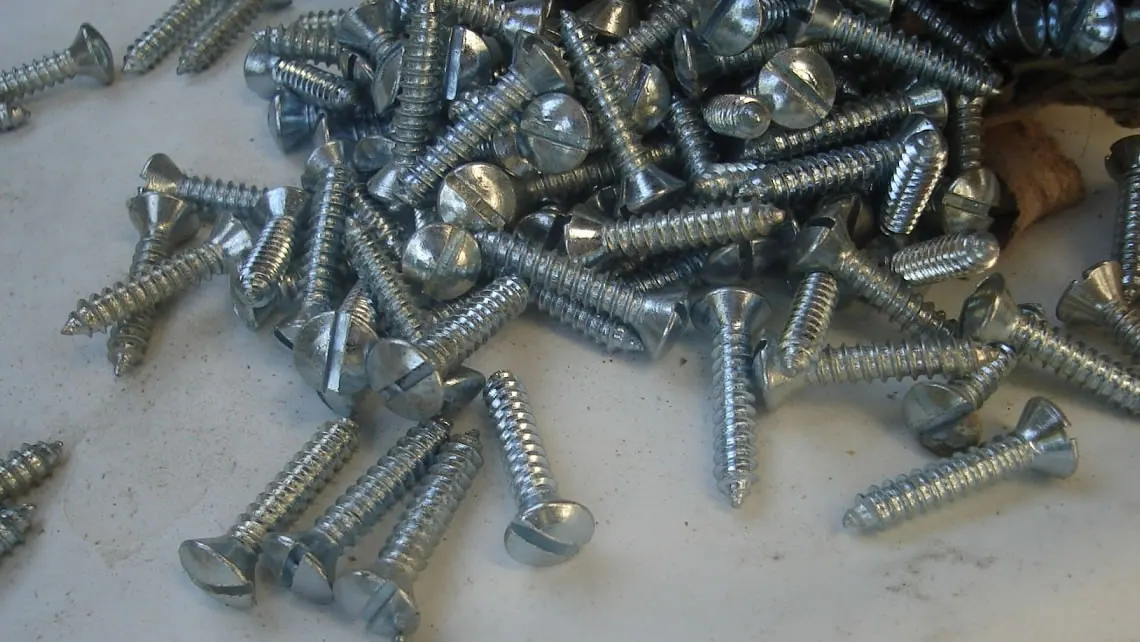
Keeping a wide assortment of screws, especially for wood, is as important as having a large number of nails. And here we need to acquire screws starting from smaller to larger, i.e. from one centimeter to five centimeters in length (larger screws are used very rarely). We will need screws made of brass and steel, with countersunk heads, half round or lens heads. Screws with lens heads should be made of nickel-plated brass, because we will mostly use them with dowels for hanging objects in the bathroom and kitchen (soap holders, towels, etc.). We should not forget about the screws with a simple hook, which we will fix in the window frames to place the curtain rods on them. We will complete the assortment of screws with a number of screws with plastic or nylon dowels of appropriate dimensions. In this way, we will avoid screwing the wrong size screws into the inserts.
All screws are supplied in small quantities (we rarely use a large number of the same screws) and can be found in small packages, in hardware stores or in department stores. Wood screws that end with a round hook instead of a head are mostly used inside furniture to store various small things.
In electrical household appliances and in cars, the so-called “self-tapping screws” for metal, which when tightened into a perforated sheet, hold quite well. However, it is not uncommon for them to dislodge from their nest and get lost. Therefore, it is not a bad idea to get a few of these self-tapping screws for metal in four or five different sizes, to have them on hand in case of need. Also, pieces of folded sheet metal can serve the same purpose, having a hole in the center and two tabs that, when fastened in a suitable place, allow the screw to be tightened all the way and to hold it firmly. However, we cannot always use them, if the seat of the screw is inaccessible. But where possible, it’s always good to use them, because that way we avoid screw loosening due to vibrations. Self-tapping screws are supplied with normal or cross-tapping heads. We should get a few pieces of both types, because although technically one type is worth as much as the other, it is unaesthetic and impractical to replace one lost screw with another with a different thread. Not only does it look ugly, but also when repairing or removing it, we need to have two screwdrivers with us instead of one.

Illustration of different types of nails, hooks and screws
Cylindrical screws
Unlike wood and sheet metal screws, which are typically conical in shape, cylindrical screws can be screwed into either threaded holes or nuts. With this species, the question of what to get is rather vague. This is primarily because we are rarely in a situation where we need to replace any of these screws which are less likely to bend or break.
This type of screw has standardized threads and sizes, but a very wide range. They are made of brass, steel, special steel, hex head, hex head, screwdriver slot (only for smaller screws) and so on. They can be without surface treatment, or they can be phosphorized (then they are dark gray), galvanized, nickel-plated or galvanized and chrome-plated.
If we do some mechanical work, repair household appliances or construct some more complicated objects, we will already, according to the need, acquire a certain number of nuts, screws, various washers and blocking pads that are placed under the head of the screw and nut and prevent unscrewing due to the vibration of the object on which they are mounted. In principle, experience teaches us that we always need the smallest screws, with a diameter of 3-8 millimeters and a length of 1 centimeters to a maximum of 4-5 centimeters. Therefore, we can freely limit ourselves to the supply of screws of these dimensions, but therefore in all varieties of heads, materials, pitches and types of threads, finishes and so on.
To begin with, it is best to obtain a small number of plain, galvanized hex head screws of various diameters and lengths. And here the rule that we presented for nails, screws for metal and wood applies. You should always avoid keeping all the screws in the same box (otherwise they are quite heavy). To find a single screw, it would be quite difficult if we kept them all in one place, unseparated and unsorted.
Inserts (dowels)
The need and habit of modern man to put various things on the walls, from pictures, shelves to pieces of furniture, has led to the increasingly widespread use of inserts. They are most often made of plastic, nylon, lead, steel and other materials, and smaller inserts are primarily made of nylon or plastic. Inserts are placed in pre-drilled holes and when a screw is inserted into them, they expand, exerting pressure on the walls of the hole. In this way, we can hang much heavier objects than with nails and hooks.
Rubber inserts are installed with the bolt body already inserted and can be plain keyed, can end in a half-round or ring hook, can be wedge-shaped, or a threaded shaft protrudes from the insert to tighten one or two nuts. Once the insert is in place, the bolt body tightens and simultaneously pulls the insert toward the top of the hole. The rubber part of the insert is thus shortened and thickened exerting a strong pressure on the walls of the hole or on the wall behind the hole (for example in a hollow brick). These types of rubber inserts are made in a wide variety of sizes and shapes. It is good to have more of them in the house because it is rare that we use a series of the same inserts during one job. If that happens, we will select the appropriate type and obtain a sufficient number of the same inserts for that specific job. It is more often the case that we have to replace some weakened inserts or install new ones for a picture or purchased hanging furniture. Otherwise, we should also keep this material in labeled boxes with transparent tiles.

Illustration of different types of inserts and how to attach them
Clips
This type of material is not used that often, although it can be very useful. A metal clip (also made of nylon and plastic) consists of a ring-bent metal strip with slots that engage the screw threads when it is tightened, thus reducing the circumference of the clip. We use them to clamp flexible hoses that connect household gas consumers to the wall taps of the gas installation. In this way, we prevent the hose from being partially or completely pulled out when the consumer is moved (when cleaning the premises or due to some other need), and the gas can flow out freely. This is important because connection points are often hidden from view and possible leaks are harder to spot.
Another typical use of metal clamps is to join two rubber or plastic hoses (drain or supply hoses of washing machines or dishwashers, garden hoses, and so on). We will make the connection by inserting one piece of metal pipe halfway into the ends of the hoses we are connecting and tightening the clamp on both ends. We can also use the clamp to fasten the electric cable to the plumbing pipe when we want to ground an electrical consumer. This solution is not exactly by all the rules, but it is often the solution if there is no other alternative.
The previous historical statement about connecting the electrical cable to the water pipe for grounding must not apply. Plumbing installation is not a safe substitute for a properly constructed protective conductor and grounding; inspection and any modification of the electrical installation must be performed by a qualified electrician according to the applicable rules.
Nylon clips can also be of different shapes, with holes or teeth. They have a thousand uses, are inexpensive, and easy to install. We can use them, for example, to tie the hose of a washing machine or dishes so that it runs parallel to the metal pipes, rather than being dragged across the floor and thus collecting dust behind the appliance. Nylon and plastic clamps are certainly less strong than metal ones, but they can be used for a variety of purposes and can tie and fasten much larger things such as electrical cables and more. The assortment we need in the house is quite modest: a dozen metal clips of various diameters, a dozen nylon clips, some with holes and some with teeth, and several meters of plastic tape with holes and corresponding locking buttons.

Illustration of construction of metal clips
Felt coasters
Felt is usually used sparingly even though it can be very useful for a small cost. That’s why we need to get felt cut in various shapes: round, square, rectangular and several millimeters thick, and several larger pieces of hard felt over 5 millimeters thick. Felt pads are placed between objects that rub against each other. Thus, we can stick round felt mats on the legs of all chairs or place thin strips on the backs of chairs or armchairs so that they do not leave ugly marks on the wall.
Gaskets and other material to obtain a leak-proof connection
The so-called seals deserve a brief review, albeit an incomplete one, because the same term is used to denote a variety of materials that are used in completely different situations. These are primarily seals that are always found in a plumbing installation. In all faucets, we periodically have to replace the working seals (usually round rubber plates, with or without a screw hole). It is not uncommon for the joint of two pipes to loosen and we need to replace the O-ring. In certain parts, especially where the hot water comes (at the outlet of the water heater, at the entrance of the central heating installation), there are gaskets made of more resistant and harder materials, such as asbestos, asbestos cardboard and so on.
If asbestos is suspected in an old gasket or insulation material, the material should not be touched, cut, scraped, punctured, broken or reused. Identification, safe removal and disposal should be done by an authorized professional; before working on the boiler, heating or other hot system under pressure, it is necessary to safely shut down the system.
Therefore, we need to know what kind of hard rubber seals were used on the plumbing in our house, and to get a certain number of them for replacement. Then we need to see what the ring seals are like (even those in thermos bottles and coffee machines) and get them as a spare. Since there is a fairly strict standard in this field, it is not difficult, if we consult with a plumber we trust, to make a list of all the possible seals that are in the installation. It is not out of the question to complete the range of ring and ring seals with a sheet of rubber, 3 or 4 millimeter thick, from which we can easily cut a seal of the appropriate size with the help of a compass. Also, for the same purpose, we can also get some heat resistant material.
It often happens that faucets leak water “from above” when they are open. In those cases, it was not the working seal that gave way, but the one that is located, enveloped by the casing, around the rotating shaft that carries the handle or lever. The repair is less simple than replacing an ordinary gasket and requires the use of a plaster, possibly coated with a little plaster. In this and similar cases, Teflon tape can also be useful. This type of adhesive tape should complete the range of seals because it allows us to solve other problems, among which the most common one is when the siphon under the sink, which is composed of two elements with notched threads, cannot be clamped tightly enough.
For similar, difficult cases, we should also get a tube of putty, i.e. resins specially prepared to be inserted between threads to act as a sealant. In the event that the elements need to be unscrewed, we will not have any problems: the material is very soft and with ordinary keys we will easily be able to separate the parts.
Also, silicone sealants that are available in a wide variety (white, gray, transparent) can provide a solid and leak-proof connection. They are used with great success to prevent drops of water from spilling between the wall and the sink, which we should avoid especially if the space under the sink is filled with shelves with various materials (cleaning agents, stain removers, etc.). By spreading, as is done with window putty, silicone putty and letting it dry for a few hours, we will get a really long-lasting and effective seal. In the same way, we can prevent the penetration of rain around attic or basement windows and in hundreds of other similar situations. Sealing is not only used to prevent water dripping, but also dust and, within certain limits, even odors. A typical material for sealing and preventing the passage of odors or dust is an adhesive sponge tape that is sold by the meter and in several widths (several millimeters thick, several centimeters wide). One side is coated with glue and protected with paper; when the paper is removed the tape sticks where needed. We usually stick it around the frame of a window or door through which an annoying draft blows. The use of this tape can also be extended to cabinets or kitchen furniture in general. Often, the housewife is right when she complains about dust or smog entering cupboards in the kitchen, bathroom, or the room where she keeps white linen or suits. So it’s a good idea to get a few meters of this adhesive tape.
Electrical material
This section is preserved as historical content, not as a list for DIY repair or extension of the electrical installation. Do not improvise conductors, grounds, fuses, sockets, switches or connections according to this text. A qualified electrician should determine the appropriate components according to the existing installation and applicable standards, disconnect the power supply and confirm the absence of voltage before any work.
We can determine the material that we need in the house for maintenance, repairs, replacement or extension of the electrical installation quite precisely. Wired electrical conductors (cables, wires, lines) are included in the first and basic group. We need a larger number of lines, of different lengths, types and sections:
-
ordinary two-wire lines, with an increasing diameter of copper wire, for consumers of increasing power, from an ordinary table lamp to a water heater,
-
ordinary three-wire lines, also with increasing copper wire diameters,
-
two-core and three-core lines of increasing diameter, but the so-called protected type, with one or two layers of insulating material over the wire (they serve as extension cables, for mobile electrical appliances, such as vacuum cleaners and irons, for switching on high-power consumers such as washing machines or dishwashers, etc.),
-
flexible cables with an outer sheath of cotton fibers, (in two or three sections) for connecting the iron, or for mounting lighter chandeliers.
If we want to work on a part of the installation that goes through the pipes in the walls, we will also get single-core conductors with hard copper wire. In addition to various lines, as parts of the electrical installation, there are a number of other elements that, when broken, usually cannot be repaired, but must be replaced entirely:
-
sockets attached to the wall or built into the wall in their boxes (sockets),
-
portable sockets (male and female) for higher or lower currents (amperage), therefore differently sized and made of plastic or with ceramic elements,
-
sockets for lamps,
-
portable switches (through, for two wires, or limit switches), fixed switches for permanent installation in the wall or connection to the wall,
-
multiple sockets (with two or three places), either ordinary or shuko (with grounding). Since the standards governing plugs and sockets and other electrical materials have changed or exist in parallel, we should always obtain suitable replacements, especially for fixed and movable sockets that can be with two plugs (contacts), with two plugs and with metal plates on both sides for grounding. Even if one electrical installation in the house is performed on the basis of one standard, this does not have to be the case with all the consumers we have. That is why we need to get more different electrical material so that all the consumers can function properly.
We will complete this group with an irreplaceable insulating tape of the best quality, one soldering wire (tinol) that is already prepared, i.e. which already contains deoxidizing solder paste, and with which we will connect or strengthen copper wires, a large number of light bulbs, one pair of starters and one spare ballast for fluorescent tubes (if we have them at home) and practically nothing else. If we anticipate some larger works, we will acquire the material as needed. Metal or plastic pipes (flexible or rigid) for lines with which we expand or strengthen the electrical installation, automatic or ordinary fuses, fusible fuse elements, junction boxes, socket boxes for attaching sockets and switches to the wall and so on.